Aquarium Location, Stand, and Floor Safety
Place a planted aquarium where weight, outlets, direct sun, pets, children, foot traffic, and water changes are manageable.
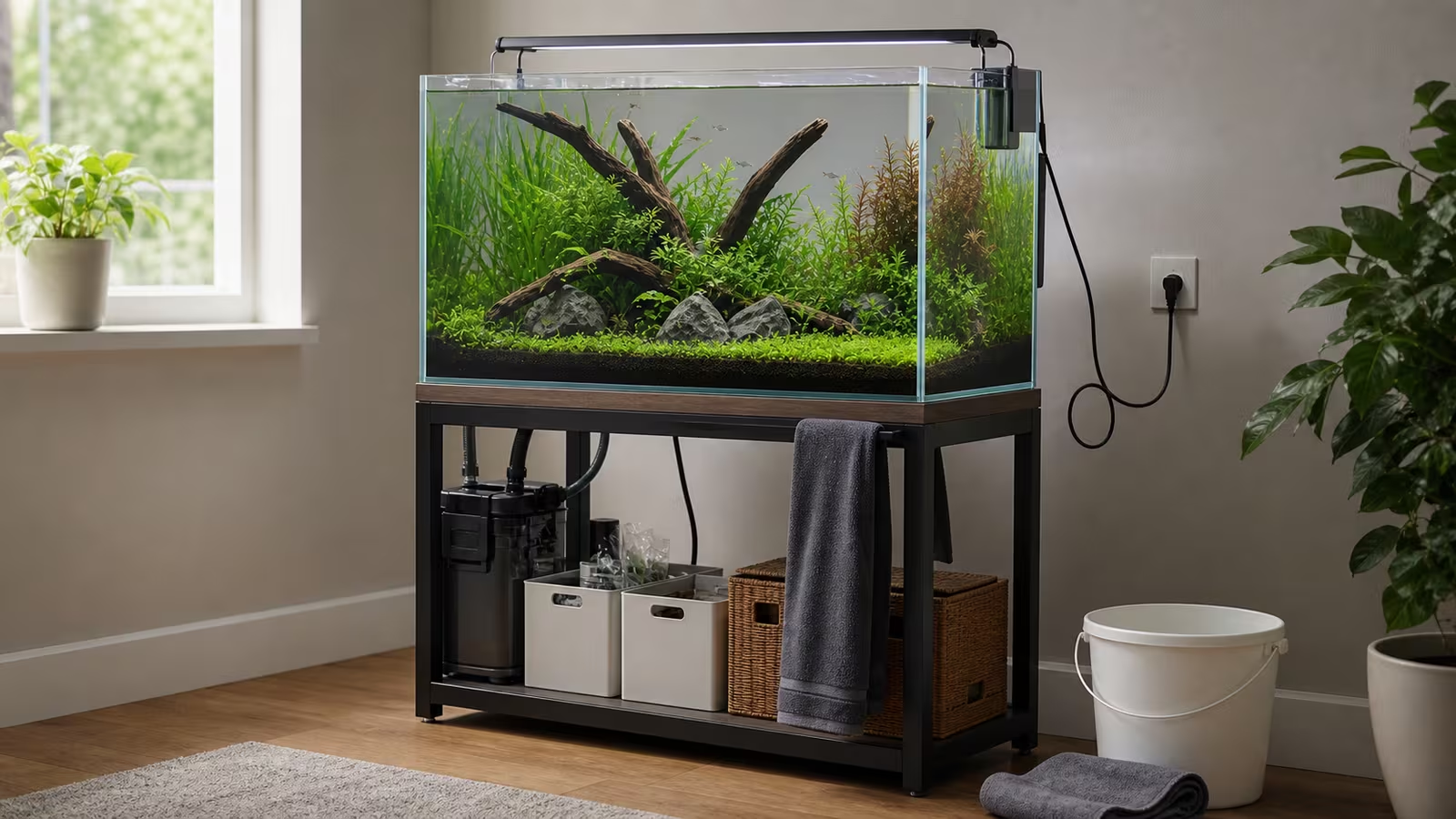
Aquarium placement is a safety decision before it is a decorating decision. A planted tank needs a stable surface, a sensible route for water changes, safe power, and enough room for maintenance. The wrong location can make a good tank feel impossible or turn a small leak into damaged flooring, furniture, books, electronics, or walls.
Do not trust a table because it feels sturdy when empty. Water, substrate, rock, wood, glass, equipment, and cabinet storage add up quickly. A stand also needs to stay level and support the tank as its manufacturer specifies; uneven support can stress the tank and its seams.
Heads up
Home-safety boundary
If you are unsure about floor loading, furniture rating, electrical safety, or a leak risk, ask the appropriate qualified professional. This guide does not replace structural, electrical, landlord, insurance, or manufacturer guidance.
Location Checklist
| Check | Why It Matters |
|---|---|
| Rated stand | Decorative furniture may sag, rack, or fail under a continuous load. |
| Level, sound floor | The floor must carry the complete setup; the stand must sit stable and level. |
| Outlet safety | Accessible, dry connections and drip loops reduce electrical hazards. |
| Direct sun and drafts | Sun and nearby heating or cooling vents can change water temperature. |
| Maintenance path | Buckets, hoses, towels, and hands need room to work. |
| Household traffic | Pets, children, chairs, doors, and backpacks can bump equipment. |
Estimate The Load
Start with the actual water volume: freshwater weighs roughly 1 kilogram per liter, or 8.3 pounds per U.S. gallon. For example, 20 U.S. gallons of water weighs about 167 pounds (76 kg) by itself. Add the empty tank, substrate, rocks, wood, equipment, and anything on the stand. The floor also carries the stand and any separate water-filled equipment or stored supplies. Use actual quantities and manufacturer weights where available; the tank’s nominal capacity may differ from the water it holds after substrate and hardscape displace water.
Aqueon’s placement guide gives approximately 10 pounds per gallon as a filled-aquarium estimate. That is a rough planning estimate, not a stand rating or proof that a floor is safe; a rock-heavy layout or additional equipment can change the total. Compare the estimated aquarium load with the stand’s specified capacity and tank footprint, and include the whole setup when considering the floor.
For a working example, suppose that 20-gallon setup contains 20 gallons of water, a 25-pound empty tank, 20 pounds of substrate and rock, and 8 pounds of equipment. The aquarium load is approximately 220 pounds (100 kg). A 40-pound stand and 10 pounds of stored supplies bring the floor load to about 270 pounds (122 kg). These are example weights, not a rating: substitute your own quantities and count any sump water and equipment as well. Compare the load each component actually carries with its specified limit.
A stand rating does not establish floor capacity. Floor construction, condition, and how a stand transfers weight all matter. If you are unsure, especially with a large setup or a questionable floor, give a qualified structural professional the total weight, stand dimensions, location, and floor details before filling. Check rental or building rules and insurance terms where applicable.
Match The Stand And Level It
Choose an aquarium stand rated for the loaded tank and compatible with its dimensions and support requirements. Assemble it according to its instructions and check for damage, loose fasteners, and wobble. A dresser or shelf is not an aquarium stand simply because the tank fits on top.
Tank designs differ. Follow the tank maker’s instructions for which parts of the base must be supported and whether a particular mat is required. For example, Ultum Nature Systems recommends a protective mat for its rimless tanks ; that instruction is specific to its tanks. Do not assume an arbitrary mat will make an incompatible or uneven stand safe. If the instructions are unclear, ask the manufacturer.
With the stand in its final position and the tank empty, use a spirit level to check side-to-side and front-to-back, including at both ends. Clear debris from the support surface before placing the tank. Confirm that the stand is stable and the tank sits as instructed, with no unsupported overhang. Correct an uneven stand or floor only as the stand manufacturer directs; do not wedge shims between the tank and stand. If you cannot achieve stable, level support, resolve the problem before filling. Carpet can compress under load and conceal an uneven floor; ask the stand and tank makers about their requirements before using a carpeted location. Once filled, check for a new tilt or movement without trying to adjust it. If support shifts or the stand becomes unstable, keep clear and seek qualified help; do not move or attempt to level a filled aquarium.
Make Room To Live With It
Choose a spot away from direct sun, heaters, air-conditioning vents, and doors that bring frequent drafts. Sunlight can warm the water and contribute to algae growth, as Aqueon’s placement guidance explains. Leave enough clearance for the actual filter, hoses, cords, lid, and your hands, including space to remove equipment for cleaning. Keep the tank clear of door swings and busy walkways, and protect cords and equipment from curious pets and children.
Think through where a leak or routine splash would go. Move electronics, books, and absorbent valuables away from that path. A leak sensor can give an early warning, but it cannot contain a failure; see Water Damage and Leak Prevention for inspection and response steps.
Power And Water Should Not Improvise
Arrange a drip loop in each cord: the cord dips below the outlet or connector and rises to it, so water running along the cord can drip off before reaching the connection. Place the tank to one side of the wall outlet rather than directly above it, and keep power strips and connections away from splashes and off the floor. Use GFCI or RCD protection as appropriate to local requirements; a drip loop does not protect against a direct splash or replace shock protection. With dry hands, unplug aquarium electrical appliances before putting hands in the water, and stop using damaged equipment. If a plug or outlet is wet, do not touch it: shut off the circuit only if the breaker is safely reachable from a dry location, or keep clear and call an electrician. See Heater, Thermometer, and Electrical Safety for safe maintenance and wet-outlet guidance.
Plan the route water will take during changes. A hose crossing a hallway, a bucket on carpet, or an unattended siphon can make maintenance risky. Keep towels and a stable bucket close, secure hoses, and watch the water throughout the change. Use manageable bucket loads and keep the route clear. The Maintenance Day Checklist covers the full routine.
Common Mistakes
- Putting a tank on a desk, dresser, or shelf without knowing its suitability and load rating.
- Counting water but forgetting the tank, rock, substrate, stand, and stored equipment.
- Assuming a rated stand proves the floor can carry the setup.
- Running cords straight into a power strip or leaving connections where water can collect.
- Placing a tank in direct sun or leaving no room to reach filters, glass, plants, or valves.
- Setting a tank where a leak would immediately reach electronics.
Related Fondsites Path
- Water Damage and Leak Prevention for inspection and spill response.
- Heater, Thermometer, and Electrical Safety for dry power and maintenance habits.
- Keepers Guild for repair limits, maintenance records, and when not to DIY.
- Clear Water Lab for water-source and testing habits.
- Pawstead for pet-aware room setup and curious-animal boundaries.
Try This Next
Before filling, estimate the complete load and check the stand and tank instructions. Place the empty tank on the stand, check level front-to-back and side-to-side, trace every cord into a drip loop, and walk the water-change route with an empty bucket. If anything rocks, lacks support, or raises a floor-loading concern, resolve it before adding water.
Sources
- Aqueon: Preparing Your Home for a New Fish Tank gives a rough filled-aquarium weight estimate.
- Aqueon: Setting Up a Freshwater Aquarium covers placement, access, stand stability, and drip loops.
- Ultum Nature Systems: Rimless Tank Safety gives product-specific support, mat, and handling instructions.
- Electrical Safety Foundation: Water-Damaged Electrical Equipment explains the need for qualified assessment of wet electrical equipment.