Aquascape Photo Journal
Use photos and simple notes to track planted aquarium growth, algae, trimming, livestock behavior, water tests, and layout changes over time.
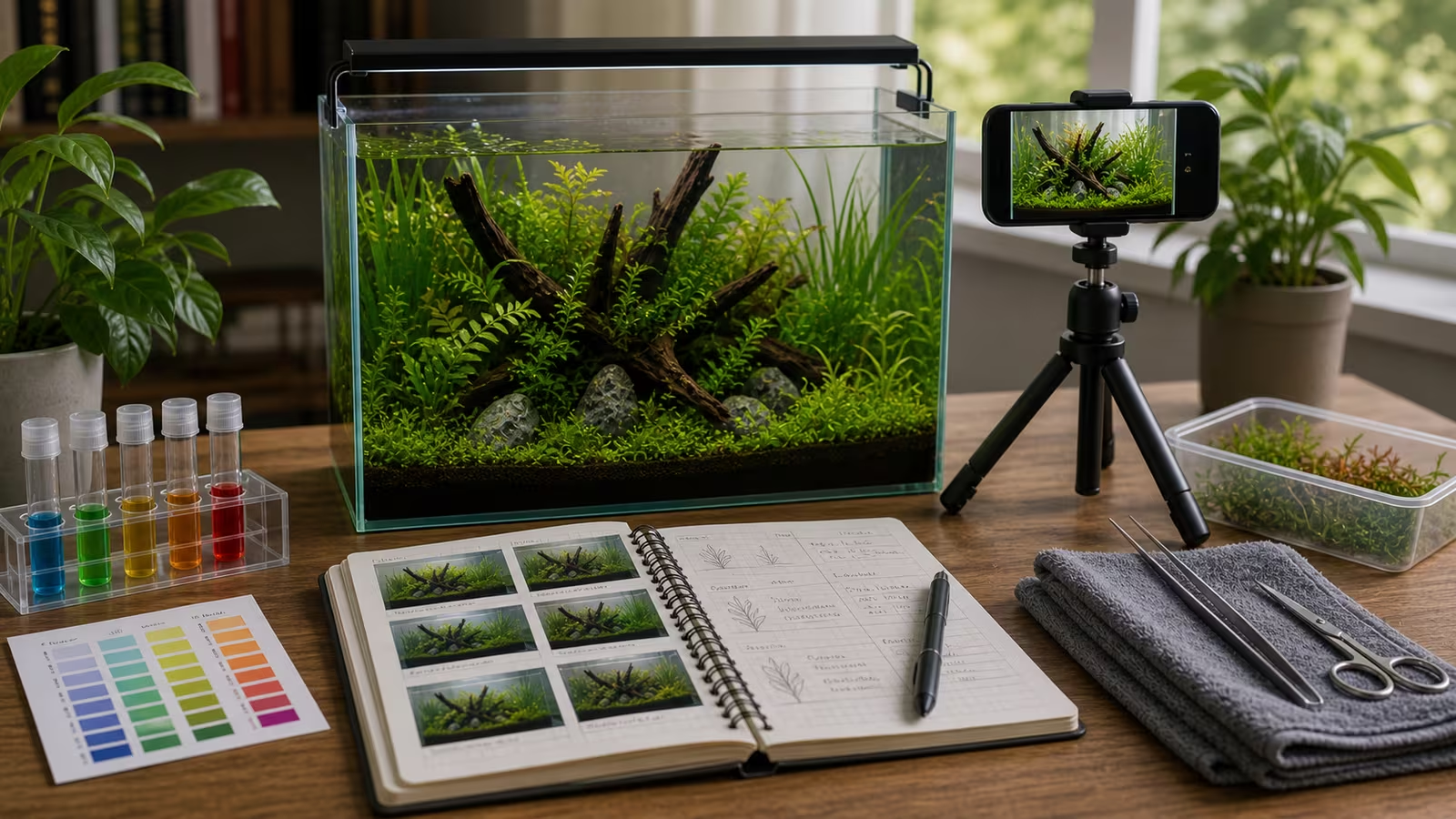
Planted tanks change slowly until they suddenly seem different. A crypt sends up one new leaf, a moss pad creeps over a stone, the background stems lean toward the filter, and a pale dusting of algae becomes a green film while you are busy looking at the fish. A photo journal catches those changes before they become vague feelings.
The point is not to make every maintenance day into a photography project. The point is to build a small evidence trail. When the tank looks “off,” you can compare today to two weeks ago. When a plant finally settles in, you can see what changed around it. When algae changes after a light adjustment, you have a record to compare with the other changes in the tank.
The journal does not need to be fancy. Consistency matters more than presentation. A repeatable phone photo, a short note, and a calm habit of looking back will teach you more than a beautiful album you only update when the aquarium is perfect.
Heads up
Photography boundary
Do not stress livestock for photos. Avoid tapping glass, harsh flash, repeated chasing, unsafe lighting, or leaving lids and equipment open just for a shot.
Take Comparable Photos
Use the same angle, distance, time of day, and lighting when possible. The easiest version is a full-front photo from the same chair, floor mark, or tripod spot every week. Turn off room glare if you can. Wipe the outside glass. Let floating food, bubbles, and loose plant bits settle before the evidence shot unless those details are what you are documenting.
Take the photo before maintenance when the tank is honest: algae is visible, stems show their true height, floaters reveal how much surface they cover, and the substrate shows whether waste is accumulating. After a trim, water change, or rescape, take a second photo to record what you actually changed. The before image records the starting condition; the after image records the intervention. Neither image alone diagnoses the cause of a problem.
Close-ups are useful for algae, plant health, spawning behavior, pest snails, damaged leaves, or equipment issues, but the full-tank image gives context. A leaf close-up without a full-tank view can make one small problem feel like the whole aquarium is failing. A full-tank photo shows whether the issue is spreading, isolated, or simply more visible because the rest of the tank is improving.
Keep the tank light at its normal setting and photograph at roughly the same point in its daily cycle. Use the same lens and zoom; if your phone allows it, keep exposure and white balance consistent. Automatic settings can make the same leaves look brighter or a different color from week to week, so do not diagnose a color change from a photo alone. Keep the original images if you edit a copy. Nikon’s aquarium photography guide explains how room reflections can obscure a view through glass.
A simple phone tripod or marked floor spot can make comparison easier. If you do not want gear, put a small piece of tape on the floor or line the phone up with the same shelf edge each time. The habit should feel low friction enough that you still do it on an ordinary week.
Build A Useful Shot List
Think of the journal as a set of views, not a pile of random pictures. A full-front image is enough for a busy week. Add the other views when they answer a question:
| Shot | Why It Matters |
|---|---|
| Full front | Shows overall plant mass, layout balance, algae spread, and water clarity. |
| Left or right side | Reveals depth, surface film, stem lean, and hidden clutter behind hardscape. |
| Problem close-up | Tracks algae, melt, damaged leaves, pests, or equipment symptoms. |
| Success close-up | Records new growth, rooting, or normal-looking animal activity. |
The success close-up is not vanity. It keeps the journal from becoming a complaint file. Planted tanks have problems, but they also reward attention in small ways. New root tips, shrimp grazing, moss attaching to wood, or fresh leaves can be useful observations. They do not by themselves establish that water conditions are safe or that an animal is healthy.
If you are starting a new tank, take a bare-layout photo before planting, then another photo after planting, then weekly photos for the first month. Early photos are especially useful because new aquascapes often go through cloudy water, plant melt, diatoms, floating plant bits, and awkward empty spaces before they look settled.
What To Record
Record the date and time, light schedule, water-change amount, test results, fertilizer dose, trimming, additions, equipment changes, and anything unusual when relevant. For tests, include the value or range, units, and whether the sample was taken before or after a water change. Record nitrate as NO3 or NO3-N as shown by the kit; those scales are different. Use the water testing guide to choose tests for the tank and situation. Short notes are better than a perfect notebook you abandon. For example:
July 7, 6 p.m. Light timer: 2–8 p.m. Before maintenance: nitrate 20 mg/L as NO3; floaters cover roughly half the surface; hair algae on front-right rock. Changed 10 L in a tank holding about 40 L, trimmed left background stems, and removed two melting crypt leaves. Fish active after maintenance.
That kind of note gives your future self something to work with. It connects the photo to the care choices behind it. Notes add context, but even a complete log cannot prove which change caused a result.
Track Decisions, Not Just Results
The most valuable part of a photo journal is the decision trail. If you reduce the light from eight hours to six, write that down. If you skip fertilizer for a week because algae scared you, write that down too. If you add fast-growing stems, change filter flow, remove floaters, move the tank away from a window, or feed less, record the choice.
This matters because some changes in a planted aquarium become visible only over time. Today’s algae may reflect the last few weeks of light, nutrients, stocking, plant mass, and maintenance. A journal helps you avoid the classic beginner loop: change something, wait two days, panic, change three more things, then no longer know which change helped or hurt.
Use the photos to ask better questions:
- Is the algae expanding, holding steady, or retreating?
- Are new leaves healthier than old leaves?
- Is plant growth dense in one area and stalled in another?
- Did water clarity change after filter maintenance, feeding changes, or a water change?
- Are animals behaving normally in the same areas of the tank?
The answers do not need to be dramatic. “A little better” is still useful evidence if it repeats across several entries.
How Photos Help Decisions
Photos can show changes in plant shape, visible algae coverage, surface cover, and how much hardscape is hidden by growth. Compare the same area and lighting, and check your notes for intervening trims or cleaning before deciding whether a change is real. The notes, rather than the image alone, reveal what you changed.
A journal can make trimming decisions much easier. In person, a jungle of stems can look lush and healthy, but the side photo may show that lower leaves are shaded and the front plants are losing space. A weekly comparison can tell you whether to trim lightly, replant tops, thin the densest corner, or simply leave the tank alone.
It can also protect you from overcorrecting. A new tank with melting leaves may still be moving in the right direction if fresh growth is smaller, greener, and more upright than the original damaged leaves. A patch of algae may feel worse because you have started looking closely, while the photos show it is not spreading. Evidence turns the emotional volume down.
For livestock, photos and short notes help you notice routines. Check animals, temperature, and equipment daily rather than waiting for the weekly photo; Merck’s maintenance checklist includes these daily checks. Are fish hiding only during maintenance, or all week? Are shrimp grazing in the open after lights come on? Are snails clustering near the surface after a change? A photo is not a substitute for water testing or experienced help, but it can preserve details you might forget when you ask for advice.
A Four-Week Starter Rhythm
For the first month, keep the system simple. On the same day each week, take a full-front photo before maintenance. Record light schedule, water-change amount, test results you are tracking, and any obvious plant or animal observations. For nonurgent experiments, change one variable at a time when practical and note the date. Do not postpone necessary care or a response to distressed animals to preserve an experiment.
Week one is the baseline. Do not judge it too hard. Week two is for noticing what changed without rushing to fix every blemish. By week three you may begin to notice patterns: algae zones, fast growers, shaded corners, floating plant coverage, or a plant that has not yet recovered. Week four is your first review. Put the four full-tank photos next to each other and describe the trend in plain language.
Useful review sentences sound like this:
- “The background grew quickly, but the foreground stayed open.”
- “Algae is still present, but the photographed patch has not visibly spread since the light change.”
- “The left side has more new leaves since I adjusted flow; other factors may also have changed.”
- “I keep trimming too much on maintenance day, then regretting the empty look.”
Those sentences turn photos into a care plan. They also make the hobby more satisfying because you can see progress that daily viewing hides.
When To Take Extra Photos
Weekly photos are enough for normal tracking, but a few moments deserve extra documentation. Take a picture before adding livestock, before and after a major rescape, when a plant first shows melt, when algae appears in a new place, when equipment changes, after a power outage, and before asking for help online or at a local shop.
If something urgent is happening, prioritize care over documentation. Test water, stabilize temperature, protect livestock, and address electrical or leak risks before composing a shot. A blurry photo taken after the situation is safe is better than a perfect photo taken while the tank needs attention.
Keep The Journal Easy To Search
Use filenames or album names that your future self can understand. A simple pattern like tank-front-2026-07-07 or right-rock-hair-algae-week-3 is enough. If you keep notes in a phone app, paste the same photo into the note or use the same date in both places.
Avoid scattering evidence across a camera roll, a chat thread, a notebook, and memory. The best system is the one you can find when the tank looks strange at 10 p.m. A single album plus a single note file is often plenty.
Common Mistakes
- Taking only pretty photos and no evidence photos.
- Changing camera angle every week.
- Forgetting to record light schedule or fertilizer changes.
- Comparing a day-after-trim tank to a four-week jungle.
- Using photos to chase perfection instead of stability.
- Deleting “ugly” stages that would have explained the improvement later.
- Photographing only problems and losing sight of growth, recovery, and calm animal behavior.
- Making several corrections between photos, then trying to credit one of them.
Related Fondsites Path
- Aquascape Composition Rules That Actually Help for reading layout changes.
- Beginner Mistakes and Reset Plan for troubleshooting evidence.
- Maintenance Day Checklist for pairing photos with a repeatable routine.
- Water Testing for Aquascapes for notes that explain what photos cannot show.
- Trimming and Replanting Planted Tanks for turning growth observations into plant care.
Try This Next
Take one full-tank photo today, then repeat it every maintenance day for a month. Add only three notes: water change, trimming, and one thing you noticed. At the end of the month, look at the four photos in order and write one sentence about what improved, one sentence about what got worse, and one sentence about what you will leave alone.
Sources
- Nikon: How to Take Great Photos at the Aquarium discusses reflections and photographing through aquarium glass.
- Merck Veterinary Manual: Essential Maintenance lists routine observation and maintenance checks.