Betta Planted Tank Ethics
Plan planted betta tanks around heated stable water, swimming room, resting places, filtration, enrichment, and realistic tankmate choices.
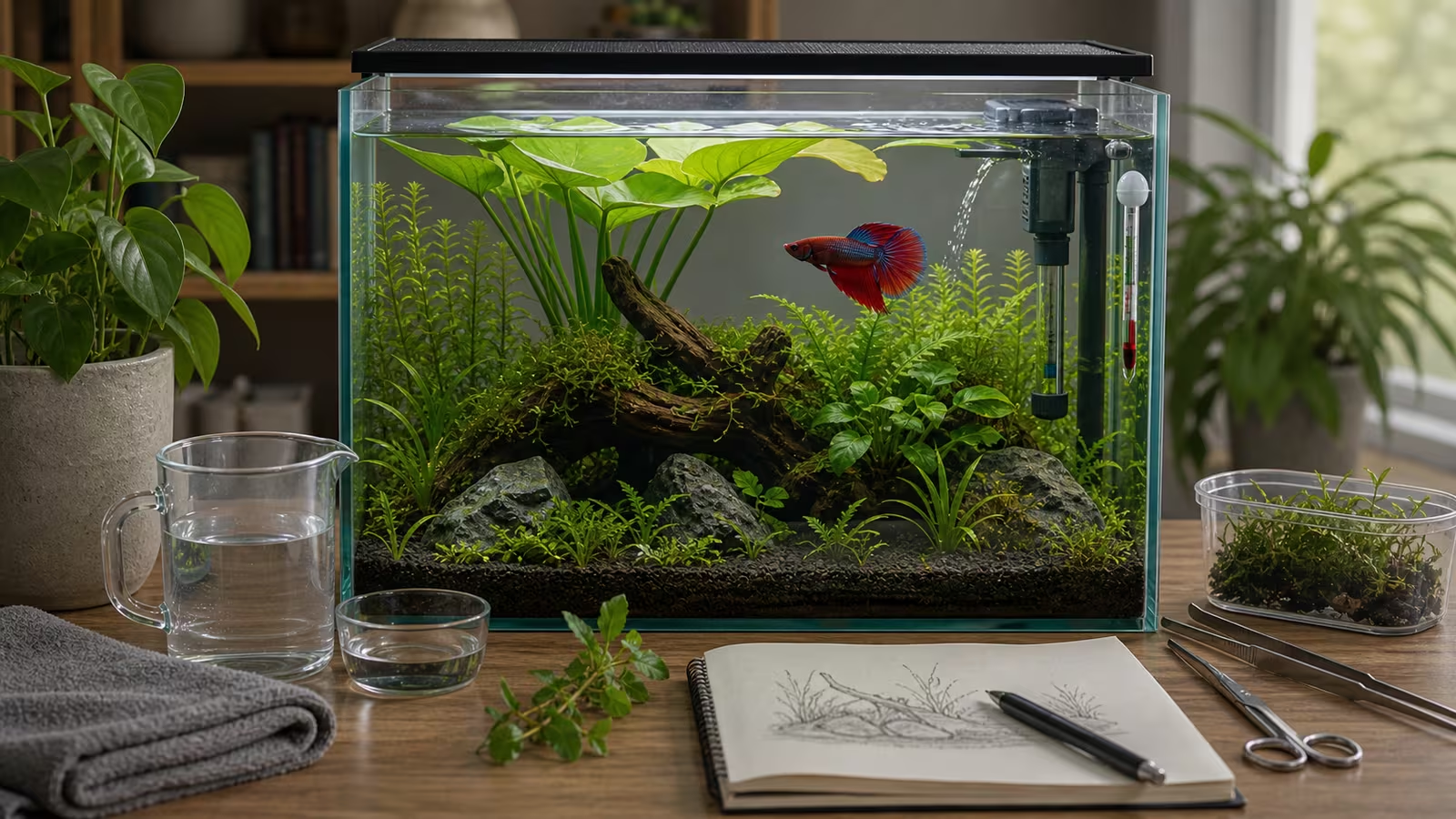
Bettas are often sold as if they are decor. A planted tank can give a betta cover, resting places, surface access, and opportunities to explore, but only if the aquarium is planned for the fish rather than the photo.
A kind betta setup starts with heated, stable, cycled water and enough room to swim. Plants are a benefit, not a replacement for the basics. This guide focuses on the commonly kept Siamese fighting fish, Betta splendens; other betta species can have different needs.
Heads up
Betta welfare boundary
Avoid bowls, sharp decor, strong exhausting flow, and casual tankmate experiments. If a fish is struggling to breathe, cannot swim normally, or shows other signs of illness, check the water and seek aquatic veterinary help promptly.
Start With Space And Stable Water
For one betta, plan for at least 20 litres (about 5.3 US gallons), with more room where practical. The RSPCA’s betta care guide recommends 20 litres or more as ideal; a larger aquarium also gives you more flexibility for equipment, swimming space, and stable water. Choose a footprint with room to move, rather than relying on a tall, narrow vessel. Keep the route to the surface easy, especially for a fish with heavy fins or limited mobility.
Use an aquarium heater and check it with a separate thermometer. The RSPCA recommends a stable 24–26°C (75–79°F) for this species. Check the reading daily, including after a water change. Fit a secure lid to prevent jumping, while leaving an air gap above the water: bettas visit the surface to breathe air. Keep an open patch of surface clear of floating plants.
Before buying the fish, establish the biological filter with a fishless cycle . An empty tank that tests zero for ammonia and nitrite is not necessarily ready: it must be able to process a measured ammonia input. Stop dosing ammonia before the fish arrives. Test ammonia and nitrite daily for the first several days after arrival and until readings are stable; aim for zero detectable ammonia and nitrite. Track nitrate too. The Ornamental Aquatic Trade Association’s betta guide recommends testing at least weekly during ongoing care.
If the fish is already in an uncycled tank, do not add ammonia. Test daily, feed lightly, and use conditioned, temperature-matched partial water changes whenever ammonia or nitrite is detectable while the filter establishes. Retest and seek experienced or aquatic veterinary help if readings persist or the fish is distressed. The water testing guide explains how to keep a useful record.
Make partial water changes as part of the routine. A practical starting point is about 25% weekly, adjusted to test results and the tank’s needs. Remove uneaten food and loose waste without uprooting plants. Treat replacement tap water for chlorine and chloramine according to the conditioner instructions, and match its temperature to the tank. Test the source water as well as the aquarium, particularly if nitrate remains high after changes. See Water Change Rhythm for building a routine.
Check pH and hardness before choosing a fish and when the water source changes. The RSPCA lists pH 6.5–7.5 for B. splendens; compare the actual water with the supplier’s conditions and avoid sudden adjustments with chemicals. If the results are outside the suggested range, get species-specific advice before making changes. See KH, GH, and pH .
What Plants Add
Broad leaves near the surface can act as resting places. Floating plants can soften light, if surface access remains open. Stem plants and crypts create visual barriers. Moss and epiphytes add exploration surfaces without filling all swimming space.
For example, place a broad-leaved plant near the surface at one end, with a sheltered hiding place below it and an open lane along the front. Keep the leaf and its access route away from the outlet; watch where the individual fish actually rests and adjust the layout if needed.
The plants should not turn the tank into a maze with no open water. Bettas still need room to move and reach the surface easily. Leave a clear swimming lane, provide cover away from the filter outlet, and trim floaters before they close the open surface. Attach Anubias or Java fern to hardscape with their rhizomes exposed; see Epiphyte Plants . Check rocks, ornaments, and artificial plants for edges that could snag fins, and make sure hiding places cannot trap the fish.
Equipment Fit
Gentle filtration matters because long-finned bettas can tire in strong current. Use a filter suited to the tank with adjustable or diffused output, and watch whether the fish can swim, feed, and rest without fighting the flow. A sponge filter or a baffled outlet can help, but the filter must still circulate water and support biological filtration. Leave a gentle surface ripple for gas exchange; access to air does not replace good water quality or aeration.
Provide a regular light-and-dark cycle for the fish and plants, and avoid leaving a mirror in the tank: repeated flaring at a reflection can be stressful. See Photoperiod and Timer Setup for a practical schedule.
Protect the intake with a securely fitted guard or prefilter appropriate for the fish, and inspect it for clogging. Keep the filter running and rinse mature media gently in removed tank water when needed rather than replacing it all at once. The filter flow guide covers adjustments and signs of distress.
Feed And Observe
Feed a betta-formulated pellet as a staple in small portions once or twice daily, adjusting to the fish and the food’s size. Remove uneaten food and avoid feeding more simply because the fish approaches the glass. Plant roots are not a substitute for food; the University of Illinois veterinary guide explicitly addresses that misconception. See Feeding Without Polluting the Tank for a cleanup routine.
Get to know the fish’s usual appetite, breathing, swimming, and fin condition. A brief surface visit or a period of rest can be normal; persistent gasping, rapid breathing, clamped fins, loss of appetite, or difficulty swimming calls for attention. If the fish is struggling, increase aeration gently and turn off injected CO2 if used. Check temperature, filter operation, ammonia, and nitrite; if ammonia or nitrite is detectable, promptly change some water with conditioned, temperature-matched water and retest. Contact an aquatic veterinarian promptly for a distressed or ill fish. These signs have several possible causes, so do not guess at a diagnosis or add medication casually to the display tank.
Choose And Introduce The Fish
Choose a seller who can explain the fish’s care and source, and look for an alert fish that swims without obvious difficulty, with intact fins and no visible sores. Do not assume appearance proves health: fish can carry disease without obvious signs. Ask about the water the fish is coming from and plan a calm, prompt trip home. The OATA care sheet describes signs to check and an acclimation method.
Prepare the heated, cycled tank before purchase. Compare the source and destination water and ask the supplier or an aquatic veterinarian for an acclimation plan if they differ substantially or the journey was long. Avoid pouring transport water into an established aquarium. If other animals are present, plan a separate suitable quarantine setup and dedicated equipment; see Quarantine and Acclimation Basics . Observe the newcomer closely after arrival.
Tankmates Are Not Automatic
A single betta can be the whole stocking plan. Never house two male bettas together, and do not keep a male and female together as a casual pair. Females can also be aggressive; a group is not a beginner shortcut.
Some bettas tolerate certain tankmates; others do not. Shrimp may be eaten, and fin-nipping fish are a problem. Small tanks leave fewer options and less room for animals to avoid each other. A peaceful photo online does not guarantee your fish’s temperament. If considering companions in a suitably larger tank, research each species’ adult size, group needs, water requirements, and behavior first. Have a separate, heated and filtered arrangement ready and separate animals promptly if chasing, fin damage, or persistent hiding occurs.
Common Mistakes
- Treating plants as proof the tank is ethical or as a substitute for food.
- Adding the fish before the tank can process waste.
- Using sharp plastic or rough stone with long fins.
- Adding tankmates to a small tank for human entertainment.
- Ignoring heater and thermometer needs.
- Blocking surface access with floaters or using flow too strong for the fish.
Related Fondsites Path
- Choose Tank Size for room and stability.
- Filter Flow and Surface Agitation for gentle movement.
- Stocking Caution for Small Tanks for tankmate restraint.
- Quarantine and Acclimation Basics for the arrival plan.
Try This Next
Before buying a betta, sketch the tank from the side. Mark the heater, filter, open swimming room, surface resting places, and clear route to air. Write down the cycling test results and your water-change routine, then decide whether a tankmate is needed at all. If the fish is an afterthought, redesign.
Sources
- RSPCA Australia: How Should I Care for My Siamese Fighting Fish? — space, temperature, water quality, enrichment, and compatibility.
- OATA: How to Look After Siamese Fighting Fish — water testing, equipment, selection, and introduction.
- University of Illinois College of Veterinary Medicine: Bettas Need More Than Bowls — housing, diet, and animal care.