Carpeting Plants Reality Check
Decide whether aquarium carpeting plants fit your light, CO2, substrate, trimming habits, livestock, and patience before buying a foreground carpet.
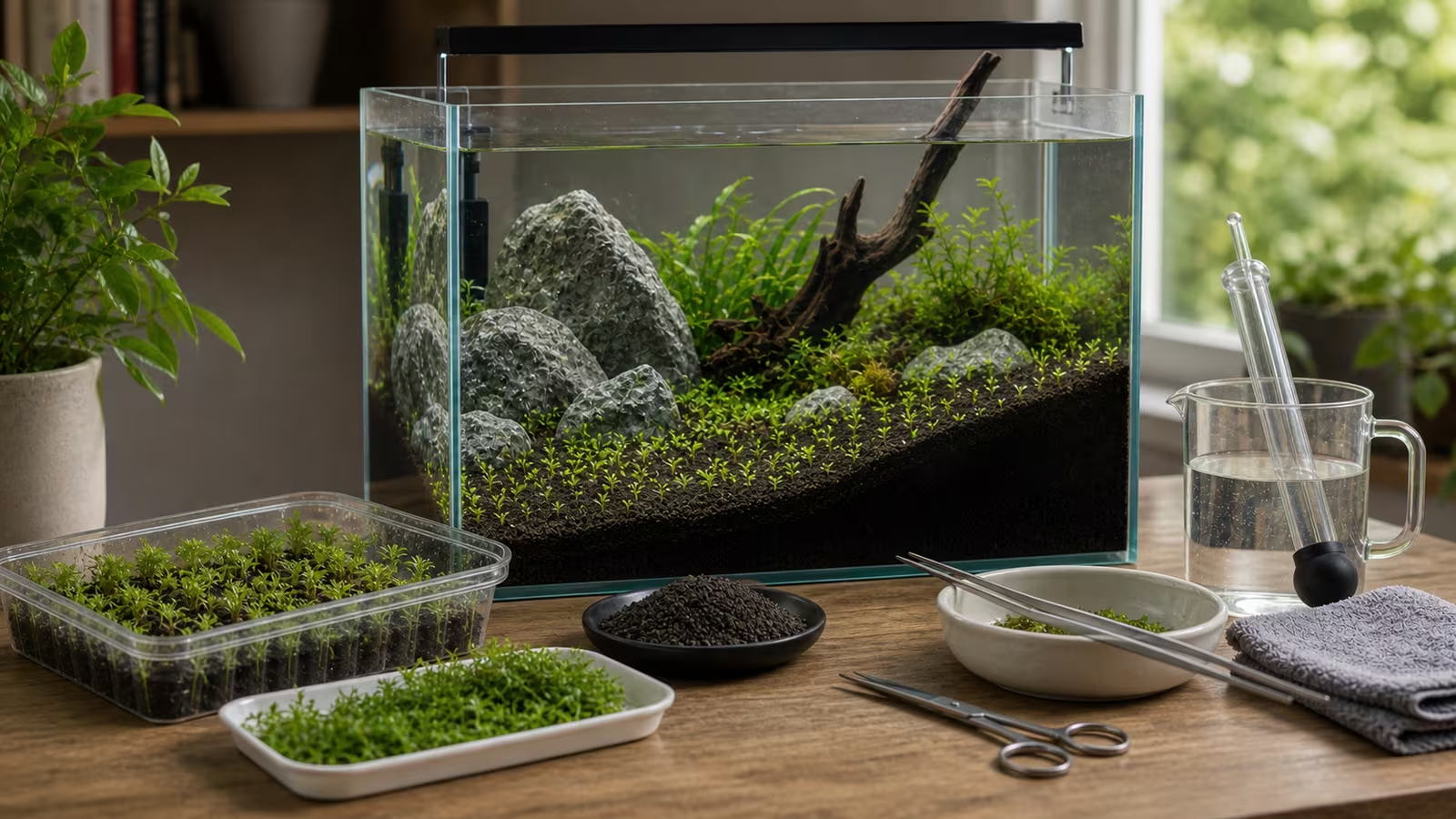
Carpeting plants can make an aquarium foreground look like a miniature meadow. They also ask more of the tank than a photograph suggests: light must reach the bottom, small portions need time to root and spread, and a mature carpet needs trimming and cleaning.
A beginner can try one, but choose the plant for the actual tank and the time available to maintain it. A small test patch is a useful way to learn before committing the whole foreground. In a low-tech tank, a looser patch of a less demanding plant may be a more realistic goal than the dense, uniformly short lawn in a display photo.
Heads up
Livestock and substrate boundary
Do not repeatedly uproot a stocked aquarium in pursuit of a perfect carpet. Disturbed substrate can cloud water, release debris, and stress animals. Major rescapes are safer before livestock or with careful planning.
Why Carpets Are Demanding
Foreground plants sit farther from the light than plants near the surface. Water depth, floating plants, tall neighbors, and hardscape shadows all affect how much light reaches them. Some creeping plants grow upward instead of staying compact when light is insufficient. The same lamp can give a shallow, open foreground and a deep, shaded one very different conditions.
Light is only one part of the system. Plants also need available nutrients and carbon, as well as water movement that reaches the foreground. Injected CO2 can help demanding plants grow, but it is not a substitute for appropriate light or maintenance. If you already use CO2, keep its delivery consistent and watch livestock; gas exchange still matters. If animals show distress, stop injection and increase aeration immediately. Increasing brightness or the hours on a timer does not guarantee a carpet and can make algae harder to manage. See Light Balance for Aquatic Plants and CO2 Versus Low-Tech Planted Tanks before changing equipment.
Dense growth can trap food, mulm, and dying leaves. A carpet that looks tidy from the front may need thinning and gentle cleaning underneath. Make sure you can reach it with scissors and a siphon without dismantling the layout.
Common Carpet Choices
| Plant | What to expect |
|---|---|
| Monte Carlo (Micranthemum tweediei) | Small round leaves and creeping growth. More adaptable than dwarf baby tears, but moderate to high light and added CO2 help produce the best results. Trim an established mat before it becomes too thick. |
| Dwarf hairgrass (Eleocharis species and varieties) | Fine, grasslike leaves spread by runners. Check the exact variety: height and growth vary. Tropica recommends moderate to strong light and CO2 for the best results with its Mini variety . |
| Dwarf baby tears (Micranthemum callitrichoides ‘Cuba’) | Very small leaves, but a demanding choice for a dense carpet. Tropica lists high light and CO2 needs , so it is a poor first experiment without the equipment and routine to support it. |
| Marsilea | A low foreground option with leaves and height that can change as it adapts. Tropica describes M. hirsuta as having low light and CO2 demands; its submerged leaves may look quite different from those sold. Allow time for runners to fill the patch. |
Names on shop labels are not always precise. Confirm the species or variety and its expected size before buying, especially with hairgrass and Marsilea. Tropica’s Monte Carlo guide compares it with ‘Cuba’ and explains why an overgrown mat can lift. Even a plant that survives without injected CO2 may spread slowly or stay sparse; survival is different from the dense result in a display photo.
For a low-tech first attempt, a small patch of M. hirsuta is a reasonable starting point if its changing leaf shape and potentially taller growth suit the design. For a very short, dense lawn, compare the demands of Monte Carlo and ‘Cuba’ with your actual foreground conditions and maintenance routine before buying. No choice guarantees a particular fill-in time: plant quantity, adaptation, light, nutrients, and carbon all affect the result.
Plant A Patch That Can Spread
Choose an open area where the light reaches the substrate and where taller plants will not soon shade it. Fine, plant-friendly substrate makes small portions easier to anchor than large, loose gravel. An inert substrate can work, but consider how rooted plants will receive nutrients; Substrate for Aquatic Plants and Root Tabs and Root Feeders explain the options.
- Inspect the plant and remove damaged material. For tissue culture, rinse away the growing medium and gently divide the plant into small portions. Remove the pot and excess mineral wool from potted plants. See Tissue Culture Plants in Planted Aquariums .
- Plant separate portions evenly across the intended patch with tweezers, leaving gaps for them to spread. For ‘Cuba’, Tropica suggests small clumps a few centimetres apart; use the supplier’s guidance for other plants. Push roots and the base into the substrate while keeping leaves above it; release the tweezers and withdraw them gently so the portion stays put. If it floats up, plant it slightly deeper without burying the leaves. Tropica’s planting guide describes dividing carpeting plants rather than burying the whole pot as one clump. More portions in a smaller area can give faster coverage than stretching the same plant across the entire foreground.
- In a new tank, keep exposed plants wet while working, then fill slowly over a saucer or other diffuser to avoid dislodging the portions. In an established tank, work gently in a small area and replant any pieces that float up.
- Give the plants time to anchor. Digging or substrate-foraging animals can uproot fresh portions, so choose a protected area or plant before adding compatible livestock. Do not add animals until the aquarium is ready and cycled.
Some plants are grown above water before sale and may lose older leaves as they adjust. Remove soft, decaying material, but look for firm bases and new submerged growth before deciding the patch has failed. Plant Melt and Recovery helps distinguish adjustment from ongoing decline.
If floating portions are the main obstacle in a new, unstocked tank, a dry start is another way to establish roots before flooding. It adds a humid growing phase and does not eliminate the plant’s needs or the aquarium’s cycling period after flooding.
Maintain And Troubleshoot
Once the carpet is rooted and growing, trim a little at a time and collect the cuttings with a net or siphon. Thin a thick creeping mat before its lower layers die and the mat lifts; Tropica notes that its Mini hairgrass can go many weeks between trims under suitable conditions, so let the plant’s growth and condition guide the interval. Keep cuttings out of drains and natural waterways; see Invasive Species Disposal . Tropica’s trimming guide recommends small, regular trims. During water changes, hover a siphon just above the plants to lift loose debris without pulling out roots. Check the area for small shrimp or other animals first, and check the collected water before disposal.
- Portions keep floating: Replant the base gently and check whether the substrate, flow, or digging animals are preventing anchoring. Avoid repeatedly disturbing portions that are already rooted.
- Growth reaches upward or stays sparse: Compare photos from the same angle and check for new runners or leaves. Check foreground shade and whether the plant suits the light and CO2 available. A slow plant in a low-tech tank may simply take longer; more light alone is not a reliable fix.
- Leaves melt or yellow: Remove decay and inspect new growth, light, nutrients, and recent changes. Several causes can look alike, so avoid changing fertilizer, light, and CO2 all at once.
- Algae or debris gathers in the mat: Remove what you can gently, thin crowded growth, and check flow, feeding, and the lighting routine. If the mat is lifting with brown material underneath, remove loose decay and replant healthy portions in a small area rather than pulling up the entire foreground. See Algae Prevention Basics for a broader check.
Keep a photo from the same position and a short note every few weeks. Record the light schedule and any changes, then compare the patch’s coverage and new runners or leaves instead of pulling plants up to inspect the roots. If the patch continues to decline despite reasonable care, choose a plant better suited to the tank rather than rebuilding around it.
Lower-Pressure Alternatives
A foreground does not need a solid carpet. Small crypts, moss attached to flat stones, scattered low plants, open sand, or leaf litter where appropriate can create an intentional scene. Each still needs care: moss needs trimming and open sand needs gentle cleaning. Open Sand Paths and Foreground Space and Aquascape Composition Rules offer ways to make the open space part of the design.
Try This Next
Choose one named plant and a small, reachable patch. Check the light at the foreground, substrate, nutrient plan, livestock, and room for trimming before buying. If those details do not fit your routine, use a foreground that looks complete without waiting for a carpet.