How to Choose a Planted Tank Size
Choose a planted aquarium size by footprint, filled weight, maintenance access, aquascape depth, stocking options, and household risk.
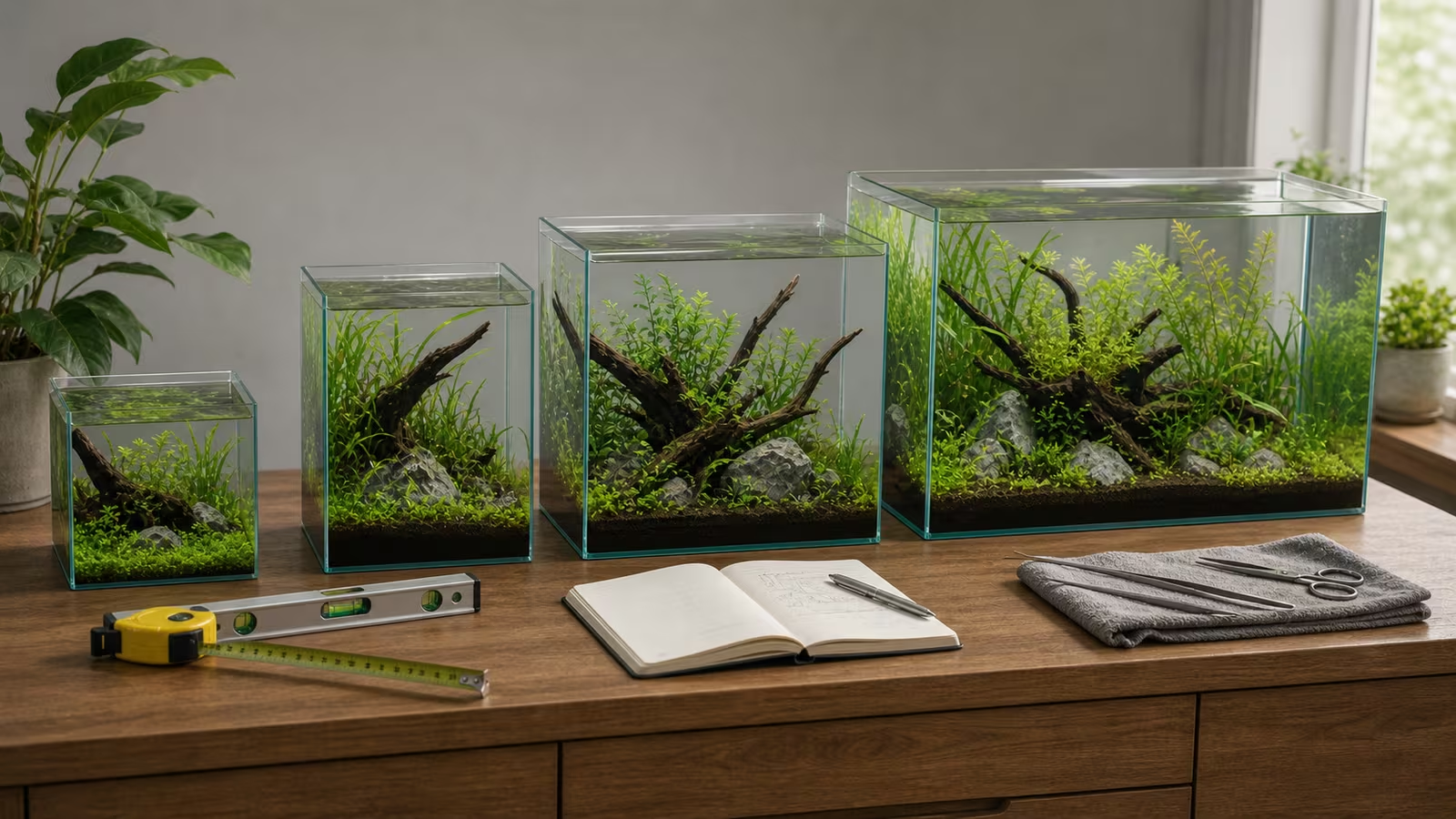
Tank size decides more than the look of an aquascape. It shapes water stability, stocking options, plant layout, equipment choices, water-change effort, filled weight, and where the tank can safely sit. A tank that is too small for the desired animals is not solved by plants. A tank that is too large for your floor, stand, lease, or maintenance routine can become a home problem instead of a hobby.
Start by separating three questions: what size can the room support, what size can you maintain, and what size can ethically house the animals you want. The right answer is where those three overlap.
Heads up
Weight and livestock boundary
Do not place aquariums on furniture that is not rated for the filled load. Do not choose fish, shrimp, snails, or other animals by body size alone. Adult size, behavior, group needs, oxygen, temperature, and water stability matter.
Footprint Matters
A long tank and a tall tank can hold similar water volumes while offering very different lives for animals and very different layouts for plants. Many small fish use horizontal swimming space. Many aquascapes need foreground, midground, and background depth. A tall narrow tank can look elegant, but it may be harder to light evenly, plant comfortably, and maintain without wet sleeves.
The displayed gallon or liter rating is also not the final water volume. Substrate, stone, wood, and equipment displace water. Heavy rock adds weight. A cabinet full of buckets, tools, and supplies adds more. Think in filled system weight, not empty glass weight.
Compare the length and front-to-back width as well as the volume. A 60 × 30 × 30 cm tank and a 45 × 30 × 40 cm tank each have a nominal internal volume of 54 liters, but the first offers 60 cm of swimming length and a larger water surface. The second is taller and shorter. Dimensions here are illustrative internal measurements; check the manufacturer’s external dimensions for fit and support. The RSPCA’s aquarium guidance explains why surface area and stable water conditions matter. Surface area alone does not guarantee sufficient oxygen: appropriate filtration and surface movement still matter.
Front-to-back width also gives a planted layout room to slope, grow, and leave open space. Before buying, sketch the hardscape inside the actual footprint, including a cleaning gap at the glass and space to reach the back. Check the height of the tank against your reach and the light’s suitability for that depth.
Sizing Criteria
| Criterion | What To Check |
|---|---|
| Stand and floor | Filled tank, substrate, hardscape, equipment, cabinet contents, and level surface. |
| Maintenance access | Can you reach the back, trim plants, remove equipment, and siphon safely? |
| Water stability | Larger volumes usually buffer temperature and chemistry swings better. |
| Livestock plan | Adult size, group size, swimming style, territory, and temperature. |
| Aquascape plan | Room for slope, hardscape, plant growth, open water, and cleaning lanes. |
Practical Beginner Advice
Choose the largest tank you can safely support, maintain, and afford, but not a tank so large that water changes become a dreaded event. If the tank is for fish, research fish first. If the tank is for shrimp, research stability and minerals first. If the tank is plants-only, you still need light, filtration or circulation, and water care.
There is no universal size that makes every fish suitable. For example, Seriously Fish’s neon tetra profile recommends a base of at least 60 × 30 cm and a group of at least 8–10. A 45 cm long tank is therefore a poor match even if its volume equals that of a longer tank. This is one species’ guidance, not a stocking rule for all small fish. Compare adult size, group needs, behavior, water conditions, and compatibility for each animal; see Stocking Caution for Small Tanks and Schooling Fish and Space Reality .
Small tanks can work as underwater gardens, but less water leaves less room for error when temperature or water quality changes. The nano tank guide walks through those tradeoffs. Plants provide cover and take up some nutrients; they do not replace a suitable footprint or a cycled filter for fish.
Estimate Water And Filled Weight
For a rectangular tank, multiply internal length × width × water depth in centimeters and divide by 1,000 for liters. Use the intended waterline, not the rim. This is water volume before subtracting displacement by substrate, rocks, wood, and equipment. Once the layout is in place, measure the water added with a marked container, subtracting any removed during setup. Record the result for water changes and dosing; update it after a major rescape. Merck’s aquarium fish guidance gives volume formulas for other shapes.
For example, internal dimensions of 60 × 30 cm with a 28 cm water depth give 50.4 liters before displacement. If the layout displaces 8 liters, the estimated water volume is 42.4 liters. A 25% water change would be about 10.6 liters; decide whether carrying that amount or using a hose fits the room and your routine. The displacement figure is only an example, so measure your own setup. See Water Change Rhythm for choosing a schedule.
For support planning, count the whole system: actual water, tank, substrate, rocks, wood, equipment, stand, and stored supplies. Fresh water weighs about 1 kg per liter, or 8.3 lb per US gallon. If the example holds 42.4 liters, its water weighs about 42.4 kg; add the other components rather than adding the weight of the displaced water too. If measuring all water added, use the dry substrate weight so water trapped in it is not counted twice. Use product weights or a conservative estimate for each item and allow for planned additions. Merck’s placement guidance emphasizes the weight of water and the need for a strong, level, stable stand and floor.
Check that the stand is rated for the load and supports the tank base as the tank manufacturer requires. A stand rating alone does not establish that the floor can support the load at that location. If uncertain, consult a qualified structural professional before filling; also check lease or insurance conditions where applicable. The stand safety guide covers placement, access, and electrical considerations.
Compare The Whole Setup
Before choosing between two tanks, note their external dimensions, estimated filled weights, initial equipment costs, and water-change volumes side by side. Check doorways and the route to the stand, space above the rim for lifting a lid and trimming, and clearance behind for filters, hoses, and cords. Choose equipment for the actual tank and inhabitants, and budget for water treatment, tests, electricity, and replacement parts as well as the tank itself. The starter budget guide has a first-year worksheet.
For a stocked tank, plan the fishless cycle and water testing before buying animals. More volume provides a buffer, not an exemption from filtration, testing, and regular maintenance.
Common Mistakes
- Choosing by empty-tank price instead of filled-system cost.
- Forgetting the stand, mat, level, outlet, drip loop, and spill route.
- Buying active schooling fish for a short tank.
- Assuming a tiny tank is easier for children or beginners.
- Building a scape so full that animals have no usable space.
Related Fondsites Path
- Tank Size Reality Check for a quick planning calculation.
- Pawstead for animal welfare thinking across species.
- Keepers Guild for furniture, repair, and household risk boundaries.
- Clear Water Lab for water-source evidence.
Try This Next
Write down the desired animals before buying the tank. If the adult group needs more room than your planned tank provides, change the animal plan or choose a larger tank. Do not make animals adapt to a decorative footprint.
Sources
- RSPCA: Choosing an Aquarium for Pet Fish — tank size, surface area, water stability, and placement.
- Merck Veterinary Manual: Providing a Home for Fish — aquarium weight, support, placement, and equipment.
- Merck Veterinary Manual: Management of Aquarium Fish — formulas for estimating aquarium volume.
- Seriously Fish: Neon Tetra (Paracheirodon innesi) — species-specific tank footprint and group size.