Cycling a Planted Aquarium Before Animals
Understand aquarium cycling, ammonia, nitrite, nitrate, beneficial bacteria, plants, testing, and why animals should wait.
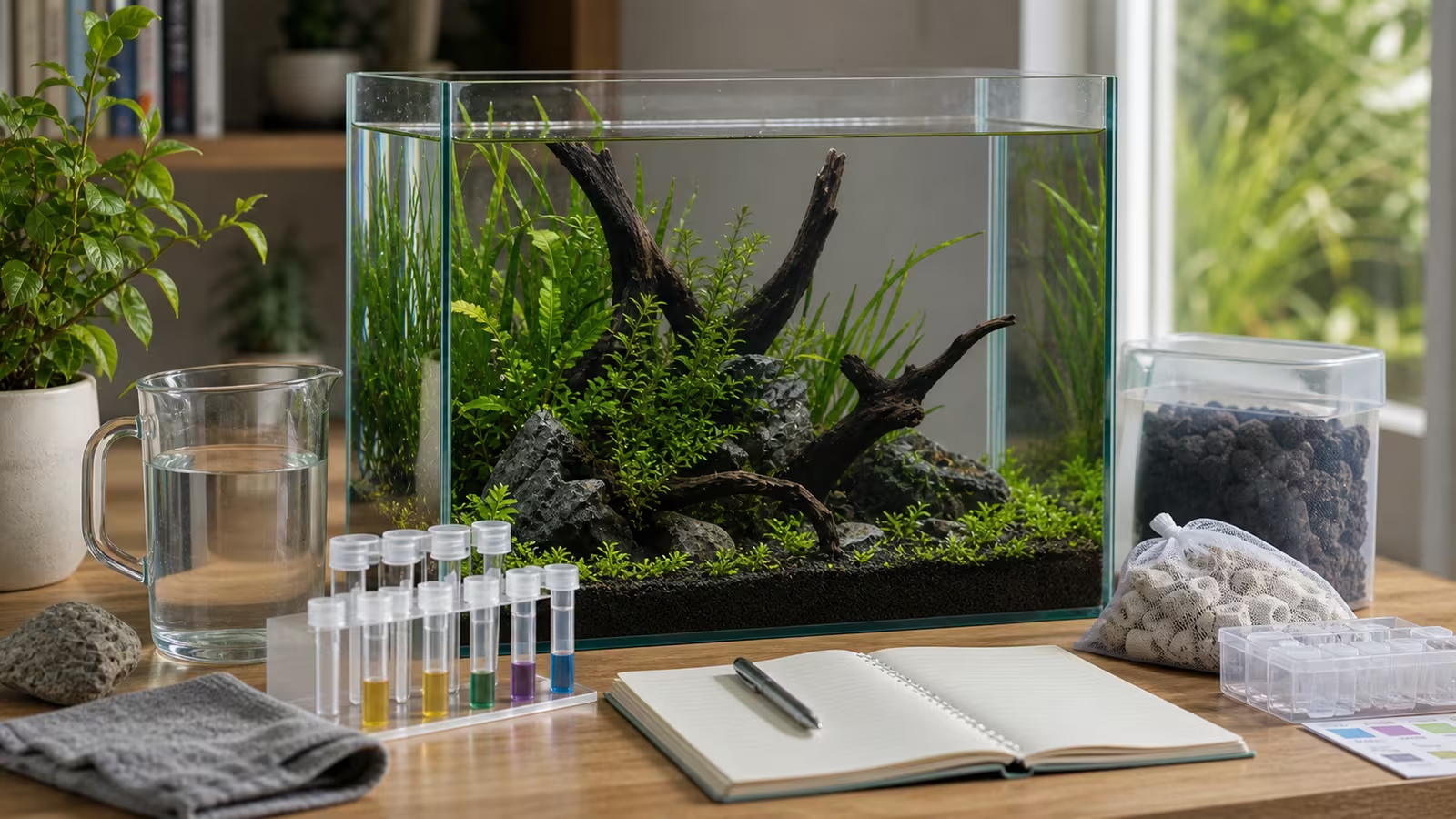
Cycling is the process of establishing a biological filter that helps convert ammonia from animal waste and decomposing material into less immediately dangerous forms. A tank can look clean and still be unsafe if ammonia or nitrite is present. Give the system time and test it before animals arrive.
Plants can take up nitrogen and provide surfaces for microbes, but they do not make testing unnecessary. In a new planted tank, growth, melting leaves, substrate, and the filter all affect what the tests show.
Heads up
Animal welfare boundary
Do not use live animals as cycling tools. If animals are already present and ammonia or nitrite is detectable, change some water promptly with conditioned, temperature-matched water from a suitable source, check the filter, and retest. Test the replacement water too: it may contain ammonia or nitrite. If animals are distressed, increase aeration and seek experienced aquatic or veterinary help promptly. Do not add cycling ammonia to a tank containing animals.
Plain Definitions
| Term | Plain Meaning |
|---|---|
| Ammonia | A waste-related compound that can harm animals; aquarium tests commonly measure total ammonia and ammonium. |
| Nitrite | A harmful compound produced as microbes process ammonia. |
| Nitrate | A product of nitrification that can accumulate and is managed through plant uptake, water changes, and stocking restraint. |
| Beneficial bacteria | Microbes that process nitrogen and live on filter media, substrate, hardscape, and other surfaces. |
| Mature media | Filter media from an established tank that already supports a biological filter. |
In the usual sequence, ammonia rises and falls, nitrite follows, and nitrate appears. Plants also use nitrogen, however, so a planted tank may not show every spike or a steady nitrate rise. Source water or fertilizer can contribute nitrate too. Nitrate alone does not prove the tank is ready. The nitrogen cycle guide explains where the microbes live.
A Fishless Cycling Routine
- Set up and test the water. Plant the tank, fill it with water treated for chlorine or chloramine, and run the filter continuously with good flow and surface movement. Use a heater if the planned plants and livestock need one. Test the source water, prepared water, and aquarium water for ammonia, nitrite, and nitrate; label and record the results and temperature. See Dechlorinator and Source Water .
- Provide a measured ammonia source. Use an aquarium fishless-cycling ammonia product and follow its dosing directions for the actual water volume, allowing for displacement by substrate and hardscape. Keep fish, shrimp, snails, and other animals out of the tank while dosing. Do not use scented or soapy household cleaners. Mix as directed, record the amount, and test after adding it so you know the starting reading. Account for any ammonia already present before dosing. An empty tank with zero ammonia and nitrite may simply have nothing to process.
- Test and maintain. Test ammonia and nitrite daily during the cycle, following the product and test-kit instructions for when to add more ammonia. Record nitrate, water changes, and anything added. Do not keep adding full doses blindly: high concentrations can slow the process. Keep the filter running, remove decaying leaves, and use conditioned water for water changes. The water testing guide covers reading and recording results.
- Check the response before stocking. When ammonia and nitrite have fallen to undetectable levels on the test kit, add a measured dose as directed for the fishless cycle. Mix, test, and record the starting ammonia reading and time; a dose that produces no detectable reading does not make a useful check. Test ammonia and nitrite again about 24 hours later without adding more ammonia in between. Both should be undetectable; repeat the check to confirm the response. If either remains detectable, continue cycling and testing before stocking.
For example, a log might show a detectable ammonia reading after a measured dose on Monday morning and undetectable ammonia and nitrite on Tuesday morning. Record the actual dose, readings, and test-kit units, not just “passed.” This checks the response of the whole planted system: plants may take up some ammonia, so it does not measure the filter alone or guarantee capacity for a fully stocked tank. “Undetectable” means below the kit’s detection limit, not proof of an absolute zero. Compare the response using the same dose and testing procedure when repeating the check.
Zealandia’s fish translocation guide describes fishless cycling and an overnight ammonia-and-nitrite check for quarantine aquariums. New Mexico State University’s aquaponics water-quality guide explains the role of ammonia, oxygen, and beneficial bacteria. These are useful principles, though a planted display aquarium is a different system.
Cycling can take several weeks or longer; the Merck Veterinary Manual notes that a tropical aquarium biofilter can take up to eight weeks to establish. Temperature, oxygen, ammonia supply, plant mass, substrate, and established media all affect the process. A calendar or a bottle of bacteria is not a readiness test.
Plants And Filter Media During Cycling
Planting before animals gives roots time to settle and lets you deal with plant melt without livestock stress. Remove soft, decaying leaves and keep light moderate and consistent. Some plant substrates can release ammonia, so test before dosing and account for what is already in the water. The plant melt guide helps distinguish adjustment from ongoing trouble.
Mature media from an established healthy tank can help seed a new filter, but it can also carry pests or disease. Know its source, keep it wet during transfer, and continue testing. Avoid replacing all filter media at once; when it needs cleaning, gently rinse it in removed aquarium water to preserve the living surfaces. See Filter Media Maintenance .
If The Readings Stall
If ammonia or nitrite remains detectable, wait before adding animals. Check that the filter is running and water is circulating, that replacement water was conditioned, and that the test kit is in date and used as directed. Compare your log with the ammonia product’s instructions before dosing again. If readings are very high, a partial water change with suitable conditioned water can dilute them; record the change and retest. Check pH and KH as well as the source water, especially if pH is falling. Nitrification needs oxygen and uses up alkalinity, so depleted buffering can contribute to a stall. The Merck Veterinary Manual discusses alkalinity and biofilter function. Avoid chasing a pH number with additives; use the KH, GH, and pH guide and seek experienced local advice if the pattern remains unclear. Change one thing at a time where practical so you can interpret the result.
Before The First Animals
Once the response check passes, stop dosing ammonia before animals arrive. If necessary, change water to bring nitrate and other conditions into a suitable range for the chosen species, then retest ammonia, nitrite, and nitrate. Check temperature and water chemistry, plan quarantine and acclimation, and add a modest first group suited to the species and tank. A schooling species still needs an appropriate group size. The planted aquarium setup guide from OATA also describes fishless cycling and gradual stocking.
If stocking is delayed, keep the filter running and follow the ammonia product’s maintenance directions for the empty tank. Repeat the response check before animals arrive; do not dose ammonia after they are added.
Feed lightly at first and test ammonia and nitrite daily for the first several days after the addition, continuing until readings are stable. If either is detectable, promptly change some water with suitable conditioned, temperature-matched water, retest, and review feeding and filtration. If animals show distress, increase aeration and seek experienced aquatic or veterinary help promptly. Wait for stable readings before adding more animals. The stocking guide and quarantine and acclimation guide help with the next decisions.
Common Mistakes
- Adding animals because the tank looks clear or a set number of days has passed.
- Assuming zero readings in an unfed tank prove it can process waste.
- Replacing all filter media or forgetting to condition replacement water.
- Confusing nitrate presence with complete readiness.
- Testing once and declaring the tank done, or adding a full stock at once.
Related Fondsites Path
- Plant Before Fish Plan for the whole setup sequence.
- Clear Water Lab for testing habits and source-water thinking.
- Pawstead for animal welfare before convenience.
- Water Change Planner for maintenance after cycling.
Try This Next
Create a cycling log with date, ammonia added, ammonia, nitrite, nitrate, temperature, water change, and plant notes. Use it to check the system’s response to a measured dose, then plan a conservative first addition rather than stocking to the tank’s limit.