Diagnose Green Water
A calm guide to green water in aquariums: likely triggers, livestock safety, light control, filtration, and what not to overcorrect.
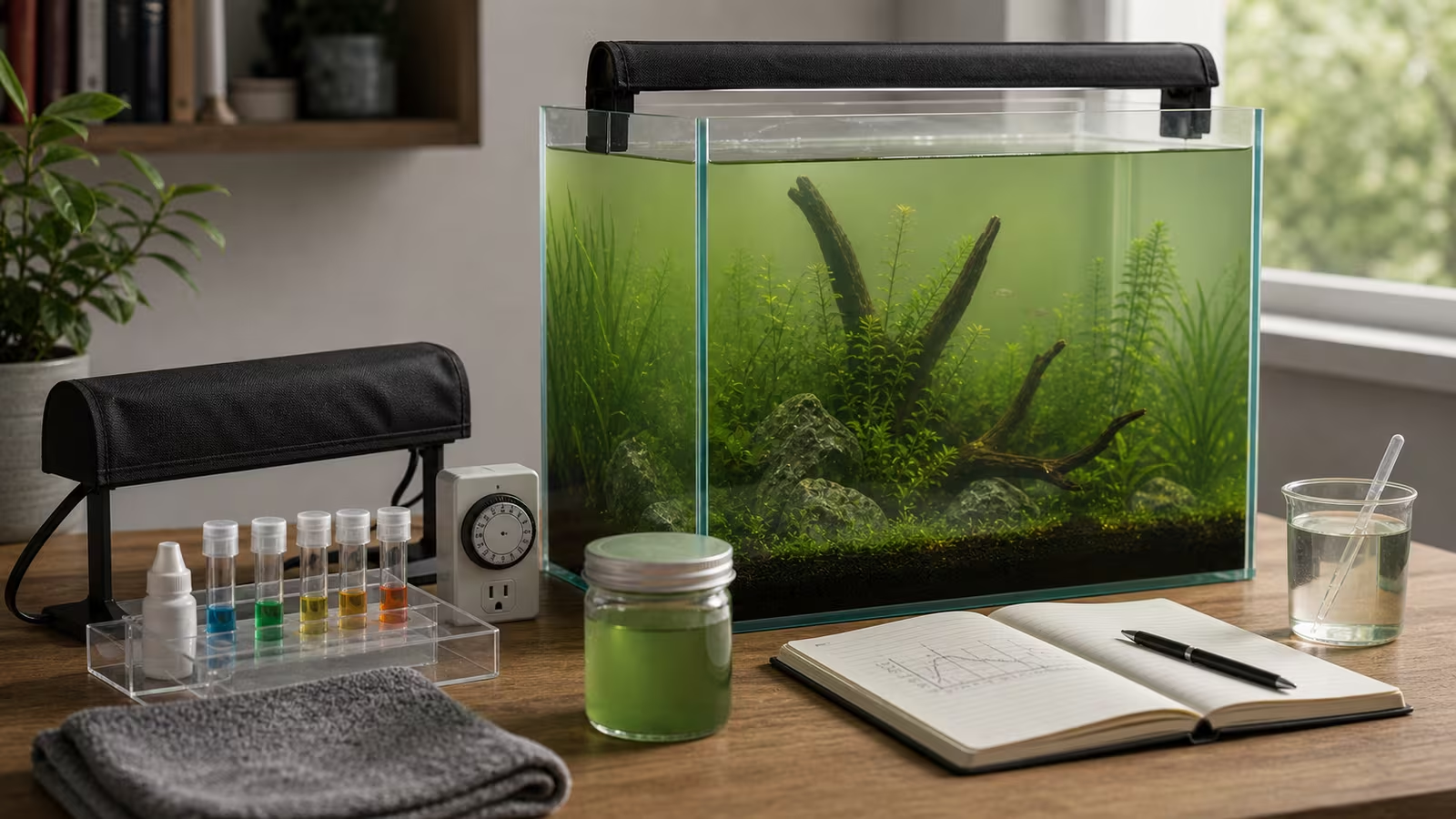
In a freshwater planted aquarium, green water is usually a bloom of algae suspended in the water, rather than algae growing on the glass or plants. The tank may look like pea soup, light may seem to vanish, and the aquascape can feel lost. It is frustrating, but a frantic reset can stress a stocked tank without fixing the conditions behind the bloom.
Start with livestock and oxygen. Then look for changes in light, feeding, maintenance, and water quality. A bloom does not point to one certain cause, and clear water alone does not prove the water is safe.
Heads up
Livestock-first boundary
If animals are gasping, lethargic, or dying, act now rather than waiting for the green water to clear. Increase aeration or surface movement, check temperature, ammonia, and nitrite, and seek an aquatic veterinarian or experienced local help. Gasping can have several causes; do not assume algae is the only problem.
Is The Water Actually Green?
Take a sample in a clear, clean container and look through it against a white background in neutral light. If the sample itself is green, suspended algae are a likely explanation; green aquarium glass alone can make the tank look green while the sample stays clear. A white or gray haze can be a bacterial bloom or fine substrate dust; dust may settle after the sample stands. Yellow or tea-colored water can come from tannins. The cup test is a clue, not a species identification or a water-safety test. See Cloudy Water After a New Aquascape Setup if the sample is not clearly green.
Green spots or strands attached to surfaces are a different problem. Scraping the glass will help those areas but will not remove a bloom throughout the water column. The Algae Diagnosis Guide can help sort visible clues.
What To Check First
| Check | What To Look For |
|---|---|
| Animals and oxygen | Check breathing and behavior, especially near the surface. Confirm the filter is running and moving the surface gently; add an air stone if needed. |
| Ammonia and nitrite | Test both, particularly in a new tank or after filter work. Any detectable reading in a stocked tank needs prompt attention, even if the water is clearing. |
| Light | Record the actual timer schedule, intensity changes, and any direct sun through a window. |
| Feeding and decay | Look for uneaten food and decaying plant material; remove what you can without disturbing the whole substrate. |
| Recent changes | Note a new tank, a stopped or heavily cleaned filter, a rescape, fertilizer changes, or a change in stocking. These are clues to investigate, not proof of a cause. |
Ammonia and nitrite problems can accompany a bloom without being caused by it. For a stocked tank with detectable readings, reduce feeding, check the filter, and make a partial water change while investigating the cause. Test the source water too; if it contains ammonia or nitrite, seek an appropriate alternative and experienced advice. Condition replacement water for chlorine or chloramine and match its temperature. Retest the tank after the change and monitor daily while readings remain detectable, repeating water changes as needed. Seek help promptly for distressed animals or persistent readings. The Merck Veterinary Manual discusses monitoring and water changes for ammonia and nitrite problems. Water Testing for Aquascapes explains how to record results.
Dense blooms deserve extra attention to oxygen, particularly overnight and if the bloom dies off. Algae respire as well as photosynthesize, and decomposition can consume oxygen. The University of Florida’s dissolved oxygen guide describes these processes in fish ponds; the practical warning is also useful for a stocked aquarium.
Make A Calm First Adjustment
Block direct sunlight with a curtain or blind and put the aquarium light on a consistent timer. If it has been on all day, six to eight hours daily is a practical starting range for a modestly planted tank, not a guaranteed cure. Tropica’s setup guide recommends starting new aquariums at six hours. If the schedule is already in that range, check intensity, sunlight, and recent changes before reducing it further. Keep the filter and heater on continuous power, and watch plant growth as well as water clarity. Light Balance for Aquatic Plants and Photoperiod and Timer Setup help with the longer-term schedule.
Feed only what the animals need, remove obvious decay, and keep the filter running. Maintain your normal, controlled water-change routine unless tests or animal distress call for more immediate action. A water change dilutes the green water, but the bloom can return if the conditions supporting it remain. Match and condition replacement water; see Water Change Rhythm for Planted Tanks .
Do not assume fertilizer alone caused the bloom or stop all plant nutrition based on color alone. Nitrate readings can help describe water conditions, but a single reading does not identify the cause or tell you how much fertilizer to add. Review what changed and make one manageable adjustment at a time, while continuing any urgent animal-care measures.
Record the date, light schedule, feeding, test results, and a photo from the same position each day. Compare samples in the same clear container against the same white background: a paler sample over several days suggests progress. If the water gets greener, animals become difficult to observe, or there is no improvement after several days, recheck the light and filter, review your notes, and ask an experienced aquarium specialist for help. There is no guaranteed clearing time.
Filtration And UV
Fine mechanical media may catch some suspended material, but very small algae can pass through it. If you try a polishing pad, check it frequently for clogging and preserve normal flow. Rinse it as needed in removed tank water; do not replace all established filter media. Filter Media Maintenance Without Losing the Cycle explains the distinction between cleaning a pad and disrupting biological filtration.
A properly sized and operated aquarium UV clarifier can help with free-floating algae passing through the unit. It does not address the reason the bloom developed, and it will not treat algae attached to plants or glass. Follow the unit’s instructions for flow, installation, maintenance, and electrical safety; never look at an exposed operating UV lamp. The manufacturer’s description of an aquarium UV sterilizer explains its intended use for free-floating algae. Check medication and equipment instructions before combining treatments.
Common Mistakes
- Repeating massive water changes for appearance alone while ignoring light and feeding. Water-quality emergencies are different and may require prompt changes.
- Turning off filtration to “rest” the tank or replacing all filter media during the bloom.
- Adding random algae chemicals, especially around shrimp, snails, or sensitive plants.
- Buying animals to solve green water. They need suitable care and add waste; they are not a substitute for finding the cause.
- Keeping the light off so long that plants suffer, then creating another problem.
Related Fondsites Path
- Algae Diagnosis Guide for sorting algae clues.
- Water Testing for Aquascapes for evidence before action.
- Algae Prevention Basics for a sustainable routine after the bloom.
Try This Next
Write down light hours, window exposure, feeding, test results, and what changed in the last two weeks. Check livestock and equipment daily, then compare the water and notes after a few days. Green water has a story; the record helps you find it before choosing another fix.