Diatoms, Hair Algae, and Black Beard Algae
Recognize common planted-tank algae patterns and respond to diatoms, hair algae, and black beard algae without overcorrecting.
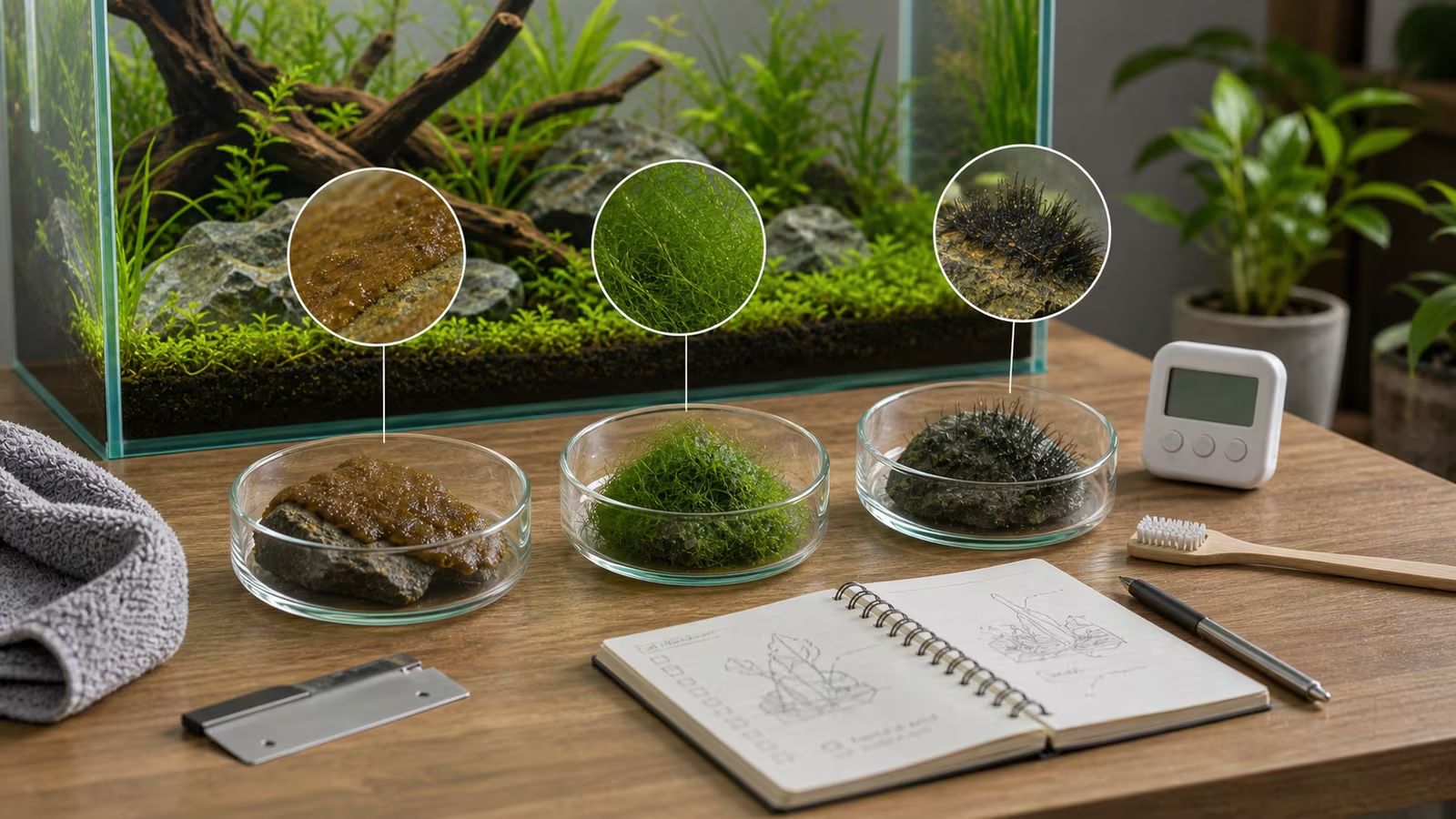
Not all algae looks or behaves the same. Brown dust on a new tank, green threads tangled in stems, and dark brushy tufts on hardscape suggest different first steps. This guide covers common patterns in freshwater planted aquariums. A visual match is a working identification, not proof of a species or a single cause.
Algae is not a failure. Look at tank age, light, plant health, feeding, debris, flow, and recent changes before reaching for a treatment.
Heads up
Treatment boundary
Be careful with algae treatments in tanks containing shrimp, snails, sensitive fish, or delicate plants. Read the product label and check that it is suitable for every inhabitant; do not improvise chemical doses or mix treatments. If animals are gasping, lethargic, or dying, check the filter and surface movement, test ammonia and nitrite, and seek aquatic veterinary or experienced local help promptly.
Start With The Pattern
| What You See | Likely Pattern | First Step |
|---|---|---|
| Soft brown dust or film that wipes away | Often called diatoms, especially in a new tank | Wipe a small area and siphon loose material during a water change. |
| Green strands or tangles attached to plants or decor | Hair or thread algae | Lift or wind out accessible strands without uprooting plants. |
| Short dark gray, black, or reddish brushy tufts that cling firmly | Black beard or brush algae, often called BBA | Remove a badly affected leaf or clean a removable piece of hardscape. |
These names describe visible patterns; several organisms can look similar and more than one may be present. A slimy sheet that peels away may be cyanobacteria rather than one of the patterns above; appearance alone cannot confirm it. Siphon out what you can during a water change and check for trapped debris and poor circulation. If it spreads quickly or animals seem unwell, seek experienced help instead of guessing at a treatment. The Algae Diagnosis Guide can help sort other patterns. If the water itself is green, see Diagnose Green Water .
Inspect a small patch in good light before cleaning it. Note whether it wipes off as a film, lifts as strands, or stays attached as short tufts. Take a close photo of the patch and a wider one showing its position in the tank; these give you a useful comparison even if the name is uncertain.
Diatoms
Diatoms often appear as a brown film on glass, substrate, hardscape, and leaves in newer tanks. The ADA Nature Aquarium Guide describes brown diatom growth during aquarium setup and removal by siphon. Brown color alone does not confirm diatoms, and their appearance does not tell you whether the nitrogen cycle is complete.
Wipe the glass with a pad suitable for glass or acrylic, as appropriate, and siphon loosened material during routine maintenance. Keep grit out of the pad so it does not scratch the tank. On delicate leaves, use a gentle swish or leave them alone rather than rubbing hard. A new tank may improve as it matures, but there is no guaranteed deadline. Continue testing ammonia and nitrite in a new or disturbed tank and keep the filter running; do not deep-clean established filter media because the film looks ugly. See Cycling a Planted Aquarium and Filter Media Maintenance .
Hair Algae
Hair algae forms green strands or tangles on plants and hardscape. Wrap loose strands around an aquarium-only toothbrush or lift them with tweezers, supporting the plant as you work. Pull gently; if the roots or a delicate stem start to lift, stop and trim a badly tangled leaf instead. Siphon or net loose pieces before they settle elsewhere. The ADA aquarium maintenance guide describes winding filamentous algae around a toothbrush and removing it by siphon or trimming when necessary.
After removing what you can, review the light schedule and intensity, plant growth, feeding, and maintenance. An unusually long light period or a recent change in plant growth is a reason to investigate, not proof of one cause. Do not stop all fertilizer just because strands appeared: plants need nutrients too, and algae alone cannot identify a deficiency or excess. See Light Balance for Aquatic Plants and Fertilizing Aquatic Plants .
Black Beard Algae
Black beard algae appears as dark, brushy tufts on hardscape, leaf edges, and equipment. Longer, visibly branching strands suggest a different pattern often called staghorn algae; the ADA Nature Aquarium Guide illustrates both. Either way, appearance alone is not a species identification. BBA can cling tightly, so prevention and early removal are generally easier than trying to strip a heavily covered tank. Trim a few badly affected leaves where the plant can spare them; keep healthy growth. If a rock or ornament can be removed without disturbing the layout, scrub it with an aquarium-only brush and rinse it before returning it. Avoid soap or household cleaners. Do not scrub fragile leaves or dismantle the tank to chase every tuft.
Look for recent changes in light, plant growth, debris, and flow. Check that the filter is working and that water moves through the tank without buffeting animals. BBA on an outlet does not prove that flow alone caused it; do not shut down filtration to keep algae away. If you inject CO2, check the equipment and schedule for consistency rather than increasing the dose as a cure. Excess CO2 can endanger livestock. Many planted tanks do not need injected CO2; the Ornamental Aquatic Trade Association’s planted aquarium guide discusses its use and monitoring. See CO2 Tuning and Stability for further checks.
A Steady Response
- Record the baseline. Photograph the affected area and note tank age, light hours and intensity, recent changes, and where growth appears. Check new plant growth and animal behavior too.
- Remove what is practical. Clean a small patch, lift loose strands, and remove decaying leaves. Siphon loose debris during a normal partial water change, using conditioned, temperature-matched water. Watch the water level while siphoning and stop before removing more than planned; finish a large cleanup over several sessions. If the water falls below the filter’s operating level, switch it off and restart it after refilling according to its instructions.
- Choose one routine adjustment. For example, shorten an unusually long light schedule or remove uneaten food more consistently. For a new, modestly planted setup, six to eight hours of light on a timer is a practical starting range, not a universal prescription; intensity matters too. If the schedule is already in that range, check intensity, direct sun, and recent changes before shortening it further. See Photoperiod and Timer Setup . Avoid a simultaneous blackout, fertilizer overhaul, and chemical treatment: you will not know what helped, and plants and animals may suffer.
- Compare after one to two weeks. Photograph the same cleaned area in similar light and compare how much of it is covered again, not just the old tufts that remain elsewhere. Slower regrowth and healthy new leaves are useful signs; old attached BBA may still need physical removal. If growth continues, revisit the baseline and check whether the adjustment was consistent before changing anything else. Do not wait for the comparison if animals are distressed or water tests are unsafe.
If ammonia or nitrite is detectable in a stocked tank, respond to the water-quality problem promptly: check filtration and use a conditioned, temperature-matched partial water change to reduce the reading. Retest and seek experienced help if readings persist or animals show distress. The OATA freshwater testing guide explains why both readings should be zero. Algae appearance cannot substitute for a test.
The Merck Veterinary Manual’s maintenance checklist includes algae removal, plant care, water tests, and filter checks as part of routine aquarium care. A clean-looking tank still needs those checks.
Cleanup Animals And Common Mistakes
Do not add animals solely as tools. Some grazers eat some algae, but they need suitable water, space, compatible tankmates, and often supplemental food. The Ornamental Aquatic Trade Association’s algae-eater guide explains that algae-eating fish do not replace maintenance and may outgrow an aquarium. See Cleanup Crew Expectations before considering an addition.
Avoid these common overcorrections:
- Treating early diatoms like a disaster or assuming they prove the tank has cycled.
- Letting hair algae grow into a large tangle before removing what is accessible.
- Expecting one algae-eating animal or product to solve the underlying conditions.
- Scrubbing slow-growing plant leaves to death or cleaning all filter media at once.
- Assuming a visible pattern identifies a specific nutrient problem, or making several major changes at once.
Related Fondsites Path
- Algae Prevention Basics for a repeatable routine.
- Algae Diagnosis Guide for structured triage.
- Light Balance for Aquatic Plants for matching light to the setup.
- Feeding Without Polluting the Tank for waste control.
Try This Next
Take a close photo, name the visible pattern, and write down tank age, light schedule, and recent changes. Remove a small patch safely, then compare the same area in a week while watching the plants and animals each day.