Driftwood, Rocks, and Substrate: What to Check First
Check aquarium hardscape materials for safety, stability, hardness effects, tannins, sharp edges, planting needs, and local collecting rules.
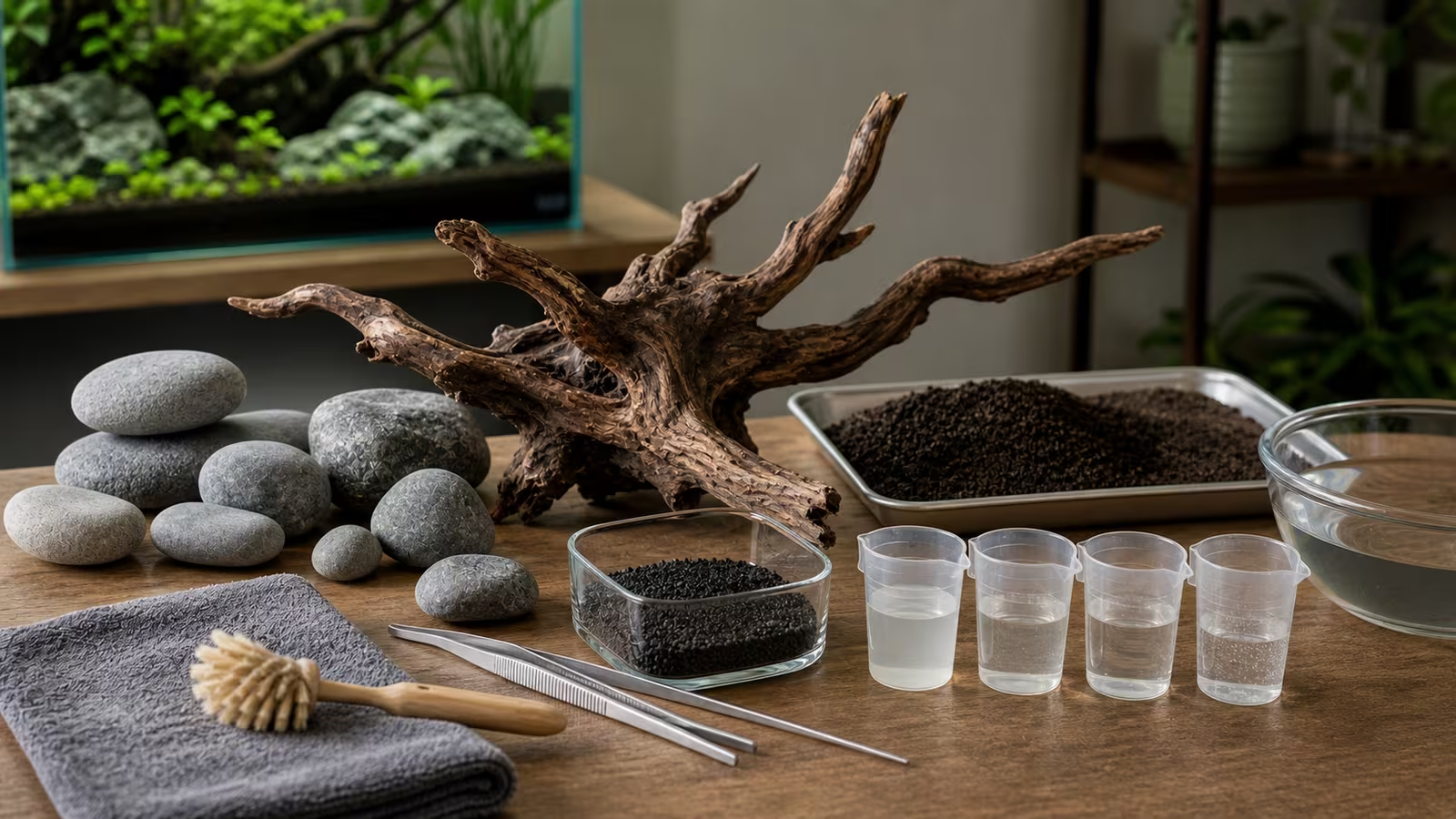
Driftwood, rocks, and substrate do more than create a look. They affect water, planting, cleaning, animal movement, and sometimes legality. A smooth stone can be inert or it can raise hardness. Wood can sink immediately or float for weeks. Substrate can hold roots well or become a compacted trap. Collected materials can carry pollutants, pests, sharp edges, or local-rule problems.
The safest beginner path is known aquarium-safe material from a reputable source. That does not mean every store item is perfect or every collected item is impossible, but it removes many unknowns while you are still learning the tank itself.
Before buying, check the needs of your intended freshwater animals and plants and test your source water. Record pH, general hardness (GH), and carbonate hardness (KH); then choose materials that work with those conditions. The KH, GH, and pH guide explains what those readings mean. Do not count on wood or stone to deliver a precise target pH.
Heads up
Material and local-rule boundary
Do not collect rocks, wood, plants, animals, or substrate from parks, waterways, beaches, or private land without checking permission, safety, and local regulations. Never use unknown treated wood, painted decor, sharp materials, or items that may leach contaminants.
Driftwood
Aquarium wood can release tannins that tint water brown. That is not automatically harmful, and some keepers like the look, but it can surprise beginners who expected clear water. Tannins can also lower pH; the effect depends on the wood, water volume, and buffering. Aqueon’s pH guide notes that the effect can be small in strongly buffered water. Test the water rather than using its color as a measure of pH or water quality.
Avoid wood with unknown coatings, rot, sap, pesticides, or urban contamination. Scrub off loose debris with an aquarium-only brush and plain water; do not use soap or household cleaners. Soak the piece in a clean container, changing the water as needed, to observe staining and buoyancy. Some pieces float for weeks or may need a secure aquarium-safe anchor even after soaking. Fluval’s driftwood guidance describes these differences and the pale biofilm that can appear on new wood.
Boiling small pieces is sometimes used to help release tannins, but it is optional and may be impractical for larger wood. Do not assume a soak or boiling makes contaminated or treated wood safe. Check for sharp splinters and tight openings where an animal could become trapped. See Driftwood Tannins and Preparation for more on soaking, biofilm, and placement.
Rocks
Some stones affect hardness and pH. Limestone and other calcium carbonate materials can raise hardness and buffering, and may raise pH; that may suit a hard-water setup but conflict with animals that need softer water. The University of Florida’s explanation of agricultural limestone describes these effects in fish ponds. Smooth, stable rock sold for aquarium use is usually easier than mystery stone, but check what the material is and whether it suits your planned livestock. Avoid sharp edges and narrow holes where animals could be injured or trapped.
To investigate a known, clean stone’s effect before using it, try a separate soak test:
- Rinse the stone and place it in a clean aquarium-only container. Fill a second, similar container with the same prepared water and no stone as a control. Use comparable water volumes, temperature, and aeration; record the amount of stone and water.
- Measure pH, general hardness (GH), and carbonate hardness (KH) in both containers at the start and again after several days to a week, using the same tests. Top up evaporation with suitable low-mineral water so concentration changes do not confuse the comparison.
- Compare the readings with the control. A consistent rise in hardness or KH in the stone container suggests an effect worth considering for your livestock. A short test may miss a slow change or a different response in the display, so continue testing after installation.
A vinegar fizz test can suggest carbonate minerals, but a weak or absent reaction does not establish that a rock is inert or free of contaminants. Neither that test nor a short soak proves an unknown rock is safe. When the source or composition is uncertain, choose a known material instead. The water testing guide explains how to track the tank itself.
Place heavy stones securely on a stable base before building substrate around them, and lower them gently into the tank. Follow the aquarium manufacturer’s guidance on weight and any protection beneath rocks, and include the hardscape when checking the capacity of the stand and floor . Do not lean stones against glass or build a pile that depends on loose substrate to stay upright. A gentle push from several directions should not shift the arrangement; burrowing, planting, and cleaning can undermine it later. See Hardscape Layout Basics for a dry-layout check.
Substrate
Substrate should match the plants, animals, and maintenance style. Compare the material itself, not just its color:
| Material | Useful Starting Point | Check Before Buying |
|---|---|---|
| Inert aquarium sand | A smooth foreground or simple bed for compatible bottom dwellers. | Fine grains can compact; plain sand supplies little root nutrition. |
| Inert aquarium gravel | A durable bed for many rooted plants. | Coarse gaps collect debris, and sharp grains may be unsuitable for bottom-dwelling animals. |
| Planted-tank aquasoil | A nutrient-containing bed for rooted plants. | Products differ and can change water chemistry or cloud when disturbed. |
Root-heavy plants in plain sand or gravel may benefit from aquarium root tabs used according to the label. Attached plants such as Anubias and Java fern do not need a soil bed; keep their rhizomes exposed as described in Epiphyte Plants . Bright decorative gravel is a visual choice, but it can make debris more visible and should still be checked for suitable texture and coatings.
Follow the substrate manufacturer’s preparation directions. Rinse sand or gravel when directed, using clean water and an aquarium-only container. Do not automatically rinse aquasoil: ADA’s instructions for Aqua Soil warn that washing can crush granules and cloud the water. Fill slowly onto a clean plate or bowl to avoid disturbing the bed. Some active soils lower pH and KH, and nutrient-rich products can affect early water chemistry; ADA’s Aqua Soil instructions give product-specific examples. Follow the product’s startup instructions, test ammonia, nitrite, pH, and hardness as appropriate, and complete the aquarium cycle before stocking. Clear water alone does not establish that the tank is cycled.
For many rooted plantings, about 5 cm (2 inches) is a practical starting depth, adjusted for the plants and layout; an open sand path or attached plants need less. Keep plant crowns above the substrate and leave space to siphon accessible areas. The substrate guide covers depth, nutrients, and cleaning in more detail.
To estimate a level bed, multiply the inside length, width, and average depth in centimeters, then divide by 1,000 for liters. For example, a 60 × 30 cm footprint at 5 cm deep needs roughly 9 liters before allowing for rock displacement or a slope. Buy by volume where possible: the weight of a bag depends on the material, so 9 liters of sand and 9 liters of aquasoil will not necessarily weigh the same.
Common Mistakes
- Using unknown rocks or wood because they look perfect.
- Ignoring hardness changes until livestock struggles.
- Choosing substrate color before plant needs.
- Stacking heavy rocks against glass.
- Forgetting that substrate depth changes planting and cleaning.
Related Fondsites Path
- Gravel Vacuuming Planted Substrate for cleaning around roots and hardscape.
- Biofilm on New Hardscape for recognizing and managing the film that can appear on wood.
- Invasive Species Disposal for Aquariums for disposing of used material responsibly.
Try This Next
Before filling the display, lay out every material on a towel. Remove sharp pieces, test questionable stone outside the tank, and write down what each material is. If you cannot identify it or explain why it is safe, do not make it the foundation of a living system.