Fertilizing Aquatic Plants Without Overdoing It
Use liquid fertilizer, root tabs, macro and micro nutrients, plant signals, and dose records without turning a planted tank into an algae project.
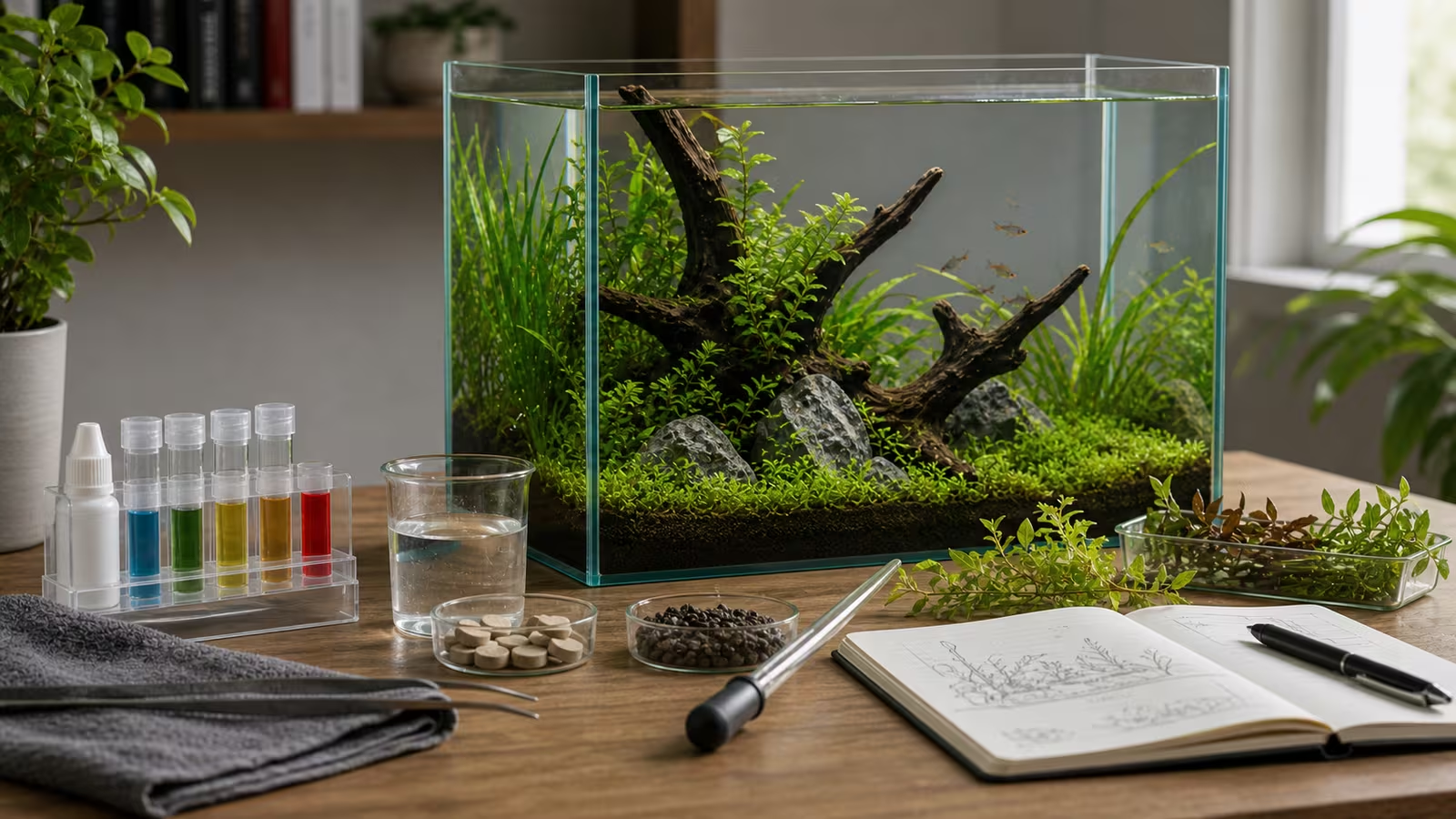
Aquatic plants need nutrients, but fertilizer is not a magic fix for every weak leaf. Light, carbon availability, roots, plant type, transition melt, source water, and livestock waste all affect growth. The beginner goal is a simple routine you can measure and observe, with changes made slowly enough to understand the result.
Heads up
Product boundary
Use fertilizer intended for aquariums and follow the label, including warnings for fish, shrimp, and snails. Do not substitute garden or houseplant fertilizer. Fertilizer does not replace cycling, filtration, or water changes.
Root Feeders And Water-Column Feeders
Submerged plants can take up nutrients through their roots and through their shoots and leaves; the balance varies with the plant and where nutrients are available. The University of Florida’s aquatic plant guide describes both routes in lake plants. Free-floating plants have no roots in the substrate, so they do not need root tabs there.
Crypts and sword plants often benefit from root nutrition, especially in plain sand or gravel. Aquarium root tabs can supply nutrients near their roots. Floaters, mosses, and epiphytes such as Anubias and Java fern have access to nutrients in the water. Stem plants can use both routes. If your tank is mostly epiphytes and floaters, root tabs may not be the first thing to try; if it is full of rooted plants in inert sand, substrate nutrition deserves attention.
A nutrient-rich substrate may already supply root nutrition, especially when new. Check its instructions before adding tabs. Keep tabs buried near the roots as directed, and note where and when you placed them. Do not bury the rhizome of Anubias or Java fern. For placement and disturbance, see Root Tabs and Root-Feeding Aquarium Plants and Substrate for Aquatic Plants .
Nutrient Basics
| Nutrient Group | Beginner Translation |
|---|---|
| Nitrogen | Plants can use nitrogen in forms including nitrate. Fish waste and food contribute nitrogen, but the amount available to plants varies. |
| Phosphorus | An essential nutrient, commonly available as phosphate. Food and waste can contribute it. |
| Potassium | Another essential macronutrient; some aquarium fertilizers supply it separately. |
| Micros | Trace elements such as iron and manganese are needed in smaller amounts. |
Calcium and magnesium also matter, and source water can supply some of both. An aquarium fertilizer labeled “all-in-one” is not necessarily identical to another: check whether it contains nitrogen, phosphorus, potassium, and trace elements, rather than assuming all are included. A nitrate test measures one form of nitrogen, not every nutrient plants need. A zero nitrate reading alone does not identify a particular deficiency.
For a concrete label comparison, Tropica’s Premium Nutrition lists no nitrogen or phosphorus, while its Specialised Nutrition includes both. These are examples, not a recommendation to buy either product: use the label on the bottle you have, and account for food, waste, source water, and substrate as well as fertilizer.
Fish waste can supply some plant nutrients, but it is not a complete, predictable fertilizer recipe. The Ornamental Aquatic Trade Association’s planted aquarium guide also stresses that plants do not eliminate the need for filtration or water changes. Avoid feeding extra just to fertilize plants.
Build A Measured Routine
- Take stock. List the plants, substrate, livestock, and any existing fertilizers. Note light hours, water-change day, and whether you add CO2. A lightly planted tank with slow growers and fish may need less supplementation than a densely planted, fast-growing tank.
- Choose a product for the need. A liquid aquarium fertilizer is a straightforward option for plants accessing the water column. Root tabs may be useful for rooted plants in inert substrate. Use both only when the plant mix and substrate call for them; check for overlapping ingredients. If plants are growing well with the nutrients already available, you may not need to add either.
- Calculate and measure. Estimate actual water volume, allowing for substrate and hardscape, rather than using the tank’s advertised capacity. For a rectangular tank, inside length × width × filled water depth in centimeters, divided by 1,000, gives liters before subtracting the volume occupied by substrate and hardscape. Follow the product’s dose and frequency for that estimated water volume. For example, if a label specifies 5 mL per 50 L and the tank holds about 30 L of water, the proportional dose is 3 mL. This is an arithmetic example, not a universal recipe. Use a graduated syringe or measuring device and record the amount.
- Keep the rest steady. Continue normal conditioned water changes and follow the product’s instructions about timing or replacement doses. A regular dose based on the whole tank and a dose specified for replacement water are different instructions; do not automatically add both after a water change. Record the date, dose, water changed, plant growth, and any changes to light, CO2, feeding, or stocking. Observe over two to four weeks before making a routine adjustment, unless livestock or water-quality problems require earlier action.
For nitrate trends, test the aquarium and source water with the same kit, following its instructions. Record when you sampled relative to dosing and water changes, so later readings are comparable. Check whether the result is reported as nitrate (NO3) or nitrate-nitrogen (NO3-N) before comparing numbers. A reading reflects the water at that moment, not everything plants have already absorbed or the nutrients held in the substrate. Test ammonia and nitrite when cycling or if livestock show signs of trouble; nitrate is not a substitute for those checks. See Water Testing for Aquascapes .
If you accidentally add too much, stop dosing and check the product instructions. A partial water change with conditioned, temperature-matched water can dilute material in the water column; it does not reliably remove buried tabs. If animals act abnormally, test water promptly and seek qualified aquarium or veterinary advice, giving them the product name, amount, and estimated tank volume. See Water Change Rhythm for Planted Tanks .
Read Trends, Not One Leaf
One yellowing old leaf does not prove a specific deficiency. New growth, whole-plant patterns, root condition, recent moves, light, and algae all provide context. Plants grown above water may shed old leaves while adapting underwater; slow growers may take weeks to show a response. Existing damaged leaves may not recover, so compare new leaves and take dated photos. Plant Melt and Recovery After Planting helps distinguish transition from a longer-running problem.
If growth remains poor, check the timer, plant placement, substrate, and recent changes before increasing a dose. Look at the product label and test results where useful, then change one part of the routine at a time. If growth is healthy and the tank is stable, there is no need to add another bottle just because it is available.
Algae alone does not prove that fertilizer is excessive or that a particular nutrient is deficient. Light, plant growth, maintenance, and nutrient inputs all deserve a look. Remove what you can, check the light schedule, and review the routine before making a large change. Algae Prevention Basics and Light Balance for Aquatic Plants offer a starting point.
Common Mistakes
- Randomly mixing several fertilizers without checking their ingredients.
- Measuring a dose against the tank’s full advertised volume when hardscape and substrate displace water.
- Ignoring root needs in inert substrate or adding tabs without checking a nutrient-rich substrate.
- Assuming every yellow leaf or patch of algae identifies a specific nutrient problem.
- Changing fertilizer, light, CO2, and feeding together, making the result hard to interpret.
Related Fondsites Path
- Houseplant Clinic for reading plant patterns without overreacting.
- Plant Light Matcher for matching light and plant ambition.
- Algae Prevention Basics for balance.
Try This Next
Review your plant mix, substrate, and current growth. If you decide to fertilize, choose an approach, calculate the dose for your estimated water volume, and write down the dose and day. Observe new growth for two to four weeks. If you change light, CO2, plant mass, or stocking, write that down too.