Nano Tank Reality Check
Why very small planted aquariums can be beautiful but less forgiving for stocking, temperature, evaporation, oxygen, algae, and water quality.
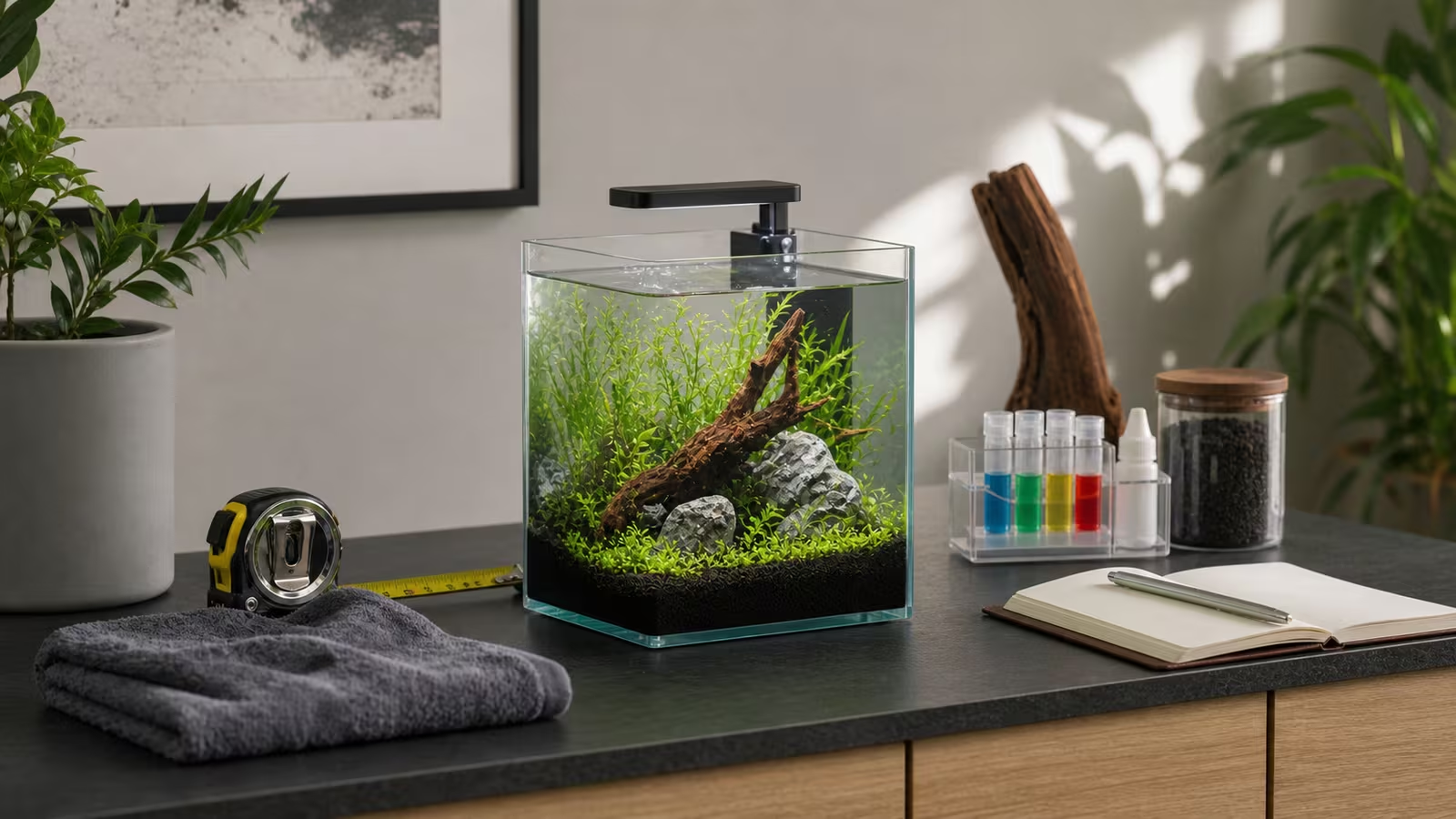
Nano tanks are appealing because they fit on desks, shelves, counters, and small cabinets. They make tiny landscapes feel possible. A small volume also leaves less margin when temperature, feeding, livestock, or maintenance is off: the same amount of waste is more concentrated in less water.
This does not mean nano tanks are bad. It means they need a conservative plan. Avoid novelty bowls, unstable furniture, crowded stocking, direct sun, and equipment shortcuts. If you want fish, choose the species and its space needs before choosing the tank; a larger aquarium may be the better starting point.
Heads up
Small does not mean low responsibility
A nano aquarium can still involve animal welfare, electrical safety, water damage, local species rules, and disease concerns. Do not use tiny tanks for animals that need more room, groups, flow, oxygen, heat, or specialist care. For sick animals or repeated losses, get qualified help.
What Makes Nano Tanks Harder
Water volume is a buffer. A small overfeed, a dead leaf, or a warm afternoon can have a greater effect in a small system. Smaller volumes can change temperature more quickly, and heater or filter problems leave little time to notice and respond. Evaporation lowers the waterline but leaves minerals behind; topping off with mineral-containing water repeatedly can concentrate them. Top-offs do not remove waste, so water changes still matter.
For scale, losing 1 liter to evaporation from a 12-liter setup removes about 8% of its water, but very little of its dissolved minerals. A lid can slow evaporation; allow for gas exchange and the equipment clearances required by the manufacturer, and continue to check the waterline.
The visual scale also tricks people. A fish can look tiny in a store cup and still need swimming length, a group, or territory that a desktop cube cannot provide. Shrimp and snails have needs too; they are not decorations or cleanup tools. Plants offer cover and take up some nutrients, but do not make an unsuitable tank suitable for animals.
Nano Tank Decision Table
| Question | Why It Matters |
|---|---|
| What is the actual water volume after substrate and hardscape? | The usable volume is less than the advertised tank capacity. |
| What is the filled weight? | Water, glass, rock, substrate, and cabinet contents all load the furniture. |
| What animals are planned? | Adult size, group needs, behavior, temperature, and swimming space decide whether the tank is suitable. |
| How often can you maintain it? | Smaller tanks need steady observation, top-offs, testing, and water changes. |
| Where will cords and buckets go? | Tiny tanks still need drip loops, dry outlets, towels, and spill planning. |
Measure Water And Weight
For a rectangular tank, multiply the internal length, width, and water depth in centimeters, then divide by 1,000 for liters. That estimates the water up to the waterline before subtracting the space occupied by substrate and hardscape. For example, 30 × 20 × 25 cm gives 15 liters before displacement. Use a marked container to measure water added after the layout is in place, subtracting any removed during setup. Record that estimate for water changes and product dosing, and revise it after major layout changes. Leave appropriate room below the rim and check the equipment’s required water level.
Each liter of water weighs about 1 kg (a US gallon about 8.3 lb). The 15-liter example therefore has up to 15 kg of water before adding glass, substrate, rocks, equipment, and anything else on the stand. Check that the furniture supports the whole load and tank base on a level surface; see Aquarium Location and Stand Safety . Do not assume a shelf is safe simply because the tank fits on it.
Check The Animals Against The Footprint
As an example, Seriously Fish’s neon tetra profile recommends a group of at least 8–10 and a tank base of at least 60 × 30 cm. The 30 × 20 cm tank above is too short and narrow for that group, even though each fish is small. Those figures are a starting point for this species, not a general stocking formula. See Schooling Fish and Space Reality for the full comparison.
Better Nano Defaults
Start with plants first. Choose hardy, small-scale plants that suit modest light, and leave access for a siphon and scissors. Keep the tank plants-only while you learn the routine, or research a suitable species before planning livestock. The beginner plant guide and moss guide offer starting points.
Plan a filter with enough circulation and surface movement for the inhabitants without forcing them to fight the current. A sponge guard can protect small shrimp from an intake, but it needs cleaning when flow slows. Keep floating plants from covering the entire surface. For animals requiring heat, choose a suitable thermostatically controlled heater, use a separate thermometer, and check it daily. Keep the heater submerged as its instructions require; unplug it before draining. Place the tank away from direct sun and heat sources. See Filter Flow and Surface Agitation and Heater, Thermometer, and Electrical Safety .
Before adding animals, complete a fishless cycle and test the water. Check that a measured ammonia dose becomes undetectable along with nitrite; a clear tank with no ammonia source does not demonstrate that it can process waste. Plants can also take up ammonia, so this check does not guarantee capacity for a fully stocked tank. Research the exact species, including adult size, group or territory needs, temperature, water chemistry, and usable tank dimensions. If a suitable group cannot fit, keeping fewer social fish does not solve the space problem. The stocking guide and shrimp guide help with those decisions.
A Routine That Fits The Tank
- Daily: Check temperature, water level, filter flow, and any animals’ behavior. Feed only what the animals need and remove uneaten food. Notice leaks or equipment changes promptly.
- Top off as needed: Restore the waterline gradually with suitable low-mineral water, such as reverse-osmosis or distilled water. Avoid pouring cold water directly onto animals. Evaporated water leaves minerals behind, so repeatedly adding mineral-rich tap water can raise their concentration. Check the source and species’ needs, and treat the water if needed; the top-off guide explains the options. This is different from preparing mineral-appropriate replacement water for a water change.
- Change water regularly: Remove water and replace it with suitable, temperature-matched water treated for chlorine or chloramine as needed. For an established freshwater community, about 25% of actual volume weekly is a starting point to adjust for the tank; 25% of 12 liters is 3 liters. See Water Change Rhythm for testing and adjustments.
- Test and record: Check ammonia, nitrite, and nitrate with an aquarium test kit, particularly during cycling and after adding livestock or changing filtration. Test ammonia and nitrite daily during cycling or while either is detectable. Record results and changes so a trend is easier to spot; the water testing guide explains what to check.
In a stocked tank, detectable ammonia or nitrite calls for prompt action: check filtration and water movement, reduce feeding, and change some water using a suitable, conditioned, temperature-matched source. Test the replacement water too; source water or treated chloramine can contribute ammonia. Retest and investigate the cause. If animals are gasping or distressed, increase aeration and seek aquatic veterinary or experienced specialist help. A long-neglected tank with very different water chemistry needs particular care; ask a specialist before making an abrupt large change.
Common Mistakes
- Calling a jar, vase, or bowl suitable housing for fish because it contains plants.
- Overstocking because the tank looks visually empty, or buying animals to solve algae.
- Trusting a desk or shelf without checking filled weight.
- Letting floaters cover the entire surface or a filter intake become clogged.
- Skipping top-off until equipment is exposed, or counting top-off as a water change.
- Assuming clear water means the tank is cycled or safe.
Related Fondsites Path
- Tank Size Reality Check for a quick planning pause.
- Stocking Caution for Small Tanks for species and space questions.
- Clear Water Lab for water-source thinking.
- Pawstead for a welfare-first view of animal care.
- Keepers Guild for home-risk and maintenance planning.
Try This Next
Before buying a nano tank, measure the footprint, estimate its filled weight, and list three stocking options: plants-only, shrimp or snails if appropriate, and fish only if the species truly fits. Write down the actual water volume once filled and plan where water changes and equipment will go. If the honest answer is “too small,” choose a larger tank or keep it as an underwater garden without fish.
Sources
- RSPCA: Choosing an Aquarium for Pet Fish — tank size, surface area, placement, filtration, and fish welfare.
- Merck Veterinary Manual: Providing a Home for Fish — aquarium weight, temperature, water preparation, and equipment.
- Merck Veterinary Manual: Management of Aquarium Fish — fishless cycling and new- and old-tank water-quality problems.
- Merck Veterinary Manual: Essential Maintenance — observation, testing, water changes, and equipment checks.
- Merck Veterinary Manual: Water Quality Tests — testing frequency during filter startup and when ammonia or nitrite is detectable.
- Seriously Fish: Neon Tetra (Paracheirodon innesi) — species-specific group size and tank footprint.