Plant Before Fish Plan
Sequence a planted aquarium so hardscape, plants, cycling, water testing, and maintenance habits are stable before adding fish or shrimp.
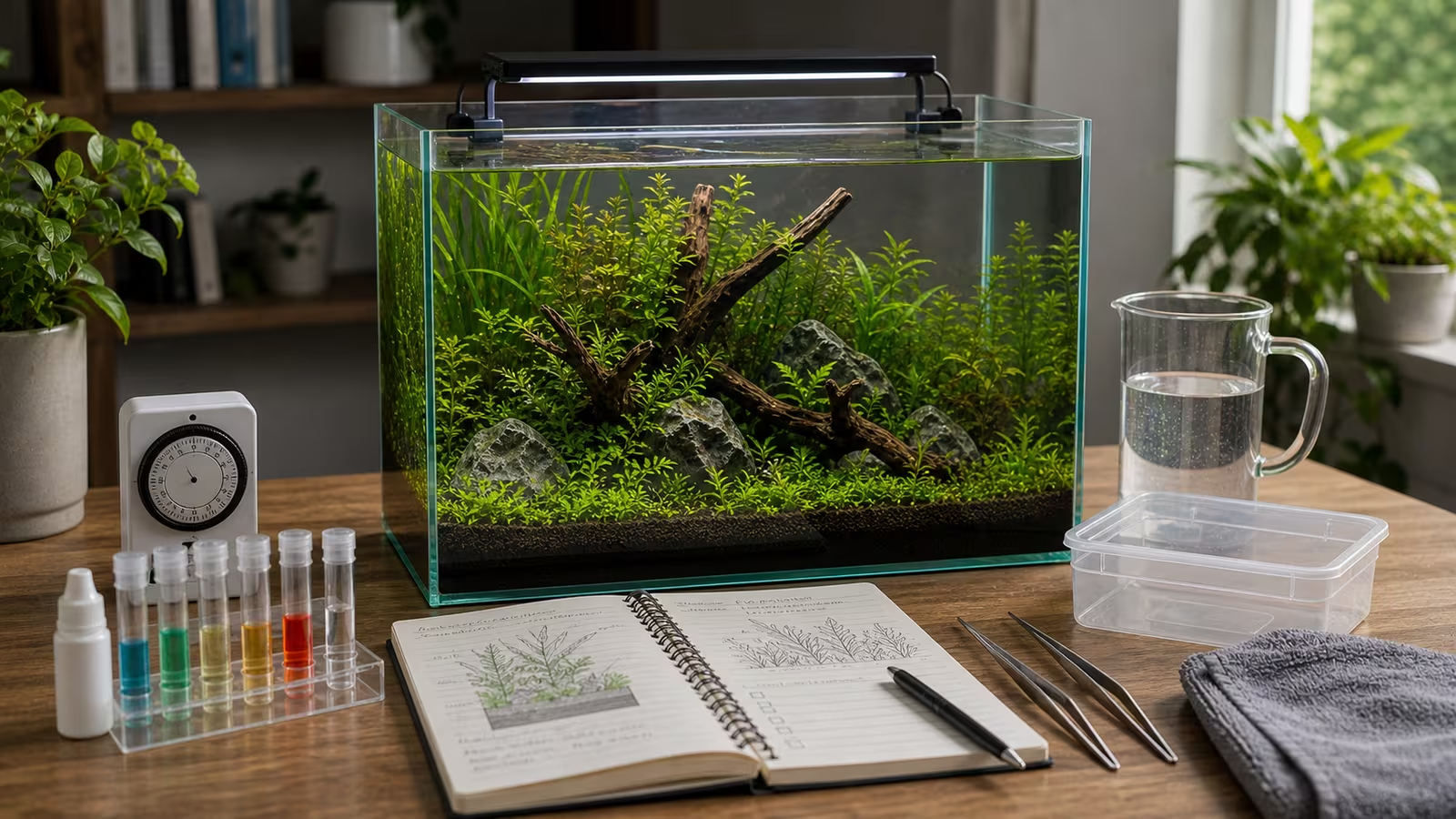
Adding plants before fish gives you time to solve layout and water problems without animals paying the price. You can adjust hardscape, plant density, light, flow, fertilizer, and water-change rhythm while the tank is still a construction site.
Waiting is not empty time. Roots can settle, the biological filter can establish, plants can reveal which leaves will melt, and your maintenance routine can become real. The goal is a tank that can handle an initial animal load, not a tank that has simply been running for a particular number of days.
Heads up
Stocking boundary
Do not add fish, shrimp, or snails to an uncycled or unstable aquarium. Test water, confirm the nitrogen cycle, research species needs, and introduce livestock gradually from responsible sources.
A Gentle Setup Sequence
- Prepare the tank. Research the intended animals’ adult size, group needs, temperature, and water chemistry before choosing the tank and plants. Choose a level, suitable stand and location; leak-check the tank; then arrange stable hardscape and substrate. Make sure you can reach the filter, glass, and spaces where debris may collect.
- Inspect and plant. Remove packaging and obviously decaying leaves. Group compatible plants with room to grow and leave access for maintenance. Plant rooted species appropriately; attach Anubias and Java fern with their rhizomes exposed. The plant inspection guide covers hitchhikers, and planting density helps with spacing.
- Fill and start equipment. Fill gently to avoid uprooting plants. Treat tap water for chlorine or chloramine according to the conditioner instructions, start the filter and any needed heater, and set a consistent, moderate light schedule. Put the light on a timer, but keep the filter and heater powered continuously. Check flow, temperature, and leaks. See Dechlorinator and Source Water and Photoperiod and Timer Setup .
- Cycle without animals. Supply a measured ammonia source and test the water as the filter establishes. Remove decaying plant material, keep the filter running with surface movement, and practice partial water changes with conditioned water.
- Stock only when ready. Confirm the tank can process an ammonia input, check that water and temperature suit the intended species, and make a quarantine and acclimation plan. Add a modest first group appropriate to the species, then monitor before adding more.
Feed The Cycle, Then Test Its Response
Beneficial microbes need an ammonia source. An empty tank with zero ammonia and nitrite may simply have nothing to process. Have tests for ammonia, nitrite, nitrate, and pH ready. Test the source water and the filled tank first: some substrates or source water can already contribute ammonia. Account for that reading before adding an aquarium fishless-cycling ammonia product, and follow its dosing and testing instructions for the actual water volume after substrate and hardscape displacement. Do not use scented or soapy household ammonia. Keep a dated log of the amount added and ammonia, nitrite, and nitrate readings. Follow the test kit instructions, including its timing and units; do not add repeated full doses without checking the readings.
Ammonia and then nitrite commonly rise and fall as the filter develops. Plants also take up nitrogen, so a planted tank may not show a textbook spike or a steadily rising nitrate reading. Nitrate alone does not prove readiness. When ammonia and nitrite are undetectable, add a measured dose according to the cycling product, mix, and record the time and starting ammonia reading. If the reading is not detectable, the check has not demonstrated a response. Without adding more ammonia, test both ammonia and nitrite about 24 hours later; both should be undetectable. Repeat the check to confirm the response. Undetectable means below the kit’s detection limit, not necessarily absolute zero.
This checks the combined planted system’s response; it does not measure the filter alone or guarantee capacity for a full tank of animals. A very small detectable dose only demonstrates a response to that dose, and removing a large amount of plant growth or filter media can change the system’s capacity. The Ornamental Aquatic Trade Association’s planted aquarium guide explains fishless cycling and gradual stocking; Zealandia’s fish translocation guide describes an overnight dose-and-test check for a quarantine aquarium, a different setting from a planted display.
Before animals arrive, stop dosing ammonia and make a partial water change if needed to bring nitrate and other water conditions into a suitable range for the chosen species. Test again. If ammonia or nitrite is detectable, wait and continue the cycle. Do not rely on clear water, a bottle of bacteria, or a date on the calendar as proof. The Merck Veterinary Manual notes that a tropical aquarium biofilter can take up to eight weeks to establish; individual tanks vary.
If readings remain high or stop changing, check filter flow, conditioning, test-kit instructions, and the dosing log before adding more ammonia. A partial water change with suitable conditioned water can dilute very high readings. Check pH and KH too if pH is falling; the cycling guide has more troubleshooting steps.
What Plants Can And Cannot Do
Healthy plants take up nutrients, provide surfaces for microbes, and show whether their light and placement suit them. Fast-growing stems and controlled floating plants can add useful plant mass early. Slow epiphytes add structure, but a tank with only a few slow plants under bright light may be harder to manage. Leave space for flow and maintenance rather than packing every gap.
Plants do not cancel the nitrogen cycle, neutralize untreated tap water, or make overstocking kind. They do not guarantee zero ammonia or nitrite. Some newly submerged leaves may melt as plants adjust; remove soft, decaying material and look for healthy new growth before replacing the whole plant. The plant melt recovery guide helps distinguish adjustment from ongoing trouble.
A Four-Week Working Calendar
Use four weeks as a planning window, not a promise that the tank will be ready by the end. Cycling can take longer, and the test results decide when to move on.
| When | Work | Decision |
|---|---|---|
| Setup day | Plant, fill with conditioned water, start equipment, and record baseline tests and temperature. Begin the chosen fishless cycle. | Fix leaks or equipment problems before proceeding. |
| First week | Test ammonia and nitrite and check equipment daily; remove decaying leaves. Practice a partial water change and record it. | Adjust obvious flow or planting problems while access is easy. |
| Weeks two and three | Continue dosing and testing as directed; record water changes, plant growth, and any algae. Trim only where needed. | If ammonia or nitrite persists, keep cycling and do not shop for livestock yet. |
| Week four and beyond | Check the response to a measured ammonia dose, repeat the test, and assess water and temperature for the planned species. | Stock only when the readiness checks pass; otherwise continue the routine. |
A log can be as simple as date, ammonia added, ammonia, nitrite, nitrate, temperature, water changed, and plant or equipment notes. Test the source water too, so a nitrate reading from the tap is not mistaken for a change in the aquarium. Water Testing for Aquascapes explains how to use trends.
When The First Animals Arrive
Choose animals for their adult size, social needs, temperature, and water chemistry, not just the empty spaces in the layout. A small first addition does not mean separating a schooling species below its appropriate group size; choose a suitable species and group for the tank. Quarantine when possible, acclimate carefully, and avoid pouring transport water into the display.
Stop adding cycling ammonia once animals are present. Feed lightly at first and check ammonia and nitrite daily for the first week, then continue monitoring as the tank adjusts. If either becomes detectable, promptly change some water using suitable conditioned, temperature-matched water, review feeding and filtration, and retest. Test the replacement water too: ammonia or nitrite in it can limit the benefit of a change. If animals are distressed, increase aeration and seek experienced aquatic or veterinary advice promptly. Wait for stable readings before adding another group. A mature-looking aquascape still needs ongoing water changes, filter care, and observation.
Common Mistakes
- Buying fish the same day as the tank or treating a four-week calendar as a deadline.
- Assuming zero readings in an unfed tank prove it can handle waste.
- Rescaping repeatedly after livestock is already inside.
- Treating plant melt as a reason to add animals quickly.
- Using a vague “the water looks clear” test.
- Skipping quarantine or acclimation planning.
Related Fondsites Path
- Cycling a Planted Aquarium Before Animals for nitrogen-cycle basics.
- Stocking Caution for Small Tanks before choosing animals.
- Quarantine and Acclimation Basics for the arrival plan.
Try This Next
Make a four-week setup calendar with planting, testing, water changes, and observation days. Put livestock shopping after the tank has evidence, not before, and leave extra time on the calendar if the cycle needs it.