Stocking Caution for Small Tanks
Plan livestock for nano and small planted aquariums with adult size, bioload, behavior, water stability, group needs, and maintenance capacity in mind.
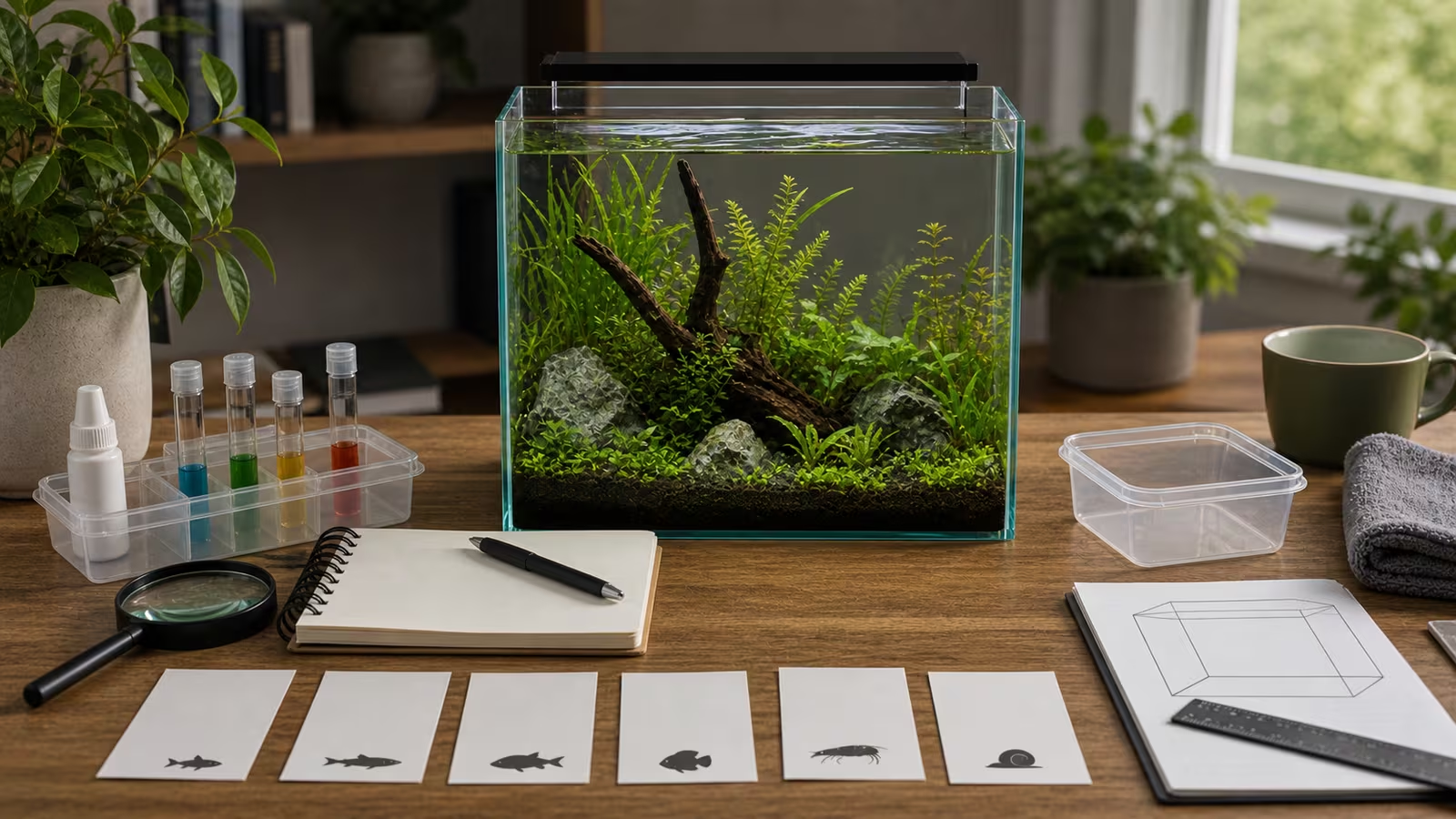
Small planted tanks are appealing because they fit desks, shelves, and apartments. They are also easy to overstock. Less water means less dilution when waste accumulates, and a small footprint offers fewer swimming options and places for animals to avoid each other.
Stocking a small tank well is an exercise in saying no. The best choice may be suitable shrimp, snails, a single suitable fish, or no animals at all while the plants grow. None is automatically appropriate for every small tank.
Heads up
Small-tank welfare boundary
Do not rely on inch-per-gallon shortcuts. Research adult size, group needs, behavior, temperature, water parameters, bioload, and swimming room. When in doubt, stock lighter or choose a larger tank.
Why Small Tanks Are Unforgiving
A pinch of extra food, a pile of decaying leaves, or a heater error can have a greater effect in a small volume. Evaporation leaves dissolved minerals behind, while topping off does not remove accumulated waste. Regular water changes still matter. The nano tank reality check covers these limits in more detail.
Plants can take up some nutrients and offer cover, but they do not replace filtration, water changes, or space. Dense growth can reduce open swimming room; rocks and wood also displace water and occupy floor area. Measure the usable length and width as well as the actual filled volume after the layout is in place.
Ask These Questions Before Buying
| Question | What It Protects |
|---|---|
| What is the adult size and lifespan? | Avoids buying juveniles that outgrow the tank or exceed your care plans. |
| Does it need a group or territory? | Respects social needs and gives animals room to avoid conflict. |
| How active is it, and where does it swim or forage? | Protects swimming and bottom-space needs, not just volume on paper. |
| Do temperature and water chemistry suit it? | Checks the actual tank and source water against the species’ needs. |
| Can filtration, oxygen, feeding, and maintenance support the whole plan? | Accounts for waste and care, including every proposed tankmate. |
| Is the tank cycled and appropriate for the animal? | Avoids exposing sensitive arrivals to an unprepared system. |
Write down the scientific name, adult size, recommended group and tank dimensions, temperature, and water needs from reliable species-specific sources. Compare them with the tank’s measurements and test results. If an appropriate group or territory does not fit, choose a different plan or a larger aquarium; keeping fewer social fish is not a way to make the species fit.
A Size Check: Neon Tetras
A neon tetra (Paracheirodon innesi) is small, but it is a group fish. Seriously Fish lists an adult standard length of about 30 mm (1.2 inches), a group of at least 8–10, and a recommended aquarium base of at least 60 × 30 cm (24 × 12 inches). A short desktop cube may be unsuitable even though one fish looks tiny in it.
These are starting points for this species, not a formula for how many fish any tank can hold. A larger group or tankmates need additional consideration for space, compatibility, and water quality. See Schooling Fish and Space Reality for more on group and swimming needs.
Better Small-Tank Thinking
Choose one main livestock idea, then design around it. A shrimp tank, a snail-focused planted tank, or a single suitable fish tank can be easier to plan than a tiny community with conflicting needs. Research the exact animal first: shrimp and snails have water, food, and temperature needs too, and reproduction may increase their numbers. A jar or bowl is not automatically suitable housing. Check local rules before acquiring or disposing of any species.
Avoid buying animals to solve algae. So-called cleanup animals produce waste and have their own care requirements. Plan feeding and a way to manage offspring or rehome animals responsibly before they arrive. A plants-only aquarium is a valid choice when the footprint or care routine does not support livestock.
Prepare, Add, and Observe
Complete a fishless cycle before adding animals, and check that the filter and water conditions suit the planned load. Clear water alone does not prove the tank is ready. Prepare a suitable quarantine space and arrange introductions with the supplier or an experienced keeper so social fish are not left in an undersized group; see Quarantine and Acclimation Basics .
After introduction, check temperature and behavior daily and test ammonia and nitrite daily while the tank adjusts to the added load. Both should read zero. If either is detectable, use appropriately conditioned, temperature-matched replacement water, reduce feeding, and keep testing. Check the filter and seek experienced or veterinary help if readings persist or animals are distressed. Consult a specialist before making abrupt large changes in a long-neglected tank with very different water conditions. The water testing guide explains how to record results and respond.
Watch for persistent chasing, hiding, rapid breathing, or difficulty feeding. These signs call for checking water, equipment, and compatibility; they do not identify a cause on their own. Continue routine water changes and remove uneaten food rather than treating a stable test result as permission to keep adding animals.
Common Mistakes
- Treating store labels as complete care guidance.
- Mixing several species in a nano tank without checking their combined needs.
- Buying juveniles that will not stay small.
- Adding animals before the tank is cycled and suitable for them.
- Choosing fish because the aquascape needs motion.
- Assuming a filter upgrade makes up for inadequate swimming space.
Related Fondsites Path
- Nano Tank Reality Check for volume and stability.
- Stocking Caution Checker for structured questions.
- Schooling Fish and Space Reality for group species.
- Shrimp Tank Basics for a species-specific invertebrate plan.
Try This Next
Make a stocking plan with one species or group as the priority. Record the tank’s usable dimensions, filled volume, test results, and the animal’s adult size, group needs, and water requirements. If you add a second animal, explain exactly why it fits the same water, space, behavior, and maintenance limits. If the plan does not fit, revise it before buying.
Sources
- RSPCA: Choosing an Aquarium for Pet Fish — fishless cycling, water testing, and aquarium care.
- Merck Veterinary Manual: Management of Aquarium Fish — biofiltration and water-quality problems in new and neglected tanks.
- Seriously Fish: Neon Tetra (Paracheirodon innesi) — adult size, group, and aquarium dimensions for the example.