Substrate for Aquatic Plants
Choose planted aquarium substrate by root needs, nutrients, cleaning, compaction, aquasoil behavior, and maintenance instead of color alone.
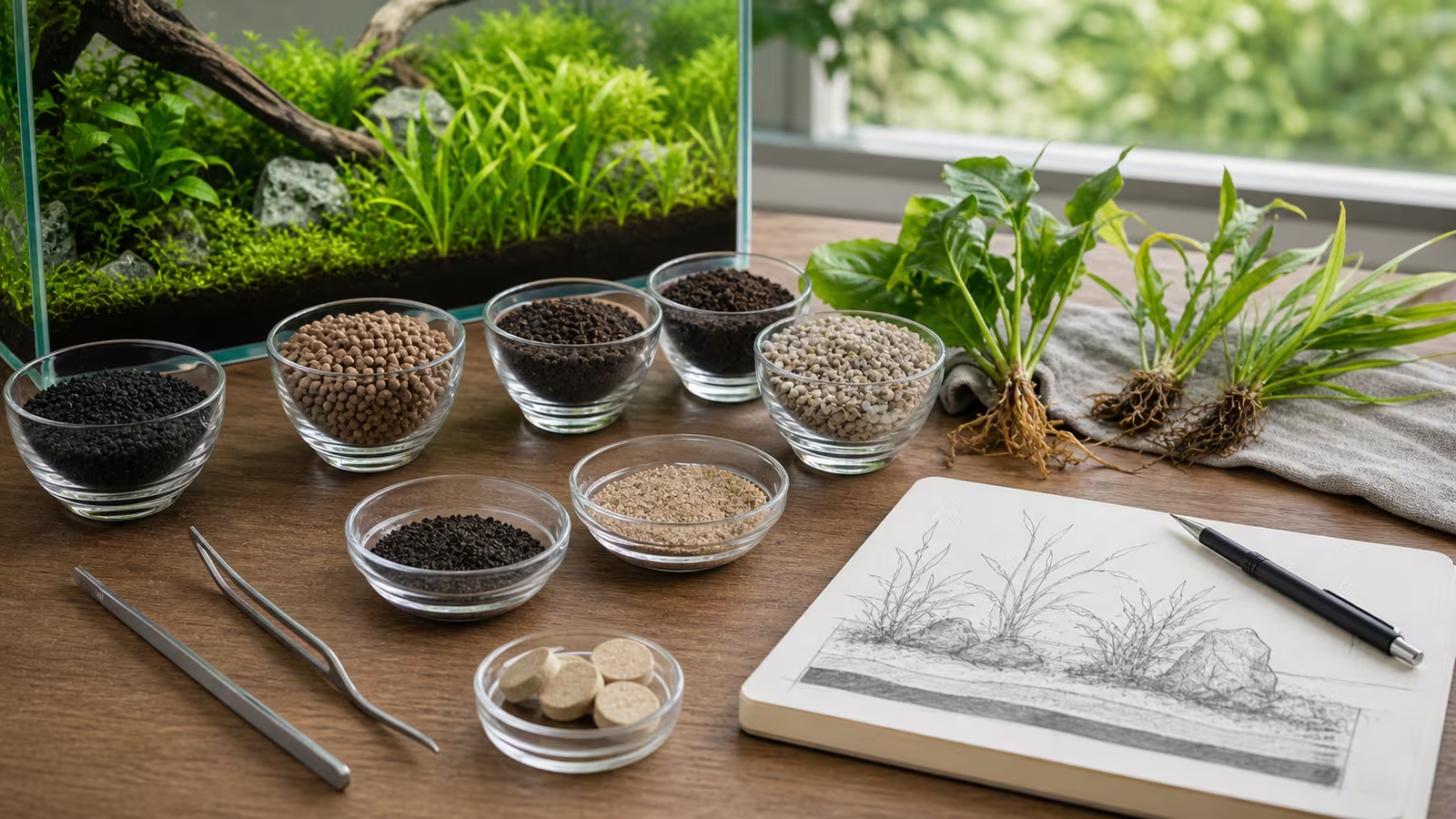
Substrate is not just the color at the bottom of the tank. It is a planting medium, debris surface, nutrient zone, and maintenance choice. The right substrate depends on whether you want rooted plants, epiphytes attached to hardscape, carpeting plants, shrimp, burrowing animals, high-energy growth, or a simple low-tech tank.
Beginners often choose substrate by appearance and only later discover that stems will not stay planted, heavy root feeders are hungry, gravel traps food, or active soil changes early water chemistry. A better choice starts with the plant list and the maintenance routine.
Heads up
Substrate and livestock boundary
Substrate can affect water chemistry, animal safety, and cleaning. Research the needs of planned livestock before choosing active soils, sharp gravel, very fine sand, or mineral-changing materials.
Main Substrate Types
| Substrate | Useful When | Watch For |
|---|---|---|
| Aquarium sand | You want a smooth-looking foreground or a surface suitable for compatible bottom-dwelling animals. | Fine grains can pack tightly; plain sand supplies little root nutrition. Light grains may be drawn into a siphon. |
| Inert aquarium gravel | You want a durable, simple planting medium. | Plain gravel does not feed roots by itself; coarse gaps can collect food and make small plants harder to anchor. |
| Planted-tank aquasoil | You want a substrate designed for rooted plants and are prepared to monitor its effects. | Products differ: some lower pH or release nutrients early. Granules can break down or cloud water when disturbed. |
| Nutrient base with a cap | You want a richer layer covered with sand or gravel. | Planting and rescapes can mix the layers and bring the base to the surface. |
“Inert” here means a material chosen not to deliberately alter water chemistry or supply significant nutrients. Check the product and the needs of your planned animals: mineral-containing materials may affect hardness or pH, and a grain size suitable for one species may be unsuitable for another. Aquarium-specific material with smooth edges is a sensible starting point; avoid assuming that any decorative sand or garden soil is safe for a stocked tank.
Match Plants To The Bottom
Rooted plants such as many crypts, swords, and some stem groups can benefit from nutrients around their roots. Submerged plants can also take up nutrients from the water; the balance depends on the plant and nutrient availability, as the University of Florida’s guide to aquatic plants explains. In plain sand or gravel, aquarium root tabs may help a root-heavy planting. Follow the label for placement and dose, and check what a nutrient-rich substrate already supplies before adding more. See Root Tabs and Root-Feeding Aquarium Plants .
Epiphytes such as Anubias and Java fern can be attached to hardscape; leave their rhizomes exposed rather than burying them. Moss can live on wood or stone. Floating plants have no roots in the substrate. These plants still need access to nutrients in the water, so a simple bottom does not eliminate the need to observe growth and consider fertilization .
If you want a low-tech beginner tank, you can keep the substrate simple and choose plants accordingly. If you want demanding carpeting plants, the substrate is only one piece; light, CO2, trimming, and patience also matter.
Plan Depth And Quantity
Choose enough depth to anchor the plants you actually intend to grow. Around 5 cm (2 inches) is a practical starting point for many rooted plantings, not a requirement for every species or an open sand path. Large swords may need more room; attached and floating plants need no planting bed. Leave plant crowns above the substrate and follow the plant’s planting instructions. A gentle slope toward the back can create depth, but allow for the extra material and support steep areas with stable hardscape.
For a rectangular footprint, multiply length × width × average depth in centimeters, then divide by 1,000 for approximate liters. A 60 × 30 cm tank with an average 5 cm bed needs about 9 L before allowing for hardscape displacement or an uneven slope. Measure inside the tank, subtract substantial areas occupied by hardscape, and treat the result as an estimate, not a bag count by weight: materials have different densities. Tropica’s soil calculator guidance uses the same volume calculation.
Set Up And Watch The First Weeks
Read the instructions for the exact substrate. Some sand and gravel need rinsing; some aquasoils should not be rinsed because their granules can crumble. For example, the ADA Amazonia Ver.2 instructions say not to rinse that product. Arrange stable hardscape before planting, then fill gently over a plate or similar barrier to avoid stirring the bed. The OATA planted aquarium guide describes preparation and gentle filling.
Active soils do not all behave alike. Some can lower pH, and some nutrient-rich products or supplements can release ammonium during setup. ADA’s instructions, for example, warn that its Amazonia supplement can produce ammonium and nitrite initially. Follow the product’s water-change directions, use conditioned replacement water, and test ammonia and nitrite as well as pH, KH, and GH when relevant to the substrate and planned livestock. Compare readings with your source water. Do not add fish or shrimp just because the water looks clear: complete a fishless cycling plan and check that conditions suit the species before stocking. See Water Testing for Aquascapes for a testing routine.
Maintenance Reality
Substrate affects cleaning. Bare-looking foreground sand shows debris quickly. Coarse gravel can hide uneaten food until it becomes a water-quality problem. Deep slopes can flatten over time. Fine soil can cloud water when uprooted. None of this is disqualifying, but it should be part of the plan.
Remove uneaten food and loose leaves, and hover a siphon above planted areas instead of routinely digging through roots, buried tabs, or a nutrient cap. Clean open areas as needed and control suction so sand stays behind. If a bed develops a persistent rotten smell or plants and livestock are struggling, investigate water quality and seek experienced help rather than churning the entire bed at once. Gravel Vacuuming Around Planted Substrate covers the technique.
Common Mistakes
- Choosing substrate only because it looks good in a photo.
- Vacuuming planted substrate aggressively like a bare fish tank.
- Burying rhizome plants.
- Using too little depth for rooted plants.
- Rinsing an aquasoil without checking its instructions or adding animals before the tank is ready.
- Forgetting that substrate displacement reduces actual water volume.
Related Fondsites Path
- Houseplant Clinic for root and potting-medium thinking.
- Clear Water Lab for water-chemistry caution.
- Keepers Guild for maintenance routines and tool storage.
Try This Next
List your planned plants in three groups: rooted, attached, and floating. If most plants are attached or floating, do not overbuild the substrate. If most are root feeders, plan nutrients and depth before buying the prettiest bag.