Water Change Rhythm for Planted Tanks
Choose planted aquarium water-change volume and frequency around stocking, feeding, nitrate trend, source water, tank age, and maintenance access.
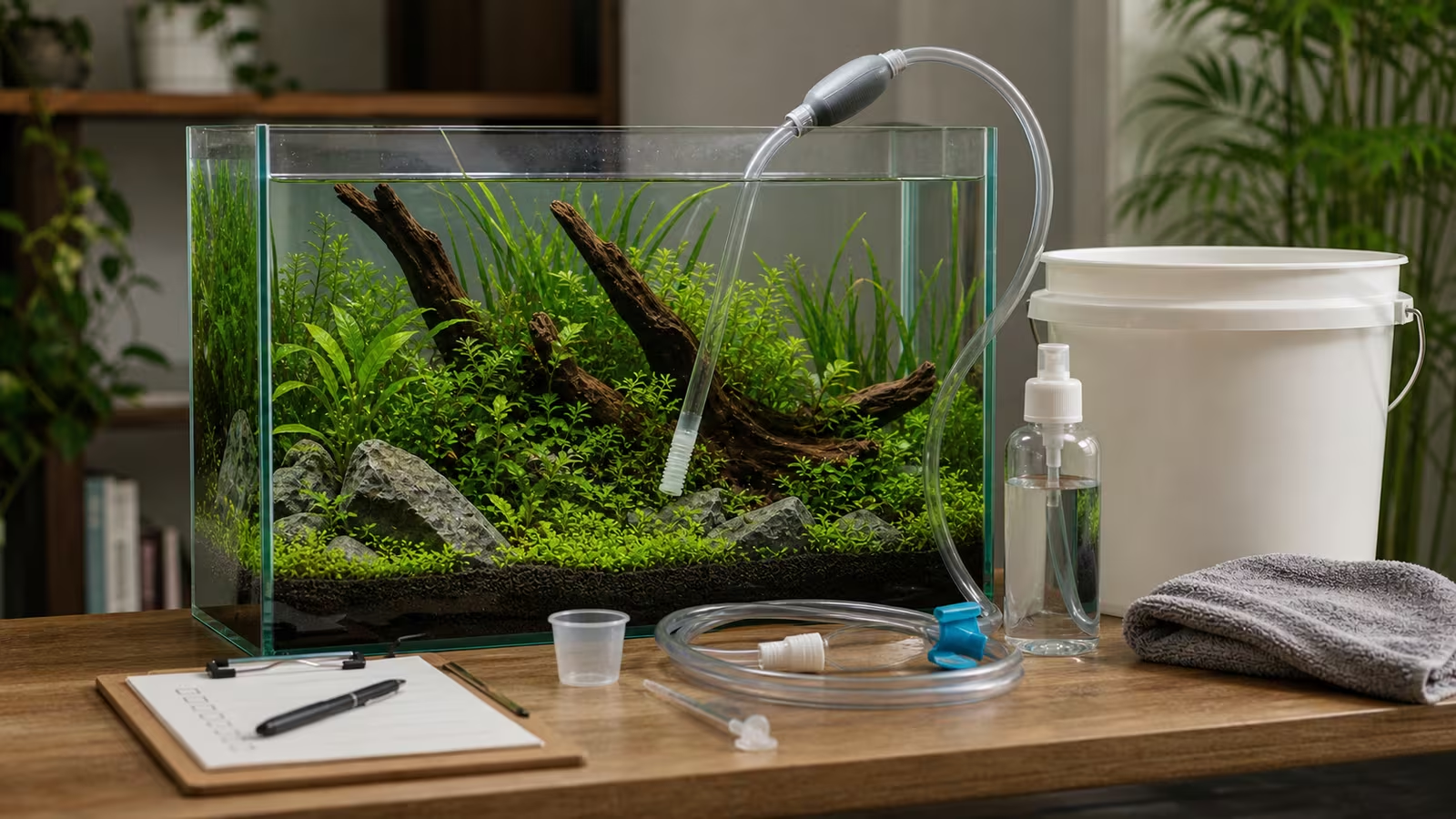
Water changes are not punishment for a dirty tank. They are a routine way to keep a living system within a range the plants and animals can handle. In a planted aquarium, the right rhythm depends on stocking, feeding, plant growth, source water, tank age, and how disruptive each session becomes.
For an established freshwater community tank, changing about 25% of the actual water volume once a week is a practical starting point, not a universal requirement. Observe and test before each change, then adjust the volume or frequency to the tank. A new tank, a heavily stocked aquarium, and a lightly stocked mature scape may need different routines.
Heads up
Water-change safety boundary
Match temperature and use replacement water with chemistry suitable for the inhabitants. Treat chlorine or chloramine as needed, control siphons, and keep water away from electrical equipment. If animals are distressed or ammonia or nitrite is detectable, act promptly rather than waiting for the next routine change. A long-neglected tank with very different source-water chemistry needs particular care; seek experienced aquatic or veterinary help.
What Water Changes Do
Removing water and replacing it with suitable water dilutes dissolved substances, including nitrate, and can reduce tannin color if desired. Siphoning also removes loose debris and gives you a regular chance to inspect plants, animals, and equipment. A change does not replace cycling, excuse overfeeding, or make an overstocked tank suitable.
Top-off is different. Replacing evaporated water restores the waterline but does not remove accumulated nitrate or other dissolved material. Repeated top-offs with mineral-containing water can concentrate minerals. See Evaporation, Top-Off, and Minerals for choosing a top-off routine.
Choose A Starting Rhythm
| Tank Situation | Sensible Starting Point |
|---|---|
| Established beginner community | Try about 25% weekly, then adjust using pre-change tests, observation, and the needs of the species kept. |
| New planted tank without animals | Follow the substrate and cycling instructions; some new soils release ammonia and need more frequent changes. Track ammonia and nitrite rather than assuming clear water means the tank is ready. |
| Shrimp nano tank | Use gentle, consistent changes with well-matched replacement water. Check the needs of the shrimp and avoid abrupt changes in temperature or mineral content. |
| High plant mass, light stocking | Start with a regular routine and test trends before extending the interval. Low nitrate alone does not establish that every other condition is safe. |
| Problem tank | Test promptly, address the immediate water-quality problem, and investigate its cause rather than relying on the usual schedule. |
Use the water actually in the tank, not just the aquarium’s advertised capacity: substrate and rocks displace water, and the tank is not filled to the rim. For example, if the tank holds about 40 liters of water, 25% is about 10 liters. A marked bucket makes the amount repeatable; the Water Change Planner can help with the arithmetic.
Estimate that volume from the water added when setting up, or measure the tank’s internal length, width, and water depth. For a rectangular tank, multiply those measurements in centimeters and divide by 1,000 to get liters, then allow for displacement by the substrate and hardscape. Mark the normal waterline and use a measured bucket to find the lower level for your chosen change. A drop in water level alone is only an estimate because substrate and hardscape occupy space below the waterline. If the tank has lost water to evaporation, restore the normal waterline with suitable top-off water before using the marks.
Use Tests To Adjust
For the first four weeks, test nitrate just before the weekly change, at roughly the same point in the routine. Record the result and units, the amount changed, feeding, animal behavior, and significant plant or equipment changes. Test prepared replacement water too: nitrate in it affects how much a change can lower the tank reading. Follow the kit instructions and compare readings on the same scale. Nitrate as NO3 and nitrate-nitrogen as NO3-N are reported as different numbers: 10 mg/L NO3-N is approximately 44 mg/L NO3. Check the label before comparing a kit result with a water report or another kit.
If pre-change nitrate keeps rising, review feeding, stocking, plant growth, fertilizer dosing, and source water; increase change frequency or volume as appropriate and check the trend again. Choose a nitrate goal appropriate to the animals rather than assuming one number fits all tanks. Low nitrate is not proof that the cycle is complete or that other dissolved substances are under control. Do not wait four weeks to respond to sick animals or a concerning test. Water Testing for Aquascapes explains how to interpret the readings.
The source-water reading sets a limit on what a change can accomplish. For example, if tank water measures 40 mg/L nitrate and prepared replacement water measures 10 mg/L on the same scale, a 25% change should bring the mixed water to roughly 32.5 mg/L. This is a dilution estimate, not a target or a guarantee: test uncertainty and nitrate produced or taken up afterward affect the next reading. If replacement water has as much nitrate as the tank, that change will not lower it; if it has more, the reading can rise. Investigate a suitable alternative source instead of simply changing more water. Check its temperature and chemistry and prepare it for the inhabitants before using it; a conditioner alone does not make unsuitable source water suitable.
When readings and livestock remain stable over several weeks, keep the routine or cautiously adjust one variable at a time and continue the log. If a larger single change is difficult to match or handle, a more frequent smaller change may be practical. Two 25% changes with thorough mixing remove about 44% of the original water, not 50%, because the second change also removes some replacement water. This arithmetic does not account for waste produced or nutrients taken up between changes. Both approaches still need water suited to the inhabitants.
If you miss a routine change, observe the animals and test before deciding what to do. In an otherwise stable tank with suitable replacement water, resume the usual schedule; there is no need to double the next change just to make up a missed date. If readings are concerning or the tank has been neglected for a long time, use the problem-tank guidance below rather than assuming the usual amount is enough.
In a stocked tank, detectable ammonia or nitrite needs prompt attention. Check the filter and water movement, reduce feeding, and change some water with conditioned, temperature-matched water from a suitable source. Test the replacement water and retest the tank after the change; repeat as needed while investigating the cause. Monitor ammonia and nitrite daily while a disrupted or new biofilter recovers. If animals are gasping, lethargic, or dying, increase aeration and seek aquatic veterinary or experienced specialist help promptly. For a long-neglected tank with very low pH or a large difference between tank and source water, a sudden large change can be dangerous: as pH rises, more ammonia can shift into its more toxic form. Get expert help promptly with a gradual correction. The cycling guide covers biofilter development and monitoring.
Maintenance Flow
- Observe and prepare. Check animals, temperature, filter flow, and leaks. Take planned test samples before the change. Set out aquarium-only buckets, a siphon, towels, and a thermometer.
- Prepare replacement water. Match temperature and check that the water’s chemistry suits the inhabitants. If the supply contains chlorine or chloramine, use a conditioner appropriate for the disinfectant, following its label for the volume treated and any contact time. See Dechlorinator and Source Water Basics .
- Make equipment safe. With dry hands, unplug aquarium equipment before working in the water. Unplug the heater before draining and follow its instructions for cooling and restart; never operate it out of water. Keep the interruption to filtration and water movement short.
- Siphon the planned amount. Watch the hose and bucket throughout, and check for accidentally siphoned animals. Hover above debris around roots and active soil instead of churning the substrate. Clean another area next time if needed; the gravel vacuum guide explains the technique.
- Refill and check. Add prepared water slowly, without uprooting plants. Restore equipment once water level and any waiting periods meet its instructions. Confirm filter flow, temperature, and absence of leaks; wipe spills and record what changed.
Common Mistakes
- Skipping changes until the tank looks bad, or using a clear appearance as proof of good water quality.
- Changing water without considering temperature, disinfectant, and differences in chemistry.
- Leaving a siphon unattended or using a bucket contaminated by cleaners.
- Counting evaporation top-off as a water change.
- Replacing or aggressively cleaning all filter media along with a major substrate clean; beneficial bacteria live on filter surfaces. See Filter Media Maintenance Without Losing the Cycle .
- Relying on nitrate alone or ignoring a distressed animal while waiting for the next scheduled change.
Related Fondsites Path
- Maintenance Day Checklist for the full routine, including filter care and equipment checks.
- Water Change Planner for sizing a routine.
- Clear Water Lab for source-water thinking.
- Keepers Guild for leak prevention and maintenance checklists.
Try This Next
Estimate the water volume, mark a bucket for your starting amount, and log four weekly pre-change nitrate readings alongside animal behavior and maintenance notes. Adjust the routine from the trend and the inhabitants’ needs, and respond immediately to signs of trouble.
Sources
- Merck Veterinary Manual: Essential Maintenance outlines regular water changes, observation, testing, and equipment checks; the amount depends on stocking.
- Merck Veterinary Manual: Management of Aquarium Fish discusses new- and old-tank water-quality problems and the care needed when correcting a neglected tank.
- University of Florida IFAS: Ammonia in Aquatic Systems explains ammonia, source-water considerations, and water changes as part of a response.
- Merck Veterinary Manual: Environmental Diseases of Aquatic Animals discusses ammonia and nitrite management, nitrate reporting units, and the risk of raising pH in severely affected water.
- Merck Veterinary Manual: Providing a Home for Fish describes source-water treatment and the role of beneficial bacteria.