Water Testing for Aquascapes
Use aquarium water tests to track cycling, nitrate trends, pH, hardness, source water, plant response, and livestock safety without chasing perfect numbers.
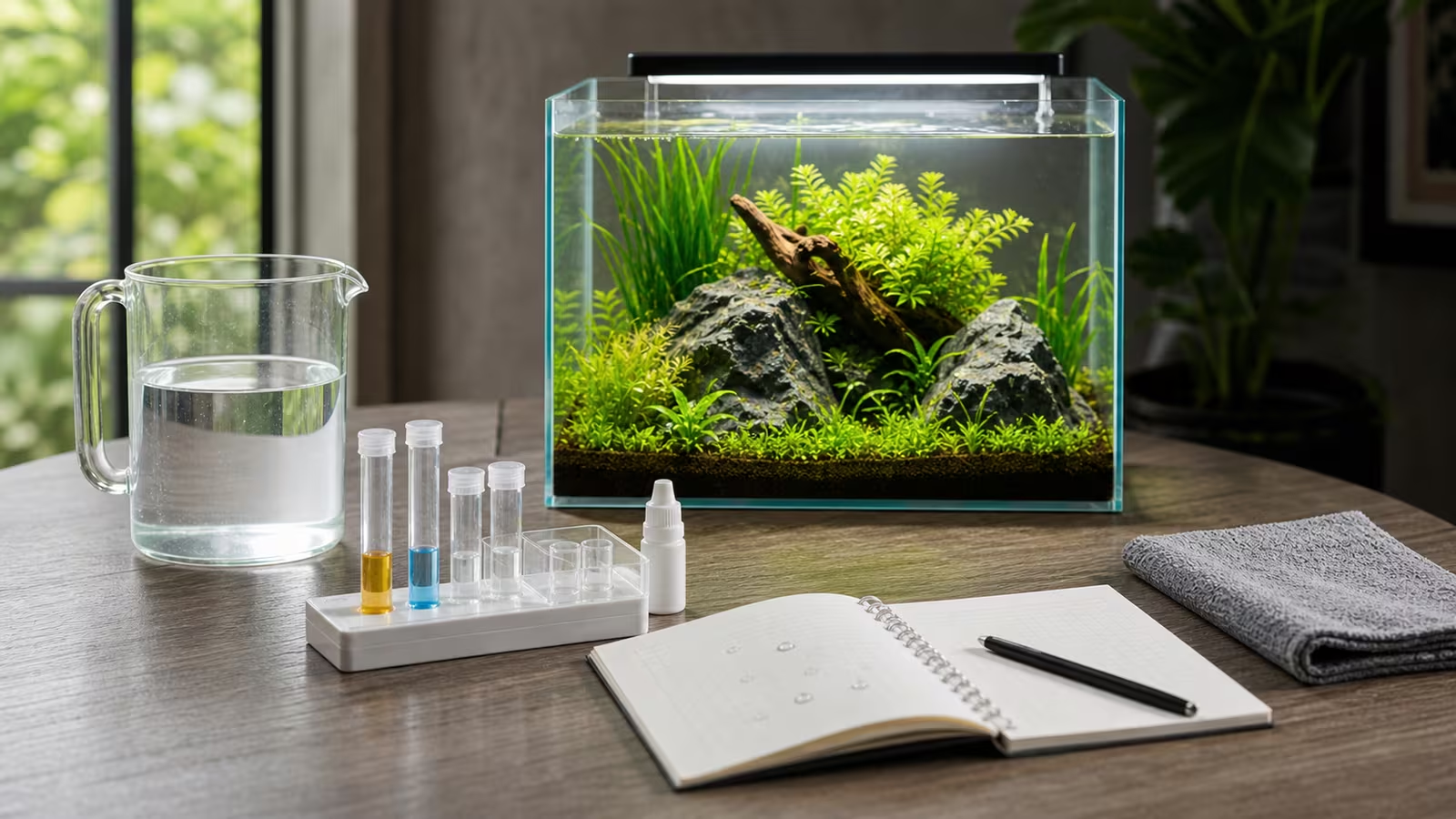
Water testing is not about collecting numbers for their own sake. It is about deciding what the tank needs next. During cycling, ammonia and nitrite can tell you whether animals should wait. Over time, nitrate trends can help you adjust water changes, feeding, plant growth, and stocking. Hardness and pH help you choose livestock that fits your source water instead of forcing water into a constant fight.
The best test result is one you can connect to an action. If a number makes you anxious but does not change your plan, you may need more context rather than another bottle.
Heads up
Testing boundary
Home aquarium tests can guide routine decisions, but they are not veterinary diagnosis, certified lab analysis, or proof that water is safe for every species. If animals are sick or dying, seek qualified help and preserve a clear timeline of tests and changes.
What Beginners Usually Need
| Test | Why It Helps |
|---|---|
| Ammonia | Critical during cycling and after disruptions; aim for an undetectable reading in a stocked tank. |
| Nitrite | Critical during cycling and after disruptions; aim for an undetectable reading in a stocked tank. |
| Nitrate | Useful for trend, stocking, feeding, plants, and water-change rhythm. |
| pH | Useful when matching livestock and tracking stability. |
| GH/KH | Useful for shrimp, snails, pH stability, and source-water fit. |
| Temperature | Check with a thermometer for animal welfare and heater problems. |
Choose a freshwater kit that covers ammonia, nitrite, nitrate, and pH; GH and KH may be sold separately. Check the range and units on each chart. Liquid kits and strips have different procedures and resolution, and not every multi-test strip includes ammonia. A thermometer is a separate tool.
Most aquarium ammonia tests report total ammonia and ammonium, not just the more toxic un-ionized ammonia. Its proportion increases as pH and temperature rise, so a total-ammonia reading needs that context; do not assume a detectable result is harmless. The University of Florida’s ammonia guide explains the distinction and why ammonia needs prompt attention.
When To Test
| Situation | Practical Starting Routine |
|---|---|
| Before setup | Test source water for ammonia, nitrite, nitrate, pH, GH, and KH so you can compare it with the tank and choose suitable livestock. |
| Fishless cycling | Test ammonia and nitrite regularly as directed by the cycling method, and record nitrate. A zero reading in an unfed tank does not prove it can process waste. Use the cycling guide for the response check before stocking. |
| Established tank | Check temperature daily. Test nitrate weekly at first, ideally before the usual water change; test pH, GH, and KH periodically and when source water or the setup changes. Adjust frequency as your records reveal a stable pattern. |
| After adding animals or a filter disruption | Test ammonia and nitrite frequently for several days, then continue until readings are stable. Test immediately if animals behave abnormally or a problem is suspected. |
These are starting habits, not guarantees. More frequent checks may be needed for sensitive species, variable source water, or an unsettled aquarium. Record the timing of a water change so a diluted result is not mistaken for the usual pre-change level.
If Ammonia Or Nitrite Is Detectable
In a stocked aquarium, act promptly rather than waiting for the next scheduled test. Change some water with conditioned, temperature-matched water from a suitable source, check that the filter is running and water is moving, and reduce feeding while investigating. Test the replacement water too: if it contains ammonia or nitrite, a change may not lower the reading as expected. Retest after the change and continue monitoring; repeat water changes as needed while finding the cause. Avoid adding more animals.
If animals are gasping, lethargic, or dying, increase aeration and seek experienced aquatic or veterinary help promptly. Do not delay action while trying to confirm a suspicious result. Check the test procedure and expiration date, and use a fresh test or a second kit if the reading is unexpected. UF/IFAS recommends water changes in small tanks when the replacement water does not contain ammonia, alongside correcting the underlying problem. The nitrogen cycle guide explains why filter media and feeding matter.
Take A Useful Reading
Use a clean vial and follow your kit’s directions for sample volume, reagent order, shaking, waiting time, and disposal. Read the color against the supplied chart in good light at the specified time. Some nitrate reagents need vigorous shaking; API’s nitrate kit instructions illustrate why the directions for the particular kit matter. Keep reagents capped, in date, and away from children and animals.
Record the value or color range and its units, rather than a false precision between chart colors. Check whether nitrate is reported as nitrate (NO3) or nitrate-nitrogen (NO3-N) before comparing results: the numbers use different scales. If a sample is outside the kit’s range, follow its instructions or use a suitable higher-range test instead of guessing.
Trends Beat Isolated Numbers
A single nitrate reading is less useful than nitrate after a week of normal feeding. A pH reading is less useful without knowing whether it swings between morning and evening or water-change day and the day before maintenance. A stable tank can have numbers that are not identical to someone else’s tank.
Write down the date, time, test results, water-change amount, livestock notes, and recent changes. This turns testing into evidence instead of guesswork.
For example, compare nitrate just before each weekly change with the source-water reading. A rising tank trend can prompt a review of feeding, stocking, plant growth, and change volume; nitrate from tap water or fertilizer also affects the result. A low nitrate reading alone does not prove the cycle is complete or that all plant nutrients are adequate. Choose a nitrate goal for the species kept rather than borrowing a universal number.
Do Not Chase Perfect Water
Many beginners see a pH number and immediately reach for bottled adjusters. That can create swings worse than the original number. A better first question is whether the planned animals fit the source water. Stable appropriate water is usually kinder than constantly adjusted water.
GH describes general hardness, largely associated with calcium and magnesium; KH is a practical measure of carbonate buffering. Compare tank and source readings before making a change, especially with active substrate, mineral-bearing rocks, or CO2 injection. Measure pH at comparable times, since CO2 and plant activity can affect its daily pattern. The KH, GH, and pH guide explains those relationships. Stability still has limits: a consistently unsuitable value calls for a better water plan or different livestock.
Common Mistakes
- Testing only after something looks wrong.
- Using expired or contaminated tests.
- Reading strips or color charts in poor light.
- Chasing pH without understanding KH and source water.
- Forgetting to test before and after major changes.
Related Fondsites Path
- Clear Water Lab for source-water evidence habits.
- Dechlorinator and Source Water Basics for preparing replacement water.
- Water Change Planner for turning results into routine.
- Pawstead for animal-observation and professional-help boundaries.
Try This Next
Create a five-line log template: date, ammonia/nitrite/nitrate, pH/hardness if relevant, water changed, and animal or plant notes. Use the same format for a month before making complicated conclusions.