In the Beginning, There Was Grain
Picture this: Mesopotamia, roughly 5,000 years ago. A woman—for it was almost certainly a woman, the original brewsters—discovers that her stored grain has gotten wet after an unexpected rain. Days pass. Something strange begins to happen. The mixture bubbles, transforms, and when she finally tastes the murky liquid? She experiences humanity’s first sip of beer.
We’ll never know her name, but her accidental discovery would shape civilizations, build pyramids, inspire poetry, and eventually launch a thousand craft breweries in strip malls across America.
The Cradle of Fermentation (3500 BCE - 500 CE)
When Beer Was Prayer
In ancient Sumer, beer wasn’t just a beverage—it was divine. The Sumerians composed the Hymn to Ninkasi, a religious poem that doubled as a brewing recipe, honoring the goddess of beer. They prayed to her, brewed for her, and offered the fruits of their labor on temple altars.
This wasn’t the crystal-clear lager you might imagine. Sumerian beer was thick, almost porridge-like, drunk through straws to filter out the floating grain. Flavored with dates and honey, it was nourishment, medicine, and wages all in one. Workers received daily beer rations; kings sealed treaties over shared cups.
The Pyramids Were Built on Beer
Cross the desert to Egypt, and beer takes on even greater importance. The workers who hauled limestone blocks to construct the great pyramids of Giza weren’t slaves—they were skilled laborers, and they were paid in beer. Four to five liters daily, in fact. When archaeologists excavated ancient worker villages, they found brewery remains still fragrant with residue.
Egyptian beer sustained the living and accompanied the dead. Pharaohs were buried with beer for the afterlife, just in case eternity got a bit dry.
Europe’s First Brews
Meanwhile, in the forested lands of Northern Europe, Celtic, Germanic, and Norse tribes developed their own brewing traditions. Without access to hops—that would come later—they flavored their ales with gruit, a mysterious blend of wild herbs and spices that varied by region and brewer. Yarrow, mugwort, and heather mingled in iron cauldrons hung over fire pits.
Beer became intertwined with mythology. The Norse believed Odin himself discovered the mead of poetry, and warriors drank to the gods before battle. Every feast, every celebration, every solemn ritual called for the shared cup.
The Monks Who Saved Beer (500 - 1500 CE)
Monasteries: Europe’s First Craft Breweries
When the Roman Empire crumbled and Europe descended into the so-called Dark Ages, the light of brewing knowledge was kept alive in an unexpected place: monasteries.
Monks needed beer. Their strict fasting rules allowed “liquid bread” when solid food was forbidden, and travelers expecting hospitality required refreshment. More practically, beer was safer than water—the brewing process killed the pathogens that medieval wells harbored.
So the brothers brewed. And because they were meticulous record-keepers, they improved. Batch by batch, century by century, European monasteries refined what had been folk art into something approaching science. The Trappist monasteries of Belgium, some still operating today, trace their traditions back over a thousand years.
The Hop Revolution
Perhaps the monks’ most significant contribution was popularizing hops. Before the 9th century, gruit ruled European brewing, but hops offered something revolutionary: preservation. A hopped beer could travel, could age, could be taxed differently than the guild-controlled gruit.
By 1516, the change was complete enough for Duke Wilhelm IV of Bavaria to sign the Reinheitsgebot—the German Beer Purity Law—mandating that beer contain only water, barley, and hops. (Yeast was added to the list later, once science understood its role.) This law, still technically in effect for German brewers today, marked the beginning of modern beer.
The Rise of Brewing Guilds
As cities grew, so did the demand for consistent, quality beer. Brewing guilds formed across Europe—London, Munich, Prague, Brussels—each codifying standards and protecting trade secrets. Different cities developed signature styles: the porters of London, the pilsners of Bohemia, the lambics of Brussels.
The tavern became Europe’s living room, a place where news was shared, deals were struck, and revolutions were planned.
Science Meets Brewing (1700s - 1800s)
The Discoveries That Changed Everything
For millennia, brewers worked in mystery. They knew that certain conditions produced better beer, but they didn’t understand why. That changed in 1857, when a French chemist named Louis Pasteur peered through his microscope and discovered yeast.
Suddenly, everything made sense. The bubbling during fermentation wasn’t magic—it was tiny organisms consuming sugar and producing alcohol and carbon dioxide. Pasteur’s discovery led to pasteurization (killing unwanted bacteria with heat), isolated yeast strains, and consistent fermentation.
Meanwhile, in the Bohemian city of Pilsen, a Bavarian brewer named Josef Groll created something revolutionary: the first pilsner. Using new pale malts, the region’s remarkably soft water, and Saaz hops, Groll produced a golden, crystal-clear lager unlike anything the world had seen. It would become the most imitated beer style in history.
Machines Enter the Brewery
The Industrial Revolution transformed brewing from craft to industry. Steam power enabled massive batch sizes. Refrigeration—arriving in the 1870s—allowed year-round production of temperature-sensitive lagers. The thermometer and hydrometer replaced the brewer’s thumb and intuition.
As the British Empire spread across the globe, so did pale ales—the original IPAs, hopped heavily to survive the long voyage to India. German immigrants carried lager traditions to the Americas, where the style would eventually dominate.
The American Story
Colonial Thirst and Founding Fermentations
America’s relationship with beer began with the Pilgrims, who landed at Plymouth Rock partly because their ship’s beer supply was running low. The first brewery on American soil opened in 1632, Dutch-built in what would become New York City.
Throughout colonial America, beer was a staple of daily life. The Founding Fathers weren’t just statesmen—they were brewers. George Washington maintained a recipe for small beer at Mount Vernon. Thomas Jefferson brewed at Monticello. John Adams started each morning with a tankard of cider or ale.
But American beer faced challenges. Barley was scarce in the early colonies, forcing brewers to experiment with corn, molasses, even spruce tips. The hot, humid climate of the South was inhospitable to fermentation. Regional brewing remained small-scale and inconsistent.
The Lager Invasion
Everything changed between 1840 and 1900, when millions of German immigrants arrived in America—and brought lager with them.
Names that would become synonymous with American beer emerged during this era: Yuengling (1829), Anheuser-Busch (1852), Pabst (1844), Miller (1855), Coors (1873). Their crisp, refreshing lagers were perfectly suited to the American palate and climate. With the arrival of refrigeration, these breweries industrialized, growing from regional operations into national empires.
By the turn of the 20th century, over 4,000 breweries operated across America. Beer gardens and saloons dotted every neighborhood. Immigrant traditions blended into a vibrant, diverse beer culture.
Then came the darkness.
Prohibition: The Drought (1920-1978)
The Noble Experiment
On January 17, 1920, the 18th Amendment went into effect, and America went dry. The “Noble Experiment,” as its supporters called it, was supposed to cure society’s ills—poverty, domestic violence, political corruption—by eliminating alcohol.
Instead, it devastated American brewing. Over 1,500 breweries shuttered overnight. Skilled brewmasters found themselves unemployed or worse. Some breweries survived by producing “near beer” (0.5% ABV or less), malt syrup (wink, wink), or ice cream. Most simply closed forever.
Bootleggers and organized crime filled the vacuum. Speakeasies served bathtub gin and questionable beer. The brewing knowledge accumulated over generations began to fade.
The Long Hangover
When Prohibition finally ended in 1933—repealed by the 21st Amendment—only about 750 breweries reopened. They emerged into a changed landscape. The Great Depression had crushed consumer spending. Prohibition had reset American tastes to whatever was available.
In the decades that followed, consolidation accelerated. Large breweries bought smaller ones. National brands—Budweiser, Miller, Coors—leveraged advertising and distribution to dominate. Regional styles disappeared, replaced by homogenized light lagers optimized for inoffensiveness.
By 1978, fewer than 40 breweries remained in all of America, producing nearly identical products. Historians would later call this the “dark ages” of American beer.
The Craft Revolution (1978 - Present)
A Presidential Signature, A Revolution Begins
In October 1978, President Jimmy Carter signed a bill that would transform American beer: H.R. 1337, legalizing homebrewing for personal consumption.
It seems like a small thing. But for the first time since Prohibition, Americans could legally experiment with beer in their own homes. They could study forgotten styles, master forgotten techniques, and dream of something better than what the macro breweries offered.
A generation of future craft brewers was born in those garages and kitchens.
The Pioneers
Fritz Maytag had already shown what was possible. In 1965, he purchased the failing Anchor Brewing Company in San Francisco and revived traditional American styles. Sierra Nevada Brewing Company opened in 1980, its Pale Ale defining what American craft beer could be. Boston Beer Company launched Samuel Adams in 1984, bringing craft to mainstream distribution. Stone Brewing arrived in 1996, aggressive and unapologetic.
The philosophy was revolutionary for American brewing: flavor over efficiency, tradition alongside innovation, quality over quantity.
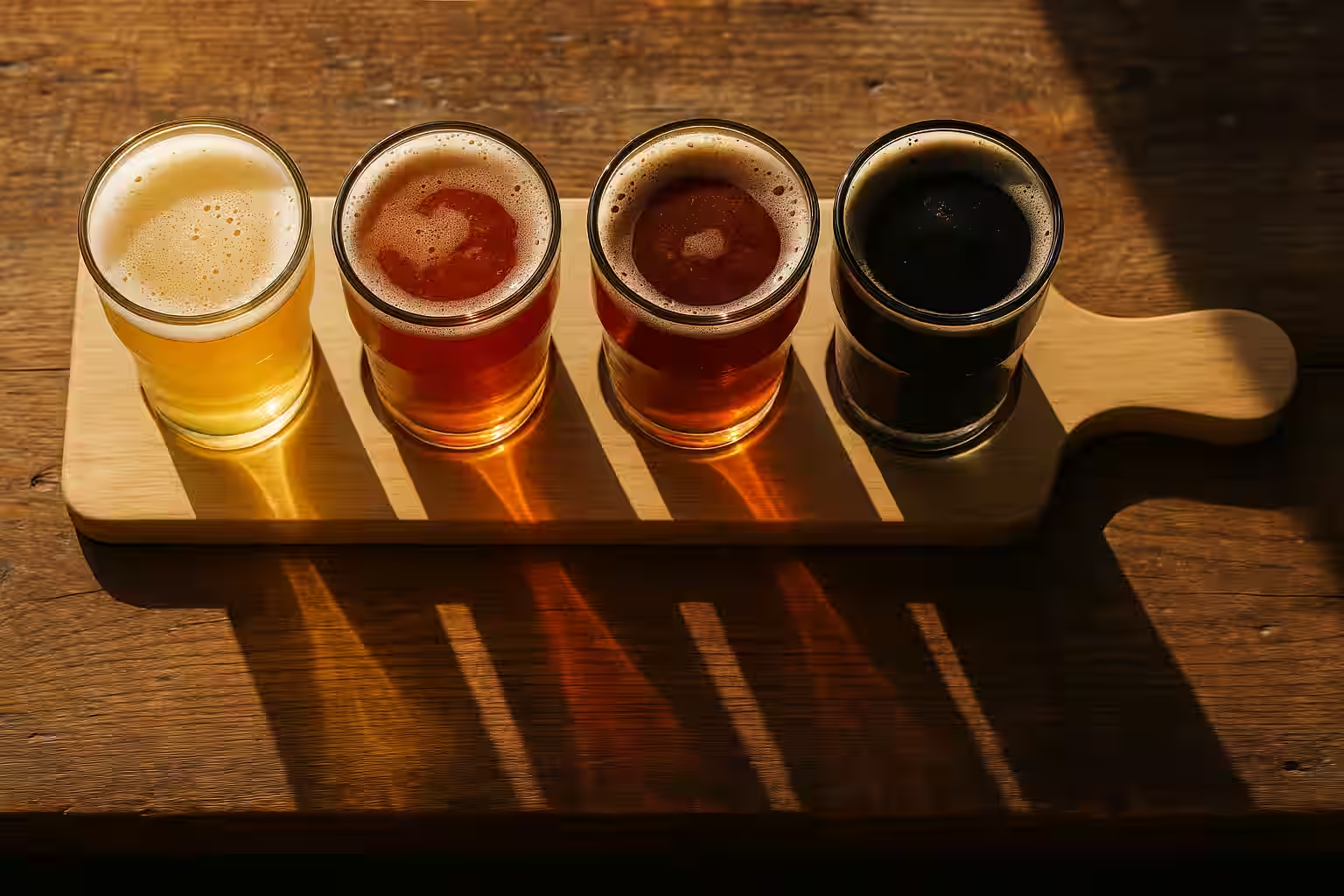
The Explosion
The numbers tell the story:
- 1980: ~40 breweries in America
- 1990: ~200
- 2000: ~1,500
- 2012: ~2,500
- 2023: Over 9,000—more than at any point in American history
Every town, it seemed, sprouted a brewpub. Every style found its champion. West Coast IPAs gave way to hazy New England IPAs. Barrel-aging programs emerged. Sour beers, once considered flawed, became coveted rarities. The old ways—farmhouse ales, wild fermentation, cask conditioning—returned alongside bold innovations.
The craft revolution spread globally. Britain rediscovered its cask ale heritage. Scandinavian brewers pushed boundaries with extreme and experimental beer. New Zealand became a hop powerhouse. Belgium, that eternal bastion of tradition, embraced innovation.
The Cascade Moment
Ask any brewer what changed the most: flavor. American hops—Cascade, Centennial, Chinook—reshaped palates. Pale ale became IPA, IPA became double, double split into West Coast resin and New England juice. Drinkers realized bitterness could be a clarion call or a whisper, depending on when you tossed hops into the kettle.
The Taproom Era
Then the law caught up. Cities loosened rules; breweries opened taprooms; locals gathered where the beer was born. Food trucks parked outside. Kids chased each other between picnic tables. Brewer and drinker closed the feedback loop over the bar top. Beer stopped being a sealed commodity and became a conversation.
A Global Chorus
Meanwhile, other countries sang their verses. Brazil’s hop-forward haze, South Africa’s indigenous grains, Japan’s precision lagers, Nigeria’s sorghum brews—every region braided its history into the modern beer story. Traditions once isolated by geography now learn from one another at the speed of collaboration brews and shared yeast cultures.
This Present Moment
Where We Are Now
We live in a golden age of beer. Never before have drinkers had access to such variety, such quality, such creativity. The neighborhood taproom has become a community gathering place. Hyperlocal ingredients tell the story of place. Sustainability and inclusivity drive industry conversations.
Yet challenges remain. Market saturation means fierce competition among those 9,000+ breweries. Big beer continues acquiring craft brands. Hard seltzer and ready-to-drink cocktails compete for attention. Rising costs squeeze already thin margins.
The Traditions That Endure
Even as innovation races forward, certain traditions anchor the beer world:
- Trappist brewing: A thousand years of monastic dedication
- Lambic fermentation: Wild yeasts and centuries-old recipe books in Brussels’ Pajottenland
- The Reinheitsgebot: Still defining German brewing after 500 years
- British cask conditioning: Real ale, served with patience
What Tomorrow Holds
The future of beer is being brewed today. Carbon-neutral breweries are emerging. AI assists in recipe development. Low and no-alcohol options achieve quality once thought impossible. Diverse voices are finally finding platforms in an industry historically lacking in representation.
Beer History FAQs
What’s the oldest evidence of beer? Traces of fermented grain residue from around 7000 BCE in China and 3500 BCE in Mesopotamia show beer’s deep roots.
Why were monks so important to brewing? Monasteries preserved recipes, embraced hops, and documented process, turning folk brewing into repeatable craft.
How did Prohibition change beer? It erased thousands of breweries and reset American tastes to light lagers; the craft movement rebuilt flavor diversity decades later.
What sparked the modern craft era? Legalized homebrewing (1978) and pioneers like Anchor, Sierra Nevada, and Boston Beer proved small breweries could thrive on flavor.
Why did IPAs get so big? American hops delivered bold citrus/pine; IPAs showcased them, evolving into double, triple, West Coast, and hazy expressions.
What’s next for beer? Sustainability, diverse ownership, low/no-alcohol quality, and cross-cultural collaborations are shaping the next chapter.
A Toast Across Time
When you raise your next pint, consider the chain of hands that lifted cups before you. The Sumerian brewster discovering fermentation by accident. The Egyptian worker refreshed after a day of pyramid building. The medieval monk perfecting his abbey’s recipe. The German immigrant bringing lager traditions to a new world. The homebrewer in their garage, dreaming of something better.
Five thousand years of human creativity, community, and culture rest in that glass. Civilizations have risen and fallen, technologies have transformed and been replaced, but the simple act of sharing beer has endured.
Welcome to the story. It’s still being written, and now you’re part of it.
Continue Your Journey
- Explore the Complete Beer Styles Guide to taste history’s diversity
- Learn Beer Tasting 101 to appreciate every sip
- Try your hand at Homebrewing and join the tradition