Most indoor air work is about comfort and particles, the visible-if-you-look world of dust, smoke, pollen, and odor. This guide is about the other category: the hazards a purifier cannot touch and a glowing air-quality display can quietly hide. Carbon monoxide and radon are the two that matter most in a home, and the single most useful thing to understand about them is that they are handled by dedicated alarms and official tests, not by air cleaners or the friendly number on a consumer monitor.
The confusion is understandable, because these words all sound like they belong together. Carbon dioxide, carbon monoxide, radon, and the fine-particle reading on a purifier are four different things measured in four different ways for four different reasons. Blurring them is where real risk creeps in, usually in the direction of false comfort: a home with a reassuring particle screen can still have a carbon monoxide problem or an elevated radon level, because those sensors were never watching for either.
Four Words That Are Not Interchangeable
Carbon dioxide is the gas people exhale. Indoors it is mostly a stuffiness and ventilation signal: when it climbs, the room is not getting enough fresh outdoor air, and the fix is usually more ventilation. It is not, at normal indoor levels, an acute poison, and a rising carbon dioxide reading is a cue to open things up, not an emergency.
Carbon monoxide is a different molecule entirely, and it is dangerous. It comes from incomplete combustion, so it is produced by fuel-burning things: a furnace or water heater that is malfunctioning, a gas range, a fireplace with a blocked flue, a car left running in an attached garage, a generator used too close to the home. It has no smell and no color, which is exactly why it is deadly and exactly why it needs its own dedicated alarm rather than a general air monitor. Do not confuse the two “carbon” gases; a carbon dioxide sensor tells you nothing about carbon monoxide.
Radon is not a combustion gas at all. It is a naturally occurring radioactive gas that seeps up from the ground into buildings, more in some regions and some homes than others, and its risk is long-term rather than immediate. You cannot smell it or feel it, and no everyday purifier removes it in a way you should rely on. It is found by testing and reduced by mitigation systems that change how the building meets the soil beneath it.
What A Purifier Display Is Actually Telling You
The number on a purifier or a popular indoor monitor is almost always a particle reading, sometimes paired with a rough estimate of volatile compounds or humidity. That reading is genuinely useful for particles: it can show when smoke is creeping in, when cooking spiked the room, or when the air has settled after you ventilate. What it is not is a safety verdict for gases. A calm particle number can sit right next to a dangerous carbon monoxide situation or a radon level that warrants action, because the device is not measuring those hazards.
Treat consumer monitors as trend tools, not judges. They are good at showing change over time and helping you time a window or a filter. They are poor at proving a room is fine, and they should never stand in for the two purpose-built tools this topic requires: a certified carbon monoxide alarm and a radon test. If a product’s marketing implies its screen covers “everything,” that is a reason to trust it less, not more.
The Tools That Actually Belong To This Job
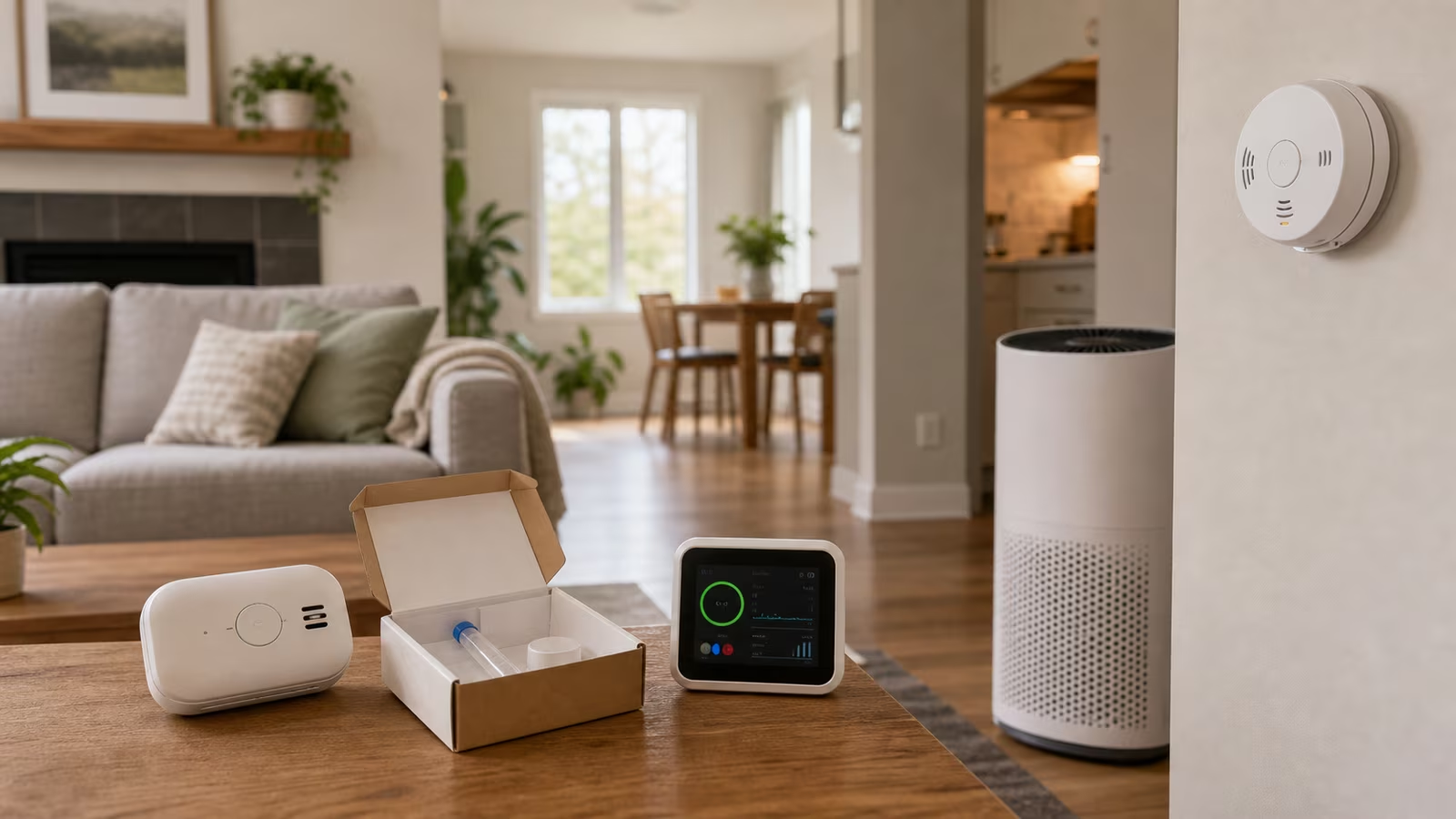
Carbon monoxide belongs to alarms, placed according to the manufacturer’s and local guidance, typically on each level of the home and near sleeping areas, tested on a schedule and replaced when they age out. These are inexpensive and non-negotiable in any home with fuel-burning appliances or an attached garage. Radon belongs to testing: a simple test kit or a longer-term measurement establishes whether your specific home has a level worth acting on, and if it does, a mitigation contractor installs a system to bring it down. Neither of these jobs is something a purifier or a general monitor performs.
Carbon dioxide, meanwhile, is the one number in this group that a consumer sensor reads well and that maps cleanly to an everyday action: ventilate. If yours runs high, the answer is fresh outdoor air. The ventilation and CO2 helper is built for exactly that translation, turning a stuffiness reading into a concrete plan for airing out a room, so you spend that sensor’s information on the thing it can genuinely improve rather than mistaking it for a safety guarantee it was never meant to provide.
Why The Ordinary Clean-Air Steps Still Matter Here
None of this makes the everyday hierarchy irrelevant; it just sits underneath the life-safety layer. Source control still applies: keeping the attached garage’s door to the house sealed and never running a car or generator in enclosed space removes carbon monoxide risk at its origin. Ventilation still applies: fresh air dilutes carbon dioxide and helps with combustion byproducts, though it is a support, not a substitute for a working flue and serviced appliances. Filtration and moisture control carry on doing their particle and dampness jobs. The point of this guide is simply that above all of that sits a category where the correct response is an alarm, a test, or a professional, and you should not let a clean particle reading talk you out of those.
A useful way to hold it in mind: purifiers and monitors manage the air you are trying to make more pleasant and less particle-laden day to day, while alarms and tests guard against the invisible hazards that do not announce themselves. The first set improves comfort. The second set is protection. Buying more of the first will never cover the second.
When To Stop And Get Help
Some situations move past do-it-yourself entirely. If a carbon monoxide alarm sounds, if anyone in the home has sudden headache, dizziness, nausea, or confusion that eases when they leave the building, treat it as an emergency: get everyone to fresh air and call for help rather than reaching for a monitor to double-check. If a fuel-burning appliance is behaving oddly, have it serviced. If a radon test comes back elevated, bring in a mitigation professional. These are not failures of your clean-air setup; they are simply the parts of indoor air that were always meant for alarms, tests, and qualified people.
For the related question of how garage fumes and combustion sources reach living space, see the attached garage and house air guide, and for a broader look at which consumer readings deserve your trust, the air quality monitors: what to trust guide continues this thread.
This guide follows the broad hierarchy shared by EPA, CDC, and CPSC resources: reduce sources, ventilate with clean outdoor air, filter, control moisture, and maintain, with dedicated alarms and testing sitting above all of it for life-safety gases. It is practical education, not medical advice, diagnosis, or remediation, and it makes no promise that any home is free of every hazard. Follow local public health and product-safety guidance for carbon monoxide, radon, and combustion issues.