PFAS in Drinking Water: What the Labels, Limits, and Filters Mean
A calm PFAS primer for public reports, regulations, advisories, certified reduction claims, boiling limits, and filter maintenance.
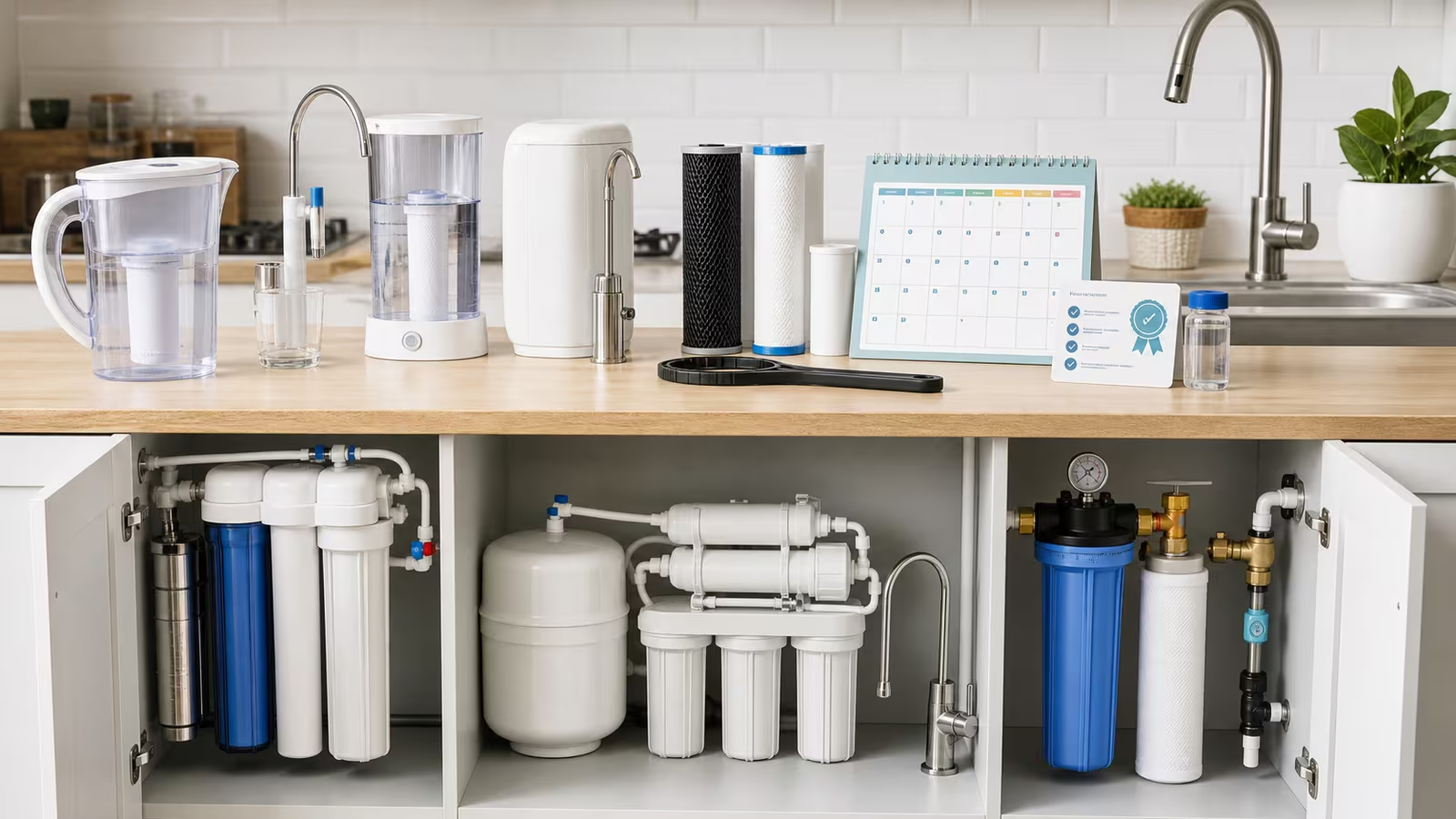
Per- and polyfluoroalkyl substances (PFAS) are a large group of chemicals, not one contaminant with one filter setting. To make a useful drinking-water decision, identify the compounds in a utility report or lab result, check the applicable local guidance, and verify the reduction claim for the exact treatment system and cartridge.
Heads up
Water safety boundary
Clear Water Lab helps with everyday water decisions, reports, testing, certification checks, and maintenance. It is not medical advice, legal advice, or a substitute for local boil-water notices, certified lab results, utility instructions, or health department guidance.
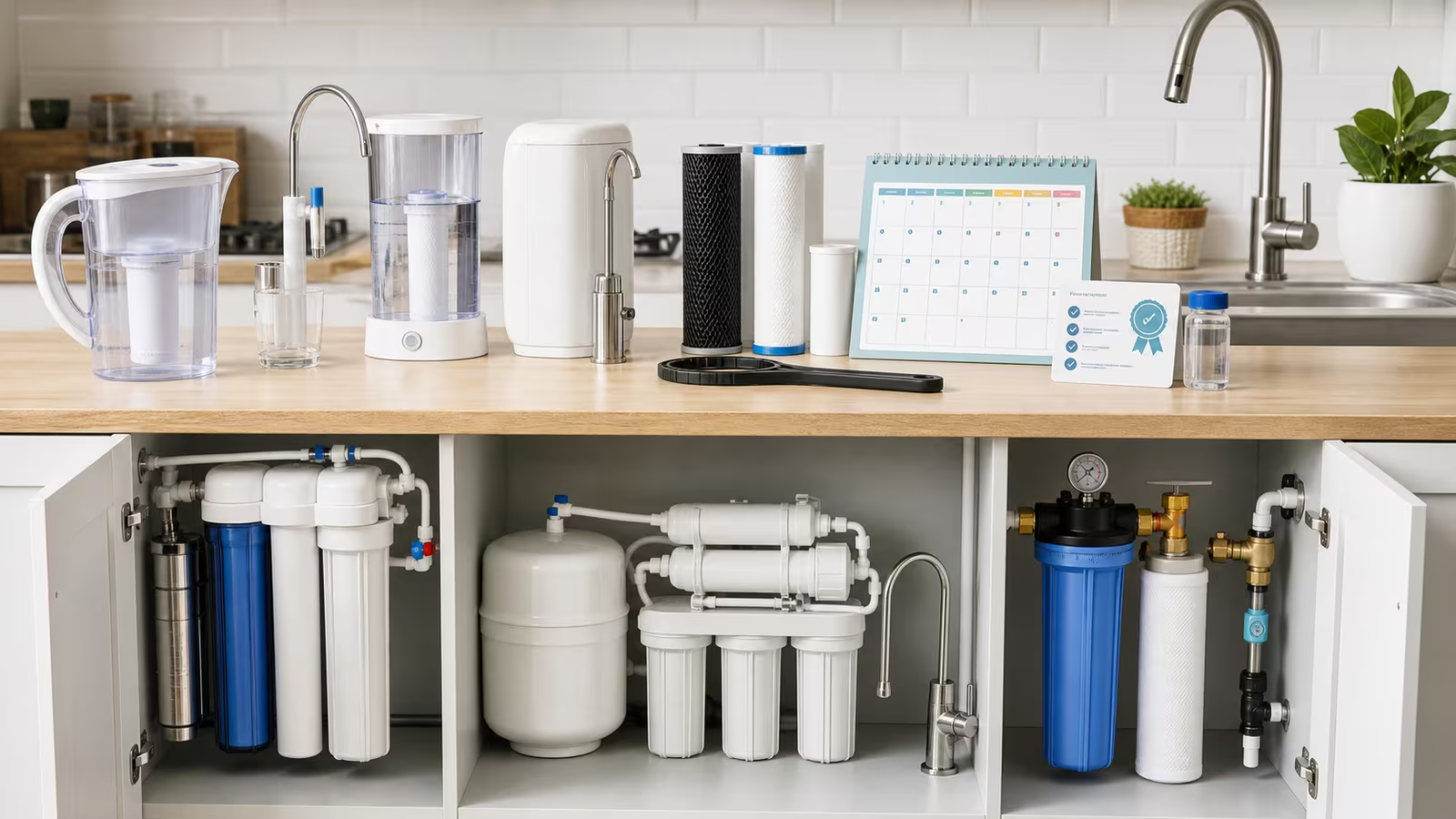
Start with your water source
PFAS have been used in many products and industrial processes, and some persist for a long time in the environment. Drinking water is one possible exposure source; food and other sources also matter. Exposure to certain PFAS has been associated with health effects, but a water result alone cannot predict an individual’s health outcome. See EPA’s PFAS overview and discuss personal health concerns with a clinician.
If you use public water, check your utility’s latest water quality report and any notices. Ask the utility which PFAS were tested, when and where samples were taken, and whether newer results are available. A report that does not mention PFAS is not proof that none are present: testing or reporting may not yet have occurred, or the report may cover a different period.
If you use a private well, there is no utility report for your individual well. Ask your state or local health department whether testing is recommended and for a laboratory certified for PFAS in drinking water. EPA’s private-well fact sheet describes this route. Federal public-water requirements do not directly regulate an individual private well; local guidance can help interpret a result and choose next steps.
Read a result before comparing it
Record the compound name, concentration, unit, sample date and location. A result from an untreated well and one from a filtered kitchen tap answer different questions. PFAS results are often reported in parts per trillion (ppt), equivalent to nanograms per liter (ng/L) in water; 1 part per billion equals 1,000 ppt. Compare values in the same units.
Not detected does not mean proven absent. Check which compounds the lab measured and the reporting limit for each. If the reporting limit is above the comparison value you need, the result may not answer that question. See Lab Result Units and Detection Limits for more on nondetects and comparison values.
For a private sample, ask the lab which PFAS its panel covers, whether its reporting limits suit the relevant guidance, and what the test costs. Use its supplied bottles and PFAS-specific collection and shipping instructions: common materials can contaminate a sample. If you want to evaluate a filter, ask the lab or health department how to collect meaningful samples before and after treatment. The home sampling guide helps you label the sample point and keep a record.
Limits and advisories are different
An MCL, or maximum contaminant level, is an enforceable standard for covered public water systems. A health advisory is guidance, not itself an enforceable limit. State requirements or advice may differ from federal values, and an individual sample should not be mistaken for a regulatory compliance determination.
EPA’s 2024 rule set MCLs of 4.0 ppt each for PFOA and PFOS, as well as limits for PFHxS, PFNA, and HFPO-DA and a hazard index for certain mixtures. Compliance is determined using running annual averages at the sampling point. The rule schedules initial monitoring and public reporting by 2027 and MCL compliance by 2029. As of October 2026, EPA has proposed an option for eligible systems to seek two additional years for PFOA and PFOS compliance and separately proposed rescinding the other PFAS limits and mixture requirement. These are proposals; check EPA’s current rule page , your state and your utility for changes and local notices.
Choose a filter for the specific claim
Boiling does not remove PFOA or PFOS; evaporation can concentrate contaminants. Follow a boil-water notice for germs when instructed, but do not treat boiling as a PFAS solution. A taste change or a TDS meter cannot tell you whether PFAS are present or being reduced.
EPA identifies activated carbon, reverse osmosis and ion exchange as technologies that can reduce PFAS. Performance varies by compound and device, so the technology name alone is not a sufficient buying decision. For a home filter, EPA recommends checking for a PFAS reduction claim certified under NSF/ANSI 53 or 58 and confirming it in the certifier’s directory.
- Write down the specific compounds in your result and the complete system and replacement cartridge or membrane model numbers.
- Find the certification body’s mark and search its current listing. Match the model, configuration and named PFAS reduction claim; a claim for one compound does not establish reduction of every PFAS. “Tested to” a standard is not by itself an active certification.
- Read the performance data sheet for rated capacity, flow, operating conditions and replacement instructions. Ask the certifier if the listing is unclear. The filter claim verification guide walks through the search.
- Install the listed components and replace them on schedule. Record the installation date and capacity; follow the manufacturer’s time and volume limits. Water that still tastes fine is not evidence that the cartridge is working for PFAS.
Certification tests a specific claim under specified conditions; it does not guarantee a particular concentration at your tap. EPA notes that the PFAS filter certification standards it described as of April 2024 did not establish reduction to the newer federal drinking-water limits. Check current guidance and product listings, and consult a qualified lab or local health department if you need to know the treated water concentration.
When a result or notice calls for action
Follow the utility or health department’s instructions. If guidance calls for an alternative source, use it for drinking and other activities where water is swallowed, including cooking, brushing teeth and preparing infant formula. Ask the health department or water supplier about suitable water and treatment while a longer-term solution is arranged. A filter at one faucet only treats water that passes through it.
Keep the report, notices, filter listing and replacement dates together. This makes it easier to compare a later result with the same sample point and to maintain the treatment you chose.
Related Fondsites path
- Does Boiling Water Remove PFAS, Lead, Chlorine, or Bacteria?
- Reverse Osmosis for Beginners
- Activated Carbon Filters
- NSF/ANSI 42 vs 53 vs 58 vs 401
- How to Verify a Water Filter Claim