How to Verify a Water Filter Claim on NSF, WQA, or IAPMO
A step-by-step guide to checking exact model numbers, certified standards, contaminant claims, cartridge requirements, and replacement limits.
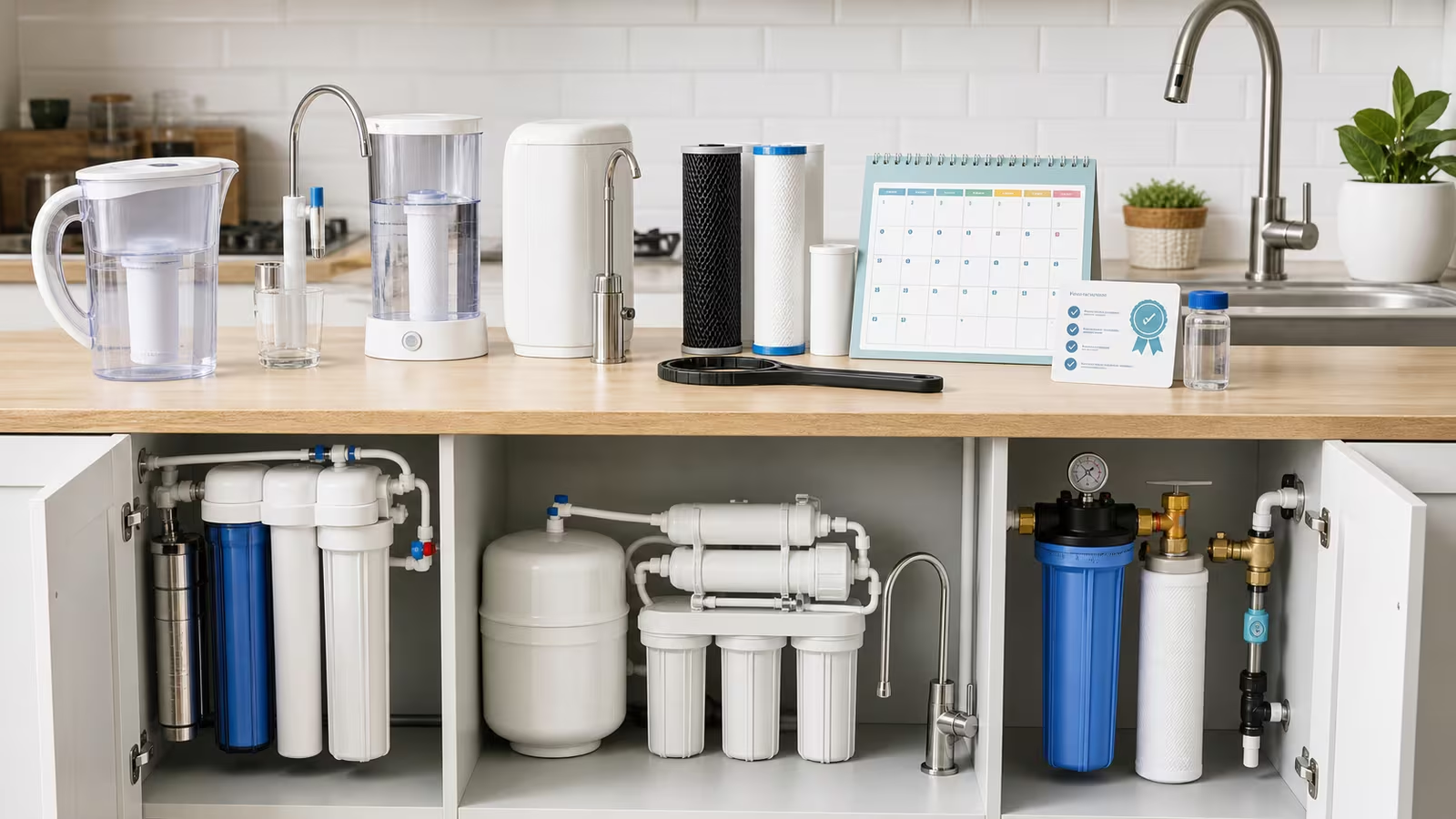
A water filter claim is useful when you can connect it to the exact product and the water problem you want to address. A certification listing can help you check the model, contaminant, replacement cartridge, rated life, and conditions behind the claim.
Heads up
Water safety boundary
Clear Water Lab helps with everyday water decisions, reports, testing, certification checks, and maintenance. It is not medical advice, legal advice, or a substitute for local boil-water notices, certified lab results, utility instructions, or health department guidance.
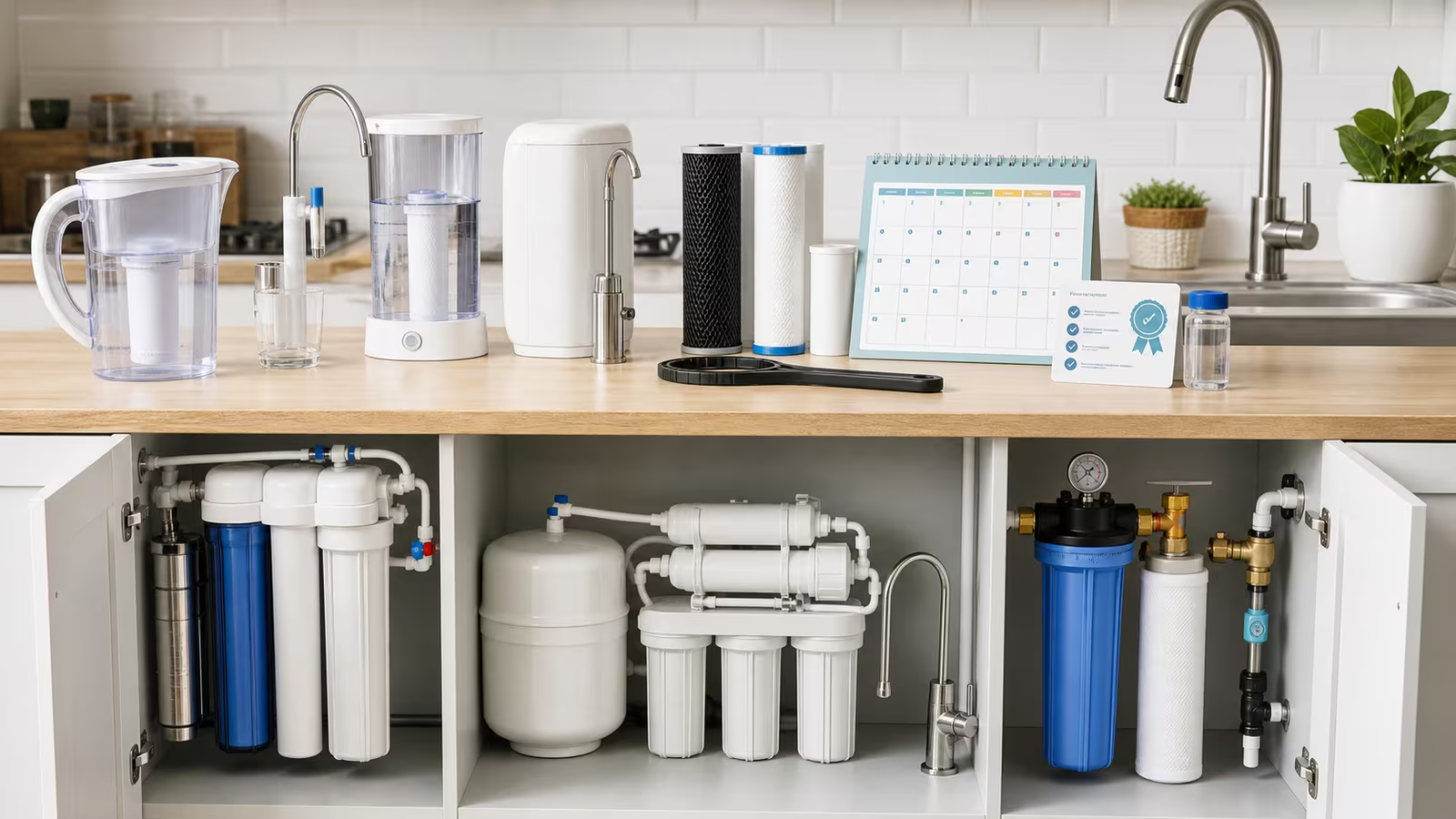
Start with the concern and the product
Write down the contaminant or problem first: for example, lead at a drinking tap or chlorine taste and odor. A water quality report or a home water test can help identify a concern. A utility report does not tell you the lead concentration at your own tap: lead can enter water from plumbing or fixtures, and results vary between homes. EPA explains how to arrange a lead test . A filter certified for chlorine taste is not automatically certified for lead, and a claim for one PFAS chemical does not establish reduction of every PFAS compound.
Then collect the identifiers from the package, manual, or product page: manufacturer, brand, complete system model, and replacement cartridge or membrane model. A refrigerator, filter housing, and cartridge may each have different numbers. Keep the performance data sheet handy if one is available.
Search the certifier’s listing
- Find the certification mark. NSF, WQA, and IAPMO are different certification bodies; an NSF/ANSI standard number alone does not tell you which one certified the product. Start with the directory of the body named on the product. EPA’s home-filter guide also links to other accredited certifiers for PFAS claims.
- Search the exact model. Try the manufacturer and model, then the brand or cartridge number if necessary. Open the result and check the complete identifier, including suffixes or variants. On a page with several models, follow the row and its footnotes to the claims that apply to your model; do not assume every model has every claim on the page.
- Read the claim, not just the standard. Check that the listing names the contaminant reduction you need for that model. For example, NSF/ANSI 42 often covers aesthetic claims; NSF/ANSI 53 covers health-related claims; NSF/ANSI 58 covers reverse osmosis systems; and NSF/ANSI 401 covers certain emerging compounds. None of those numbers alone means a product is certified for every claim in the standard. See filter certifications explained .
- Match the configuration. Confirm that the listed system and required cartridge or membrane match what you will install. A certified component does not by itself establish the same reduction claim for an assembled system. A compatible replacement may fit but have different claims; check its own listing and the applicable configuration. See compatible replacement filters .
- Record the limits. Check the listing and performance data sheet for rated capacity, replacement interval, and any applicable flow, pressure, temperature, or incoming-water conditions. Capacity is the amount of water the device is rated to treat, not a prediction of how many months it will last in your home. Save the listing or a screenshot with the date, and keep the manual and cartridge number for later.
Search the NSF drinking water treatment unit directory , WQA certified product listings , or the IAPMO R&T Product Listing Directory . In NSF’s search, selecting multiple reduction claims within a standard returns products certified for any of the selected claims by default. Select the option to search for all selected claims if you need them together, then inspect the result and its footnotes to confirm the model and configuration. Search terms may differ between directories: WQA says to choose Hexavalent Chromium when looking for chromium-6.
For a lead concern, look for a lead reduction claim on the exact system, not just a Standard 53 mark. EPA’s lead-filter guide recommends checking for point-of-use or pitcher filters evaluated for lead reduction to 5 parts per billion or less and for Class I particulate reduction. Find those claims on the performance data sheet or in the certifier’s listing, then check the replacement model.
Read the result with care
| What you find | What it tells you | Next move |
|---|---|---|
| Exact model and lead reduction listed | The certifier has verified that specific claim for the listed product and conditions. | Match the cartridge and rated life before buying. |
| Standard 42 and chlorine taste listed, but no lead claim | The listing supports the named aesthetic claim, not a lead reduction claim. | Look for a product with a verified lead claim if lead is your concern. |
| A listing says “lead-free” or materials safety only | The wording concerns the product materials, not necessarily lead reduction from water. | Look for a separate lead reduction claim for the system. |
| A cartridge or component is listed, but the system configuration is unclear | The component’s listing alone does not establish the assembled system’s claim. | Ask the certifier to confirm the combination. |
| The seller says “tested to” a standard, but you cannot find certification | A test may have been performed, but the wording alone does not establish an active certification. | Ask for the certifier and current listing; check them directly. |
Read the footnotes as well as the claim column. For example, an NSF listing may identify a component as certified for materials or structural requirements only, or mark a product for compliance with lead-content requirements. Neither statement alone is a lead reduction claim. NSF’s listings explain the applicable footnotes beside each result.
A listing can be hard to find because of a different manufacturer name, a model variant, or search terms. No search result is not proof that a product failed testing. Ask the manufacturer for the exact listing and confirm it with the certifier. If the model, configuration, or claim remains unresolved, treat it as unverified for the decision and choose a product whose claim you can check.
Make a claim record
Use a separate copy of this record for each product you are comparing. For example, if lead is the concern, the record should connect lead reduction to the exact system and replacement cartridge—not merely a Standard 53 mark on the box.
| Record | Your notes |
|---|---|
| Concern and water source | Contaminant, test result or report, and sampling point if known |
| Product | Manufacturer, complete system model, and cartridge or membrane model |
| Evidence | Certifier, directory link and date checked, standard, specific claim, and any relevant footnote |
| Use and upkeep | Rated capacity, operating conditions, replacement interval, and date installed |
If the listing and sales page disagree, save both and ask the certifier which claim and configuration are currently certified. A performance data sheet helps with operating details, but check the certifier’s listing for the certification itself.
Certification has practical limits
Certification evaluates specific claims under specified test conditions; it does not prove what concentration will come out of your tap in every situation. Compare the performance data sheet’s limits with your water information, and ask the certifier or a qualified water professional if the conditions do not match. For PFAS, identify the compounds covered and do not assume a reduction claim guarantees a particular concentration at home. EPA notes that its April 2024 description of filter certification requirements did not establish reduction to the newer federal drinking-water limits. Check EPA’s current guidance and the product’s current listing for updates.
A performance data sheet may show a percentage reduction alongside the concentration used in testing. Read both with the stated conditions; do not apply that percentage as a guaranteed result for your tap. For example, NSF’s lead-filter guide says the products in that guide were tested up to 150 parts per billion of lead and should not be relied on above that level. If your result exceeds a product’s tested input range, ask the certifier or health department about an appropriate alternative.
Certification also does not make a filter a substitute for a public water notice. Follow utility or health department instructions, including boil-water or do-not-use notices. If you need to know your treated water’s concentration, discuss appropriate before-and-after sampling with a qualified laboratory or local health department, and follow its collection instructions; taste and a low-cost TDS meter cannot confirm a specific contaminant reduction.
Keep the claim working after installation
Install the listed cartridge and follow the manufacturer’s flushing, use, and replacement instructions. Record the installation date, cartridge model, capacity, and replacement date. If the instructions specify both a volume and a time limit, replace the cartridge when the first limit is reached; a calendar or indicator light alone may not reflect household use. A change in taste or flow is worth investigating, but neither confirms that a health-related contaminant is being reduced. The filter replacement schedule guide can help make a reminder practical.
Try this next
- Write down your concern and the exact system and cartridge model numbers.
- Open the named certifier’s current listing and match the specific reduction claim and configuration.
- Compare the rated life and operating conditions with the performance data sheet; save a dated copy of the listing.
- Ask the certifier about any mismatch before relying on the claim, and set a replacement reminder after installation.
Related Fondsites path
- NSF/ANSI 42 vs 53 vs 58 vs 401
- Filter Replacement Schedules
- Compatible Replacement Water Filters
- PFAS in Drinking Water
- Lead in Drinking Water