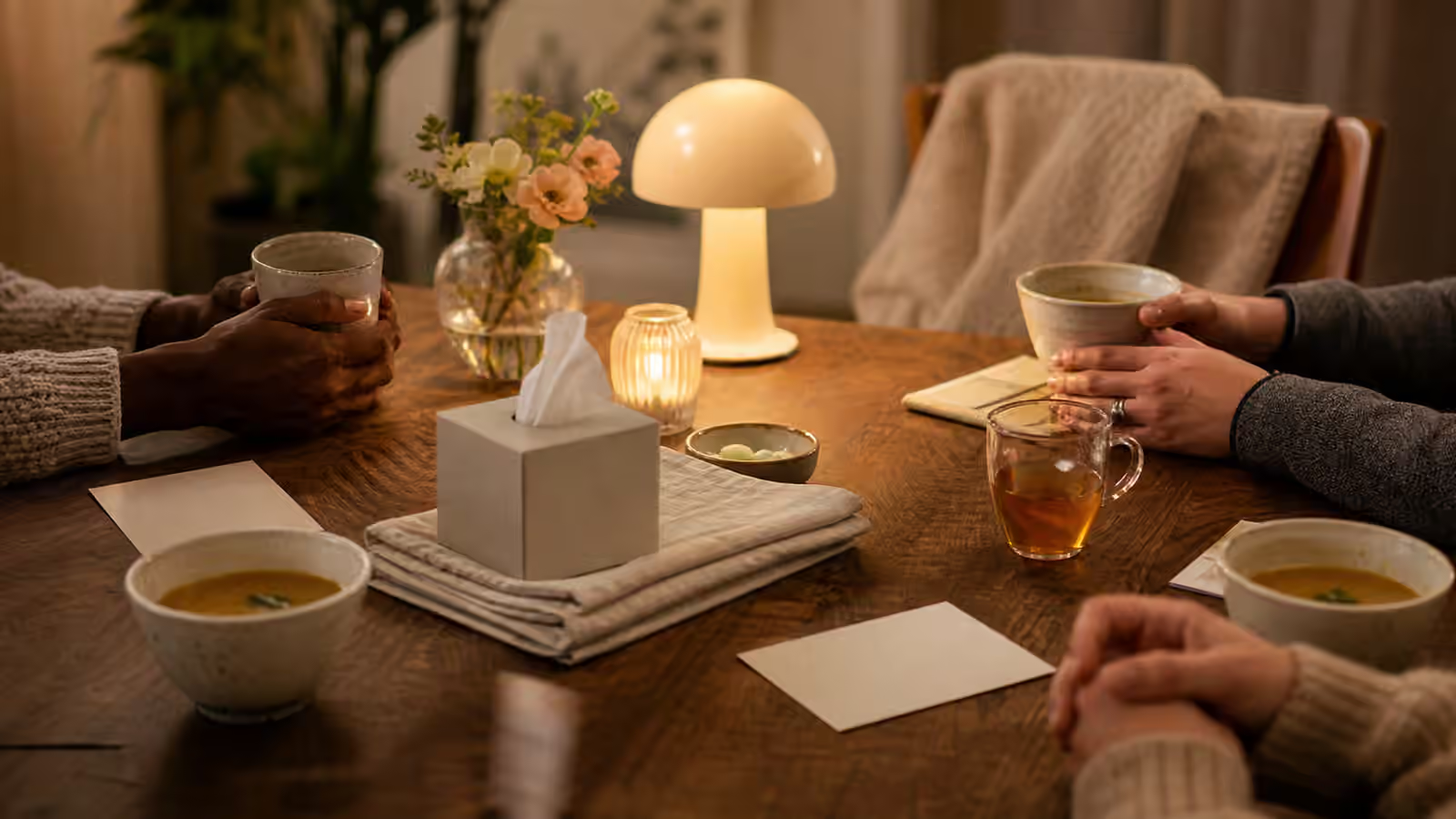

Somewhere between the silent table and the corporate icebreaker sits the thing you are actually after: a prompt that gives people something to talk about without demanding that they perform. Question cards are a small, cheap tool for this, a bowl of prompts you can reach into when conversation stalls. But most question decks, including the expensive ones sold as tools for deep connection, get the physics exactly backwards. They open with intensity, asking near-strangers about their biggest regret or their relationship with their father, and they mistake exposure for intimacy. A good card does the opposite. It gives a shy person an easy handhold and lets a talkative person go as deep as they like, and it never makes anyone choose between oversharing and looking cold.
The failure to avoid is the interview. An interview is a sequence of questions that a person must answer about themselves, in order, while others watch. It puts the guest on a small stage and turns listening into evaluation. The moment a prompt feels like it is testing whether you are interesting, vulnerable, or clever enough, the table tightens, and the quiet people go quieter. Cards are supposed to loosen the room, not audition it.
Aim for questions with a low floor and a high ceiling
The best prompts can be answered in ten seconds by someone who wants to keep it light, and can also open into a five-minute story if someone happens to have one. “Is there a food you loved as a kid that you would be embarrassed to admit you still love?” has a low floor: anyone can name a snack and move on. It also has a high ceiling: it can slide into childhood, family, a grandparent’s kitchen, an immigration story, or nothing at all, entirely at the answerer’s discretion. The guest controls the depth. That control is the whole design.
Contrast that with “What is your greatest fear?” which has a high floor and no exit. There is no light way to answer it. You either produce genuine vulnerability on command in front of people you just met, or you deflect and feel like you failed the question. High-floor prompts do not create connection; they create the anxious social labor of managing how much to reveal. Every card you write should pass a simple test: could a tired, guarded person answer this in one sentence without lying and without exposing themselves? If not, it belongs in a journal, not on the table.
Four kinds of prompt that carry a table
You do not need a hundred cards. A handful of reliable shapes will carry almost any evening. Object questions ask about a thing rather than a self: a favorite mug, the last good thing you ate, an object you would grab from a fire. They are easy because the thing takes the pressure off the person. Preference questions ask what someone likes and why, which lets people be interesting without being confessional: window or aisle, mountains or ocean, the reliable order at a restaurant they always return to. Memory-light questions invite a small, specific past moment without demanding a formative one: a good day recently, a place you keep meaning to go back to, the best meal you did not cook yourself. And then, running underneath all of them, the fourth thing, which is not a question at all but a rule: passing is always fine, and choosing a different card is always fine.
That pass-friendly rule is what makes the deck humane. State it out loud once, early, in a completely ordinary voice: “grab a card if you want one, answer however much you feel like, and passing is a totally normal move.” Said plainly, it stops being a warning and becomes permission. The first ten minutes of a gathering are where this permission does its most important work, because that is when people are still deciding how exposed they are going to be.
Keep the mining questions out of the bowl
Some subjects should simply not appear on a card at a table where trust has not been built: trauma, money, dating status, job situation, health, and identity in the pointed sense of asking someone to explain who they are. These are not forbidden topics of conversation; people bring them up all the time when they choose to. The problem is the card, which removes the choosing. A prompt that asks “how much do you make?” or “why are you single?” weaponizes the format, because now the group is watching a specific person be put on the spot about something private. If a heavy topic is going to arise, let it arise from the person, not from the deck.
The same restraint applies to alcohol, which people love to make into a conversational bit. Cards asking about your wildest drunk story, your signature cocktail, or your worst hangover quietly assume everyone at the table drinks and enjoys talking about it, and they land badly on the guest who does not. Keep the deck alcohol-neutral. There is no shortage of things to ask about that include everyone, and a table where nobody’s beverage or abstinence becomes a prompt is simply a more relaxed table. Someone who is not drinking, for whatever reason they do not owe anyone, should be able to play the whole game without a single card turning toward them.
Let the cards fade into the background
The sign that your deck is working is that people stop using it. Cards are training wheels for conversation, not the conversation itself. You reach into the bowl when the room stalls, someone answers, a real thread catches, and then the cards sit forgotten for twenty minutes while people actually talk. That is success. A host who insists on going around the circle so everyone answers every card has rebuilt the interview they were trying to escape. Let the deck be a tool you pick up and put down, offered to the table rather than administered to it. Six good cards that lower the floor and raise the ceiling will do more for a room than fifty that demand a soul. Write those six, name the pass rule out loud, and then get out of the way. When the same faces return, the work of helping people re-enter gets easier, because they already know this is a table that will never put them on the spot.
Related guidebooks
- The First Ten Minutes: Design Through Awkwardness
- Name Memory and Reentry: Help People Return
- The Common Table Quickstart: Start a Repeatable Small Gathering
- Invitations Without Pressure: Ask Clearly, Let People Decline Easily
- The Common Table guidebook shelf
- Startable Life Lab for making recurring systems easier to begin and resume.
- Reality Check Desk for calm verification habits when social media advice turns hospitality into pressure.