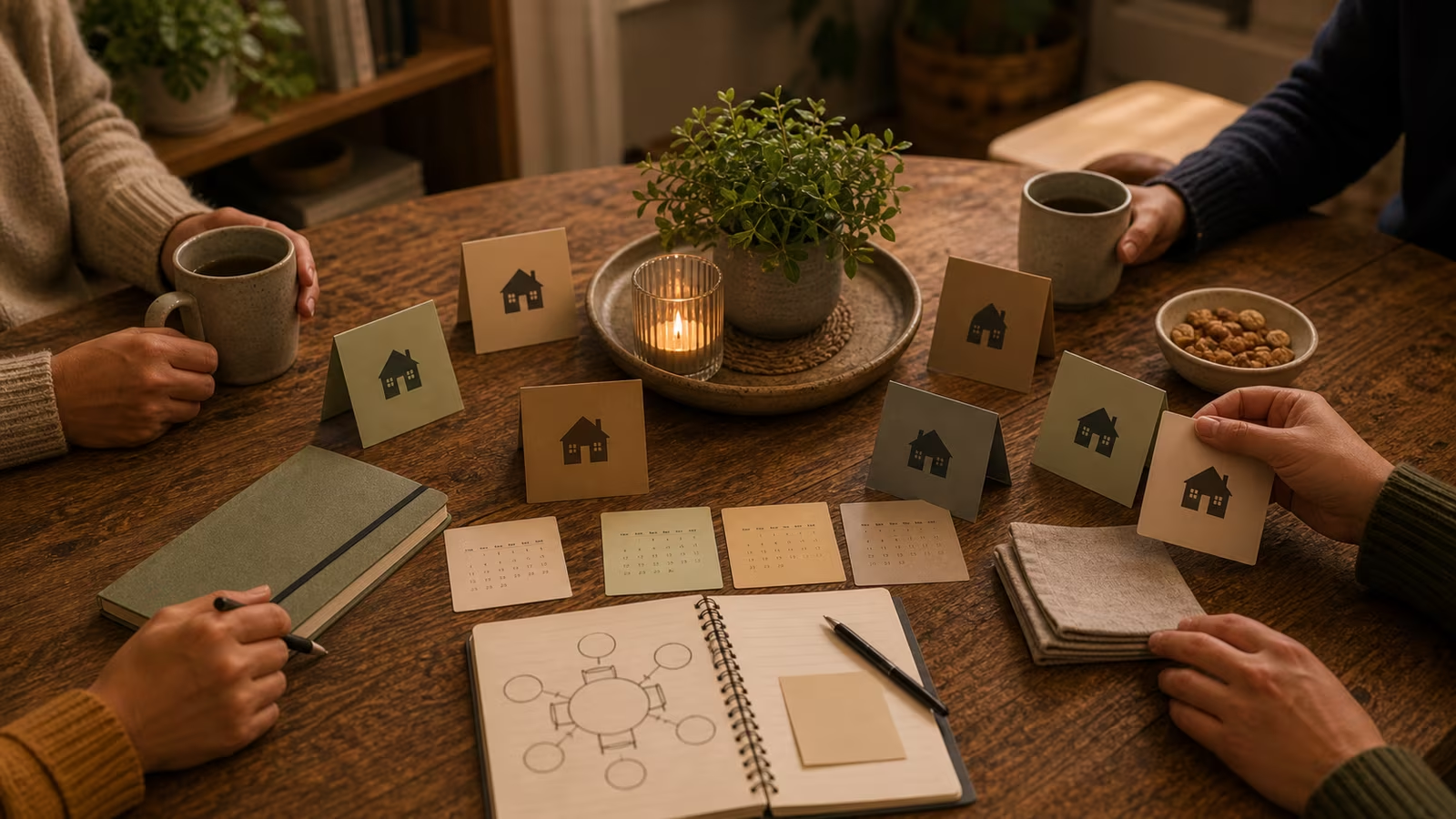
Almost every beloved recurring gathering eventually meets the same wall: it depends too much on one person. The host’s apartment, the host’s cooking, the host’s free evenings, the host’s stamina. As long as that holds, the table is wonderful and fragile at once, one bad month away from quietly stopping. Rotating the host is how a gathering graduates from a generous person’s habit into something the group actually owns together. The difficulty is that naive rotation, where each host simply does their own thing, tends to dissolve the very thing people loved. The skill is to rotate the labor while keeping the ritual recognizable. If you have not locked in a format yet, start with the Common Table Quickstart ; this guide assumes you have one worth protecting.
Separate the spine from the flavor
The whole model rests on one idea: a gathering has a fixed spine and a local flavor, and only the flavor should rotate. The spine is what makes your table itself, the promise in the invitation, the rough length, the opening beat, the closing gesture, the come-as-you-are drink policy. The flavor is everything a particular host brings, the specific soup, the neighborhood, the playlist, the exact chairs, the view from the porch. When you hand hosting to someone new, you are handing them the flavor and asking them to keep the spine. Get that boundary clear in your own head first, because you cannot delegate what you have not defined.
The reason this matters is that guests are running a quiet social contract every time they come. They know roughly what the evening will ask of them and give them, and that knowledge is what lets them relax. If a rotation changes the spine, if one month it wraps at nine and the next month it becomes a late, loud, unbounded affair, guests have to relearn the contract from scratch, and relearning is tiring. People stop trusting the invitation because they no longer know what it promises. Keep the spine steady across every home and the guest can walk into a stranger’s apartment already knowing how the night will feel.
Write the spine down before you hand it off
Do not try to transmit the format by vibe. The single highest-leverage act in this whole model is to write the fixed spine down in a handful of plain lines and give it to each host before their turn. Not a rulebook, just the load-bearing parts: what the invitation promises, the opening beat, the closing beat, the approximate timing, the drink stance, and the one logistics note that keeps things smooth. Five short lines is plenty. This tiny document is what lets a nervous first-time host say yes, because it replaces the terrifying blank of “host it however you want” with a clear, small assignment: keep these five things, make the rest your own.
A shared record helps even more once the rotation is running, which is exactly what the Shared Notes and Table Memory guide is built for. A running note of who hosts next, what the spine is, and any standing access needs means the format survives even as memory fades between gatherings. It also quietly solves the reminder problem across changing hosts; pair it with the Reminder Rhythm so that whoever is up this month knows the four beats to send and nobody has to reinvent the run-up.
The failure mode is drift, not disaster
Rotating tables rarely collapse in a single dramatic night. They erode. One host, wanting to impress, adds a course and runs an hour long. The next host, matching that, adds more. Within a few rotations the modest two-hour soup table has become an elaborate dinner party that only the confident hosts can pull off, the shy members quietly stop volunteering, and the whole thing tips back onto one or two people, which is precisely the concentration you were trying to escape. Each individual change felt generous. The cumulative effect was to price out half the group.
The guard against drift is the written spine plus a light norm that hosting is meant to be easy. Say it out loud when you hand off: the goal is not to outdo last time, it is to keep the table repeatable, and a simple pot of soup honors that better than a showpiece. Give explicit permission to keep it small. A host who knows that ordinary is the standard, not the floor, will relax, and relaxed hosts are the only kind a rotation can sustain over the long run. When someone’s month is genuinely too full, the answer is to swap turns, not to grind through an evening they cannot afford.
Let flavor vary, but keep belonging portable
The joy of rotation is precisely the flavor variety, the different homes, the different soups, the different light through different windows. Encourage all of it. What you are keeping constant is not the sensory detail but the feeling of being known and welcome, and that has to travel intact to every address. Make sure the come-as-you-are drink stance is part of the spine every host keeps, so that a guest who does not drink has the same easy path whether they are in the porch host’s backyard or the apartment host’s kitchen. Belonging should not depend on which member happens to be hosting; a nonalcoholic choice that is normal and considered in one home must be normal and considered in all of them. The same goes for any standing access need someone in the group has, a step-free entry, a quiet corner, an early leave. Those ride with the spine, not the flavor.
Practice this once
Before you ever ask someone else to host, write the fixed spine of your gathering in five short lines. Force yourself to be honest about which parts are truly load-bearing and which are just your personal habits that a different host should feel free to change. Then invite one trusted person to take the next turn, hand them those five lines, and offer to be present as a guest rather than a supervisor. Afterward, compare notes: did the spine survive, did guests find the evening recognizable, did anything important quietly go missing, did the new host feel supported or stranded.
If it went well, add a second host to the rotation and repeat, resisting the urge to over-formalize. The model gets stronger with each successful handoff because the spine gets clearer and the group’s confidence grows. What you are really building, one turn at a time, is a table that no longer needs you specifically, which is the surest sign it has become a shared thing rather than your thing. For help keeping each host’s invitation easy to say yes to, see Invitations Without Pressure , and the wider Common Table guidebook shelf holds the surrounding pieces.