Once an intruder is inside a network, they face a practical problem: the foothold on a laptop or server needs to reach back to whoever is directing it, receive instructions, and report results. That reach-back channel is what defenders call command-and-control, often shortened to C2. It is the connective tissue of an intrusion, and because it usually has to cross the network boundary repeatedly, it is one of the most observable phases of an attack. You may never see the initial break-in, but a channel that keeps phoning home leaves a trail in traffic records, and that trail is something a defender can learn to read.
This guide treats C2 as a network story told from the defensive side. We are interested in the rhythms and relationships that betray a control channel, not in how to build or hide one. The goal is to make outbound behavior legible: to know which patterns raise a question, which logs answer it, and how to separate a genuine control channel from the thousand ordinary connections a busy host makes every hour.
This guide is defensive education. It uses toy examples, observable evidence, and safe reasoning. It does not provide exploit instructions, malware code, credential theft steps, evasion playbooks, target scanning procedures, or operational offensive workflows. If you are handling an active incident, preserve evidence, follow your organization's incident-response plan, and involve qualified responders and legal counsel where appropriate.
Why beaconing is a network story
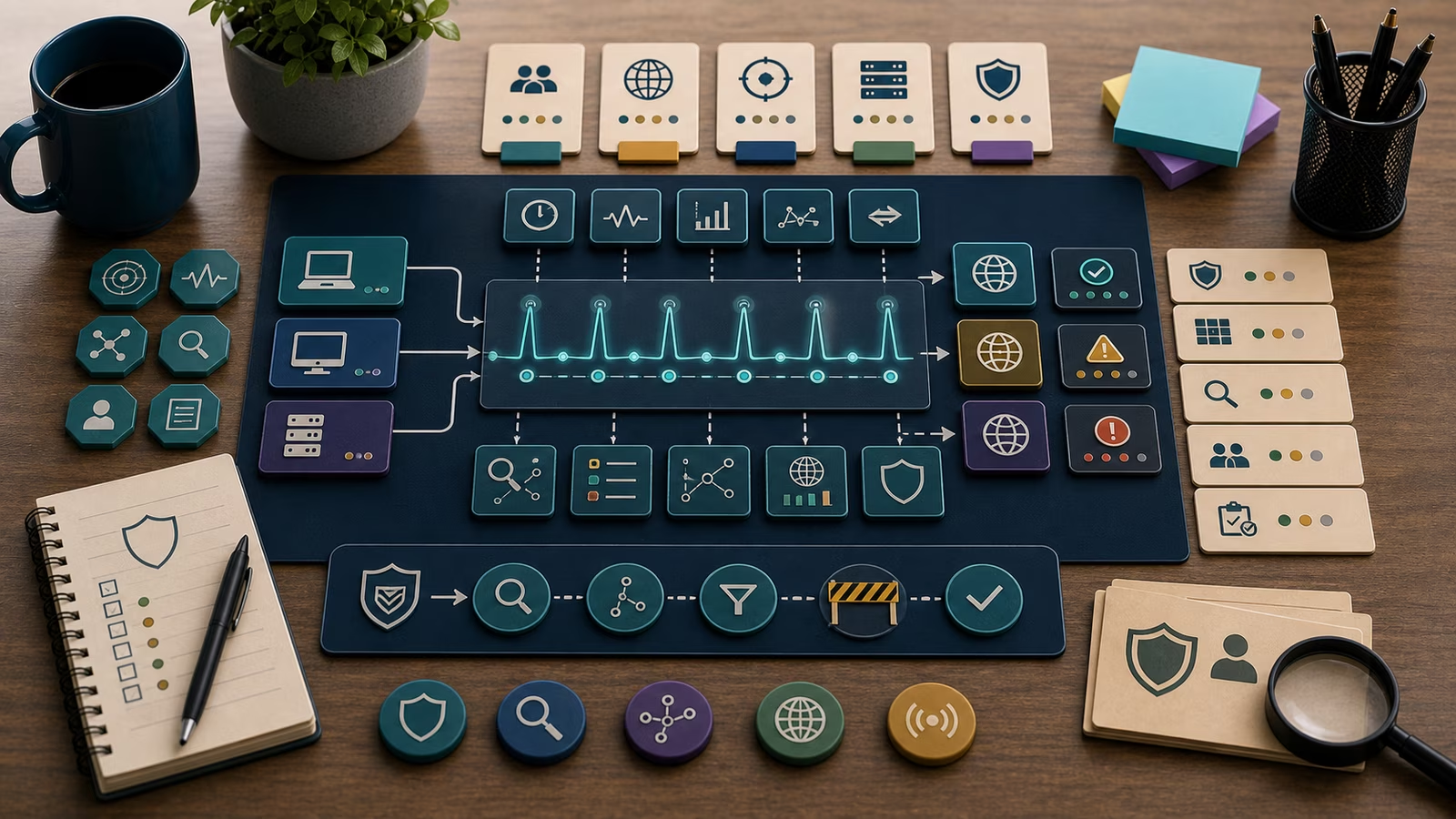
The most recognizable trait of many control channels is the beacon: a compromised host reaches out to a destination at regular intervals to ask whether there is anything to do. Even when the timing is deliberately jittered and the content is encrypted, the shape of the behavior tends to survive. A human browsing the web produces bursty, irregular, varied traffic; a beacon tends toward the opposite, a steady heartbeat of small, similar connections to the same handful of destinations over long stretches, including nights and weekends when no person is at the keyboard.
That is why the story lives in the network and not in the payload. A defender rarely needs to read what a beacon says; the interesting part is that it keeps saying it, on a cadence, to somewhere the host has no business talking to. Reasoning about ports, protocols, and remote hosts is the foundation here, and the vocabulary in Network Connections: Ports, Protocols, and Remote Hosts makes those patterns easier to describe precisely.
Where the evidence actually lives
Control channels leave records in several complementary places, and the strongest reviews braid them together. Connection and flow logs show which internal host talked to which external destination, how often, and how much data moved, which is enough to reveal a beacon’s rhythm even without payload visibility. DNS query logs are especially valuable, because a channel that resolves an unusual or newly registered domain, or that generates a stream of odd-looking lookups, often shows its hand in name resolution before anything else. Proxy and TLS records add the destination reputation and certificate details that help distinguish a legitimate cloud service from an impostor.
Two neighboring guides carry this further. Egress Filtering and DNS Logging explains how controlling and recording outbound traffic turns C2 from invisible into observable, and DNS and Domain Hygiene for Defenders covers why the domains a channel relies on are often its weakest link. The endpoint side matters too: pairing a suspicious outbound flow with the process that opened it, using the reasoning in Processes, Parents, and Command Lines , is what turns “a strange connection” into “this specific program is talking to that destination.”
Toy example
Imagine the fictional design studio Marlowe & Finch again. Over a quiet weekend, flow logs show that one workstation, “studio-07,” opened a short outbound connection to the same unfamiliar destination every eleven minutes, give or take a few seconds, for thirty hours straight. No one was in the office. The connections were small and almost identical in size. A defender does not leap to “the machine is remotely controlled.” They write the observable fact: “studio-07 made roughly 160 near-identical outbound connections to one external host at an eleven-minute cadence across the weekend; the process behind them is not yet identified.”
Then they look for innocent explanations, because several exist. Software updaters, telemetry agents, license checks, and synchronization clients all beacon in their own way. The disciplined next steps are to identify the destination’s reputation, match the traffic to the owning process on the endpoint, and check whether the same pattern appears on peer machines running the same approved software. If the destination is unknown, the process is unexpected, and the machine is alone in doing it, confidence rises and the note becomes worth escalating.
What evidence matters?
For a control-channel review, the most persuasive evidence combines regularity, destination, and process. Regularity is the beacon’s cadence and its persistence across hours when no user is active; a pattern that ignores the human workday is more interesting than one that tracks it. Destination is the reputation, age, and ownership of the remote endpoint, since newly registered domains, hosts with no business relationship, and infrastructure that many of your machines suddenly share all raise the stakes. Process is the local program responsible for the traffic, because a well-known updater beaconing to its vendor is background noise, while an unexpected process beaconing to an unknown host is a lead.
Evidence is strongest when it is timestamped, exported from the logging system rather than screenshotted, and correlated across sources whose clocks agree. A flow record, a matching DNS query, and the endpoint process that generated both tell a coherent story that a single artifact cannot. That correlation depends on the log discipline described in Logs: What to Keep and Why and the clock alignment covered in Time Synchronization and Log Correlation .
Common mistakes and false positives
The largest trap in C2 hunting is that legitimate software beacons constantly. Operating systems check for updates, endpoint agents report health, chat and collaboration tools maintain persistent connections, and cloud sync clients poll on a schedule. A rule that flags “regular outbound connection” without context will bury a team in false positives and teach it to ignore the very pattern that matters. The remedy is a baseline: know which regular beacons are normal for your environment, so the abnormal one stands out instead of drowning.
The opposite failure is over-reading a single artifact. One connection to an unfamiliar domain is not a control channel; it might be a typo, an ad network, a link someone clicked once. Confidence should be built from the convergence of regularity, unknown destination, and unexpected process, not from any one of them alone. And confidence should be stated honestly: “this host beacons to an unknown destination on a fixed cadence” is an observation, while “this host is under external control” is a conclusion that needs the process and destination evidence to back it. A false positive that ends in a better baseline or a tuned rule, as discussed in Detection Tuning and Signal Noise , is time well spent.
Worked defensive review
Return to studio-07. A disciplined analyst writes the narrow claim, then gathers the destination’s reputation and registration age, identifies the owning process on the endpoint, and checks whether peer machines show the same behavior. Suppose the destination turns out to be a recently registered domain, the process is one nobody recognizes, and no other machine talks to it. The review now supports a medium-to-high-confidence note: preserve the flow and DNS logs, capture the endpoint process details without altering the machine, and move the finding into the incident process so that responders, not a curious analyst, decide on containment. Throughout, the analyst keeps observation and interpretation in separate sentences, so that whoever reads the note next can see exactly which parts are proven and which are still hypothesis.
What to do next
Let the evidence set your pace. If the pattern matches a known-good beacon once you check the process and destination, document why and tune the alert so the same benign traffic does not cost the team its attention next week. If the destination is unknown and the process is unexpected, preserve the network and endpoint records, resist the urge to interact with the destination, and escalate. A control channel rarely travels alone; it usually accompanies elevated access and, later, data leaving the network, so Privilege Escalation Signals and Exfiltration Paths are the natural threads to follow.
For anything active, do not experiment. Preserve evidence, follow the incident-response plan, communicate through approved channels, and involve qualified responders. For learning, keep the hosts and domains fictional and practice the reflex at the center of this topic: describe the rhythm, name the destination, find the process, and only then decide how far the finding travels.
How this guide was made
This page is defensive education, drawn from public frameworks such as MITRE ATT&CK and public detection guidance, and illustrated with invented hosts and destinations. It claims no certification, legal standing, incident-response authority, or complete coverage, and it deliberately avoids operational offensive detail so that it stays useful for safe study.
Official references
As orientation rather than certification, the MITRE ATT&CK Enterprise Matrix documents command-and-control techniques and the network evidence that exposes them, the CISA Known Exploited Vulnerabilities Catalog tracks the flaws that frequently precede a foothold, and the NIST Cybersecurity Framework 2.0 situates outbound monitoring within the broader detect-and-respond functions.
Related guidebooks
To connect the channel to the rest of the story, read Initial Access Without Drama for how footholds begin and Exfiltration Paths for where they often end. For the network plumbing that makes C2 visible, Egress Filtering and DNS Logging and Network Connections: Ports, Protocols, and Remote Hosts are the best companions.