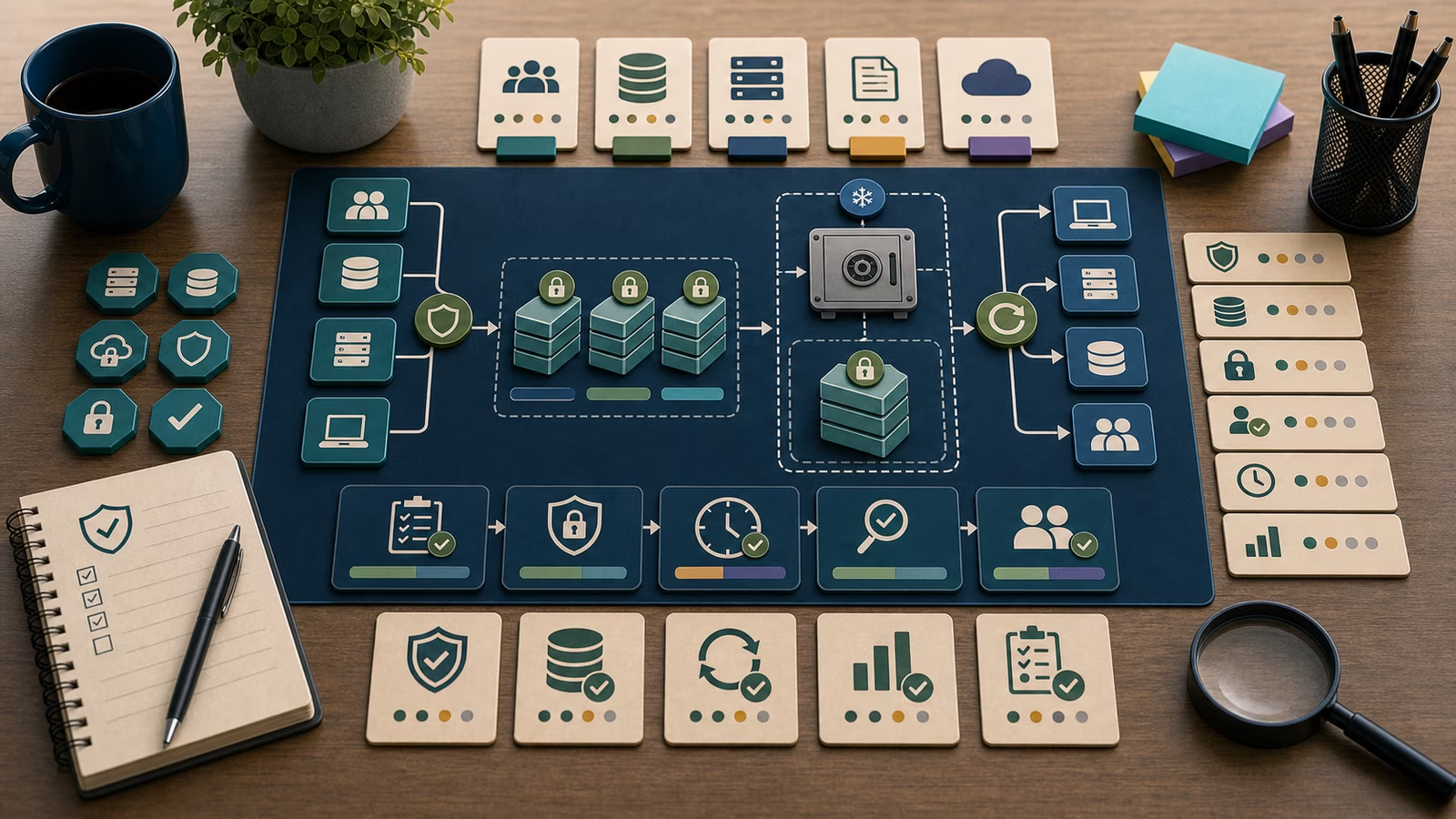

Containment is the point in an incident where a defender has to act on incomplete information and knows that every option costs something. Pull a machine off the network and you may stop a spread, but you may also alert an intruder who then accelerates, or destroy the running state that would have explained how they got in. Leave it online to watch a little longer and you buy evidence, but you gamble that the damage will not widen while you look. The phrase “decision tree” makes this sound like a lookup, as if the right branch could be read off a chart. In practice it is judgment under time pressure, and the useful skill is not memorizing branches but knowing which questions to ask in what order, so that the answer you reach is one you can defend afterward.
This guide treats containment as reasoning rather than a table. It walks through the trade-offs an intermediate defender actually weighs, in the sequence they tend to matter, using calm fictional examples. The aim is to make the choice slower on the inside even when it must be fast on the outside.
This guide is defensive education. It uses toy examples, observable evidence, and safe reasoning. It does not provide exploit instructions, malware code, credential theft steps, evasion playbooks, target scanning procedures, or operational offensive workflows. If you are handling an active incident, preserve evidence, follow your organization's incident-response plan, and involve qualified responders and legal counsel where appropriate.
The four questions behind every containment call
Before reaching for an action, a defender is really answering four questions, and the order matters. The first is whether anything is actively spreading or destroying right now, because active harm changes the arithmetic: when files are being encrypted or an account is moving between machines as you watch, the cost of waiting rises faster than the cost of acting, and isolation moves to the front. The second question is what evidence a given action would destroy. Cutting power to a host wipes memory and running processes; rebooting rotates logs; reimaging erases the timeline. If the intrusion is quiet and contained, preserving that evidence may be worth a short delay, because it is what prevents a repeat.
The third question is who needs to know before the action, not after. Taking a system offline can halt a production line, break a customer-facing service, or interrupt someone’s live work, and the person who owns that consequence deserves a voice or at least a warning. The fourth question is whether the action is reversible and proportionate: network isolation that can be lifted in minutes is a gentler move than a full rebuild, and a defender generally reaches for the lightest action that addresses the actual harm. Holding these four questions, spread versus evidence versus communication versus proportionality, is what turns a reflex into a decision. Judging the first of them well depends on understanding Impact and Blast Radius , since how far something can spread is exactly what tips the balance toward acting now.
Isolation without destroying the story
When isolation is the right call, how you isolate decides how much of the story survives. Disconnecting a host from the network, by disabling its switch port or moving it to a quarantine segment, tends to stop lateral spread and outbound communication while leaving the machine running, which keeps memory and active processes intact for a responder. That is usually gentler on evidence than yanking a power cord, and it is why network-level isolation is often preferred when the goal is to stop spread without losing what the host can still tell you. The mechanics of doing this cleanly, and of bringing a host back afterward, are the subject of Endpoint Isolation and Rejoin Planning .
The instinct to “just shut it down” is understandable and sometimes correct, but it trades away information that may be irreplaceable. A running process, an open network connection, and the contents of memory can reveal how an intruder is operating and which other machines are involved, and all of it vanishes on power-off. The disciplined move is to ask what the action costs in evidence before taking it, and to prefer the containment method that stops the harm while keeping the most of the story readable. When mass encryption is the harm in question, this pairs directly with Detecting Encryption Behavior , because the same telemetry that confirmed the event is what a hasty shutdown would erase.
What evidence matters?
The evidence that matters at containment is whatever tells you how far the problem reaches and what a given action would cost. Before isolating, it helps to know which other hosts the affected machine has been talking to, which accounts have been used on it, and whether the behavior fits any known-good baseline or maintenance window. That context distinguishes a single compromised laptop from the leading edge of something spreading, and it is the difference between a proportionate response and an overreaction. The relationships between machines that reveal spread are read the way Lateral Movement Signals describes.
Equally, the containment action itself generates evidence that must be preserved: what was isolated, at what time, by whom, and on what basis. A decision recorded this way can be reviewed later without anyone having to reconstruct the reasoning from memory, and it protects the defender who made a fast call with incomplete information. Evidence here is strongest when it is timestamped and attributed, and when the reasoning, not just the action, is written down. Keeping that record clean is closely tied to Evidence Notes and Chain of Custody , because a containment decision that damages the evidence trail can undermine the whole investigation.
Toy example
Imagine a fictional logistics company, Redpath Freight, where monitoring flags unusual activity on a workstation named “dispatch-04” late in the afternoon. A defender walks the four questions. Is anything actively spreading? The host has recently connected to a file server it does not normally touch, but there is no sign of encryption or of the same account appearing on other machines yet, so the harm is potential rather than active. What evidence would an action destroy? A power-off would lose the running process that made that unusual connection, which is the single most useful clue. Who needs to know? The workstation drives afternoon dispatch, so its owner and the operations lead have a stake in it going offline.
Weighing these, the defender chooses network isolation over shutdown: move “dispatch-04” to a quarantine segment so it can no longer reach the file server or spread, while leaving it running so the process and connection can be examined. The operations lead is told first, with a plain explanation of why and for how long. The action, its time, and its rationale go into the incident record. Nothing here required certainty; it required asking the four questions in order and choosing the lightest action that addressed the actual risk. Had the same host instead been in the middle of an active encryption sweep, the first question would have answered itself and isolation would have come first, faster.
Common mistakes and false positives
The most common mistake is reaching for the most drastic action first. Pulling power or reimaging feels decisive, but it often destroys the evidence that would have prevented the next incident, and it can be disproportionate to a threat that a simple network isolation would have handled. The opposite mistake is paralysis: waiting for certainty while active harm spreads, because no one wanted to disrupt a business process without being sure. Both come from skipping the ordered questions and jumping straight to an action. A third recurring error is acting silently, isolating a system that turns out to be load-bearing for a team that was never warned, which turns a security win into an operational incident.
Containment also has its own false positives, and treating every anomaly as an intrusion requiring isolation erodes trust quickly. The unusual connection may be a new but legitimate integration; the odd account behavior may be sanctioned maintenance; the file burst may be a backup job, as covered in Detecting Encryption Behavior . The discipline that prevents overreaction is the same one that prevents underreaction: answer the four questions honestly, write down the observable facts, and match the weight of the response to the weight of the evidence. Deciding who is allowed to authorize a disruptive containment action, before the pressure arrives, connects to Response Actions and Approvals .
What to do next
In a real event, resist the pull toward the biggest hammer. Walk the four questions in order, choose the lightest action that stops the actual harm, isolate at the network level rather than powering off when you can, tell the people who own the consequence before you act, and record what you did and why. If active destruction is underway, act first and preserve what you can as you go; if it is quiet, buy a little time to preserve evidence and understand the reach before committing.
For learning, take a fictional scenario and practice the reasoning rather than a checklist: describe the anomaly, answer each of the four questions, name the containment action you would choose and the one you rejected, and note who you would inform first. Then read Endpoint Isolation and Rejoin Planning for the mechanics, Ransomware Timeline for where containment sits in the arc, and Backup Design for Recovery alongside Restore Drills for the recovery that a clean containment sets up.
How this guide was made
This page is defensive education built from public incident-response frameworks and openly published containment guidance, illustrated with fictional companies and invented hosts. It presents containment as reasoning about trade-offs, deliberately avoiding operational offensive detail. It makes no claim to certification, legal advice, or incident-response authority; in a real event, follow your own plan and qualified responders.
Official references
For orientation rather than certification, the CISA StopRansomware Guide lays out containment steps within a response checklist, NIST SP 800-61 Rev. 3: Incident Response Recommendations discusses containment strategy trade-offs and evidence preservation directly, and the CIS Critical Security Controls v8 frame the safeguards that make measured containment possible.
Related guidebooks
Read this with Endpoint Isolation and Rejoin Planning for the how and Impact and Blast Radius for judging when to act, and pair it with Detecting Encryption Behavior and Restore Drills so that detection, containment, and recovery form one continuous response.