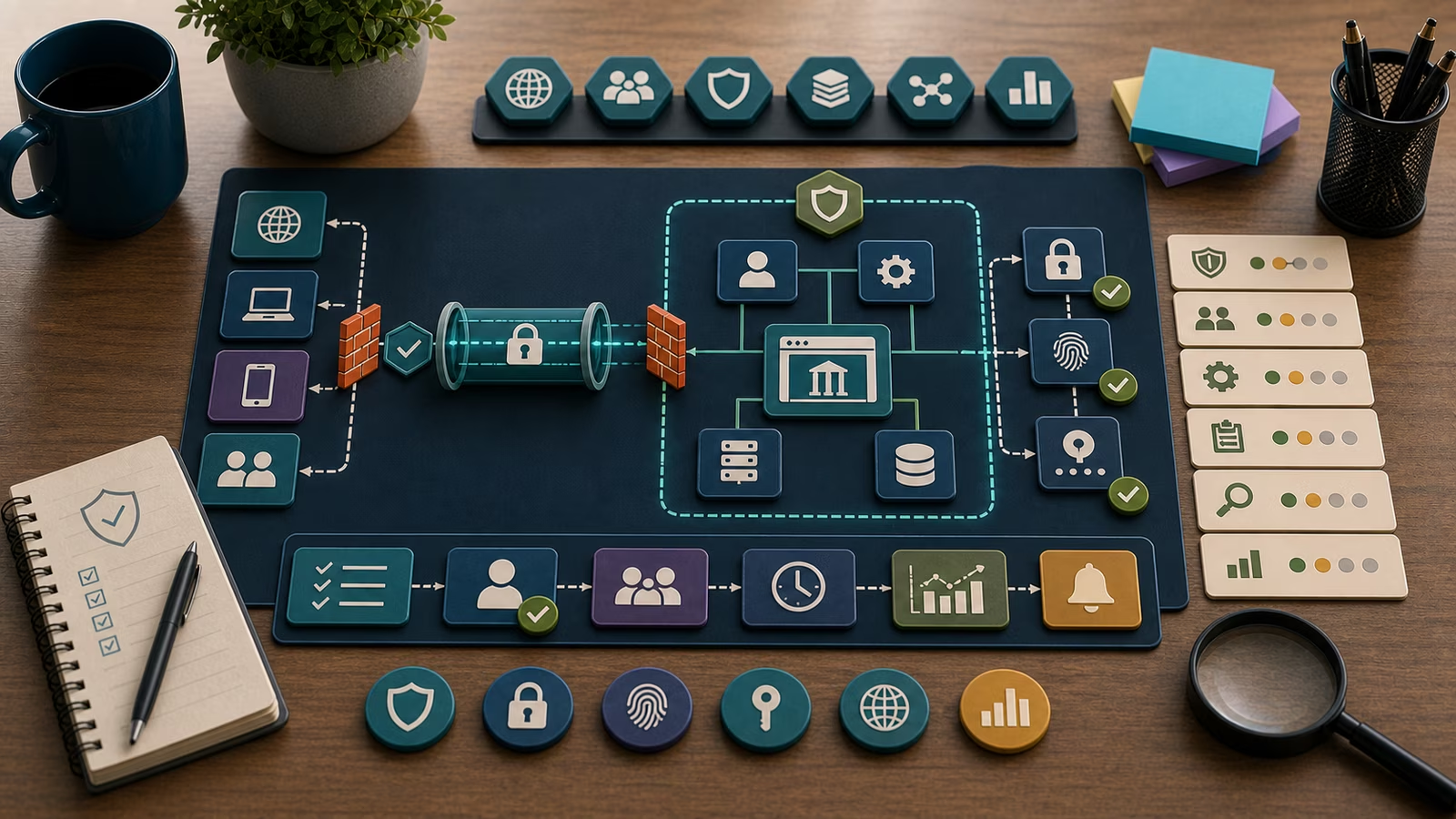

Exfiltration is the moment an intrusion stops being a story about access and becomes a story about loss. Everything before it, the foothold, the elevation, the quiet movement between systems, is reversible in the sense that the data still sits where it belongs. Once information leaves the boundary, that changes, which is why the paths data takes on its way out deserve a defender’s careful attention. The reassuring part is that moving a meaningful volume of data usually leaves marks: a spike in outbound traffic, an upload to a place the business does not normally use, a large archive appearing where none should be. Learning to read those marks is the heart of this topic.
This guide looks at exfiltration from the defensive side, focusing on what monitoring and logs can actually show. We will treat data movement as a set of observable events to be explained rather than a verdict to be declared, because most unusual transfers turn out to have ordinary causes, and the discipline is telling the ordinary ones apart from the ones that matter.
This guide is defensive education. It uses toy examples, observable evidence, and safe reasoning. It does not provide exploit instructions, malware code, credential theft steps, evasion playbooks, target scanning procedures, or operational offensive workflows. If you are handling an active incident, preserve evidence, follow your organization's incident-response plan, and involve qualified responders and legal counsel where appropriate.
The three moments before data leaves
Data rarely walks out in a single clean step. In many breach write-ups, exfiltration has a recognizable shape with three moments a defender can watch for. First comes collection, where information is pulled together from its scattered homes into one place. Then comes staging, where that collection is often compressed or bundled into an archive to make it smaller and easier to move, which is why an unexpectedly large compressed file appearing on a server or workstation is worth a second look. Finally comes the transfer itself, the outbound movement toward a destination the business does not normally send data to.
Understanding these moments matters because each one is visible somewhere different. Collection shows up as unusual access to files and databases. Staging shows up on the endpoint as new large archives and bursts of compression activity. Transfer shows up in network and cloud logs as outbound volume toward an unfamiliar place. A defender who knows the sequence can catch it earlier, before the transfer completes, and can also recognize when only one of the three is present and the others are missing.
Where the data tends to go
The destinations of exfiltration have shifted with how organizations work. The classic image of data flowing to some obscure external server is now only one option among several. A great deal of modern data movement rides on legitimate-looking channels: uploads to consumer cloud storage and file-sharing services, personal accounts on sanctioned SaaS tools, and email or collaboration platforms that employees use every day. This is precisely what makes it hard, because a large upload to a well-known cloud provider looks, at the packet level, almost identical whether it is a backup job or a theft.
The defensive answer is not to distrust every cloud upload but to know your baseline and watch the edges of it. An account that has never used a particular file-sharing service suddenly pushing gigabytes to it, a workstation uploading to a personal storage tier at three in the morning, or a service account moving data to a destination outside its normal region are the kinds of edges worth a question. The habits in Storage Bucket Mistakes and Cloud Public Exposure Mapping reduce the number of easy exits in the first place, and Shadow AI Data Leaks covers a newer path where sensitive text simply gets pasted into an outside tool.
Toy example
Consider the fictional design studio Marlowe & Finch. One evening, egress logs show that a workstation named “design-04” uploaded roughly four gigabytes to a consumer file-sharing service over about twenty minutes. On the same host earlier that afternoon, endpoint records note the creation of a large compressed archive in a temporary folder. A defender writes the observable facts plainly: “design-04 created a 4 GB archive at 15:40 and uploaded a similar volume to an external file-sharing service at 21:10; the account owner has not yet been asked, and no change record explains it.”
The team then widens carefully rather than concluding theft. Is design-04 owned by someone who legitimately delivers large design files to clients that way? Is the file-sharing service sanctioned? Does the volume match a known project handoff? Each answer moves the confidence needle. If the service is unsanctioned, the timing is off-hours, and the owner knows nothing about it, the case strengthens. If it turns out to be a designer sending final artwork to a client through an approved tool, the same evidence resolves into a normal business event with a note added to the baseline.
What evidence matters?
For an exfiltration review, the most useful evidence answers what moved, where it went, and whether the movement fits the owner’s normal work. Volume and direction come from network flow and proxy logs and from cloud provider activity records; a sustained outbound transfer that dwarfs a host’s usual traffic is the anchor observation. Destination reputation and sanction status tell you whether the endpoint is a known business partner, an approved service, or something unfamiliar. Staging artifacts on the endpoint, such as a large new archive or a burst of compression, corroborate the network signal and help distinguish a deliberate bundle from routine sync traffic.
Above all, the review needs to know what kind of data could have been involved, which is where a data classification scheme earns its keep. A large transfer of public marketing images is a very different matter from the same volume of customer records, and knowing which is which changes the urgency entirely. That judgment leans on Data Classification for Cyber Defense and, for scale, on Impact and Blast Radius . Evidence is strongest when timestamps agree across the endpoint and network records, so the log discipline in Egress Filtering and DNS Logging directly determines how much you can actually see.
Common mistakes and false positives
The busiest source of false positives in exfiltration hunting is normal bulk data movement. Backups, cloud migrations, large media handoffs, dataset syncs, and software distribution all move impressive volumes and can look alarming to a rule that only measures outbound bytes. A team that treats every large upload as a crisis will exhaust itself and start ignoring the alerts that count. The corrective is context: know which large transfers are routine for which hosts and accounts, so the genuinely unusual one is easy to see.
The opposite error is assuming that because a channel is legitimate, the transfer must be too. Approved cloud services and everyday collaboration tools are exactly where modern data loss hides, precisely because they blend in. And there is a subtle confidence trap worth naming: “a large volume left the host” is an observation, while “sensitive data was stolen” is a conclusion that needs to know what the data actually was and whether the destination was authorized. Keeping those statements separate, and tuning noisy rules the way Detection Tuning and Signal Noise describes, keeps a review honest and useful.
Worked defensive review
Return to design-04. A careful analyst writes the narrow claim, then gathers the destination’s sanction status, checks whether the archive contents can be inferred from file metadata without opening anything sensitive, confirms with the owner whether the transfer was expected, and checks the data classification of the folders that were accessed beforehand. Suppose the destination is an unsanctioned personal service, the owner disclaims any knowledge, and the accessed folders held customer information. The review now supports a high-confidence, high-urgency note: preserve the endpoint and egress logs, avoid tampering with the host, and hand the finding to the incident process where the people who can authorize containment and notification take over. The analyst records confidence as a level and keeps observation and inference in separate sentences, so the next reader can see which parts are proven.
What to do next
Scale your response to what the evidence supports and what the data was worth. If the transfer resolves into sanctioned, owner-confirmed business activity, document it, and if it revealed a gap, tighten the egress control or add the pattern to your baseline. If the destination is unfamiliar, the timing is odd, and sensitive data may have been in scope, preserve the records, resist interacting with the destination, and escalate. Because exfiltration is usually the tail of a longer story, trace backward through Command-and-Control Concepts to understand how the data was being steered out and forward through Impact and Blast Radius to size what was lost.
For anything active, do not experiment. Preserve evidence, follow the incident-response plan, communicate through approved channels, and involve qualified responders. For learning, keep the hosts and datasets fictional and practice the core reflex: describe what moved and where, establish whether it was authorized and what it contained, and only then decide how loudly to respond.
How this guide was made
This page is defensive education, built from public frameworks such as MITRE ATT&CK and public breach-pattern reporting, and illustrated with invented hosts and toy data. It makes no claim to certification, legal advice, incident-response authority, or complete coverage, and it deliberately avoids operational offensive detail so that it stays useful for safe study.
Official references
As orientation rather than certification, the MITRE ATT&CK Enterprise Matrix catalogs exfiltration techniques alongside the telemetry that reveals them, the CISA Known Exploited Vulnerabilities Catalog tracks flaws often used to reach the data in the first place, and the NIST Cybersecurity Framework 2.0 frames the detect-and-protect functions that keep data movement observable.
Related guidebooks
To follow the arc that leads to data loss and its aftermath, read Command-and-Control Concepts for how the exit is steered and Impact and Blast Radius for sizing the damage. For the controls that shrink the exits, Egress Filtering and DNS Logging and Data Classification for Cyber Defense are the most practical companions.