A single compromised laptop is a problem you can contain. A compromised laptop that has quietly reached six other machines, a file server, and a domain controller is an incident that can consume a weekend and a reputation. The difference between those two situations is lateral movement: the phase where an intruder stops sitting on their first foothold and begins spreading sideways, host to host and identity to identity, hunting for the access and data that made the intrusion worthwhile. Catching that spread while it is small is one of the highest-leverage things a defender ever does, and it is also one of the subtlest, because the movement usually wears the clothing of ordinary administration.
The reason lateral movement is hard to see is the same reason it is dangerous. By this stage an intruder frequently holds a legitimate credential, so their connections authenticate cleanly, and they often prefer the built-in remote-management tools that administrators use every day rather than anything that would look obviously foreign. There is rarely a bright red alert. There is instead a change in the shape of normal activity: accounts reaching hosts they have no reason to touch, remote execution appearing where it never appeared before, and connections forming edges in the network that never existed until now. Reading that shift is fundamentally about relationships, which is why lateral movement is best understood as a graph problem rather than a list of alerts.
This guide is defensive education. It uses toy examples, observable evidence, and safe reasoning. It does not provide exploit instructions, malware code, credential theft steps, evasion playbooks, target scanning procedures, or operational offensive workflows. If you are handling an active incident, preserve evidence, follow your organization's incident-response plan, and involve qualified responders and legal counsel where appropriate.
Why lateral movement is a graph, not a list
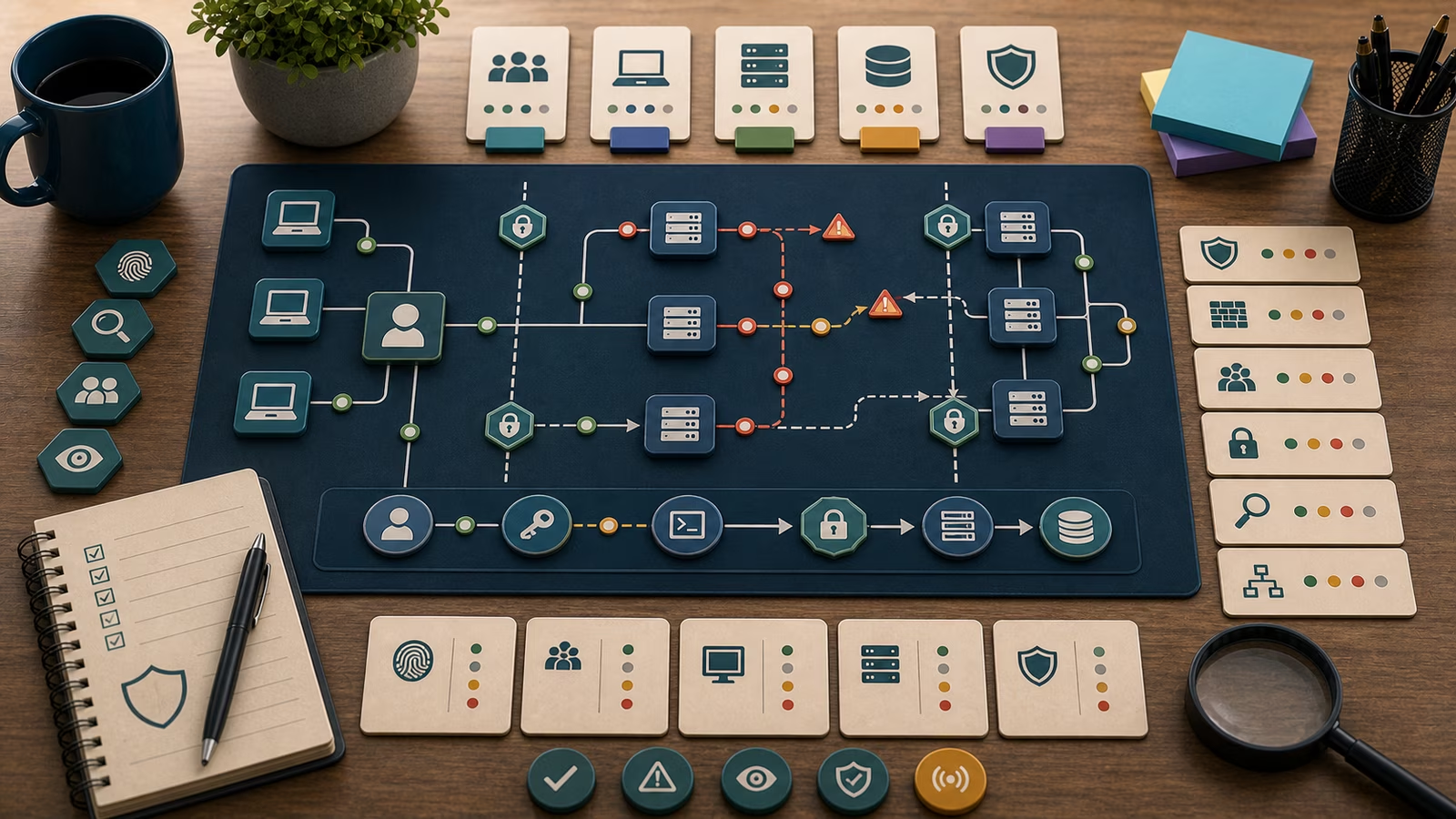
Most detection tooling presents the world as a stream of events: this login, that process, this connection. Lateral movement lives in the edges between those events, not in any single one of them. The meaningful unit is a relationship — this identity authenticated to that host, that host connected to this server, this credential appeared on a machine it has no business being on. Drawn out, these relationships form a graph of who can reach what, and an intrusion is a path being traced through that graph in near-real time.
Thinking in graph terms changes which questions feel important. Instead of asking “is this one login bad?” a defender asks “does this login create an edge that should not exist, and where does that edge let the path go next?” A workstation account authenticating to a database server is not suspicious because the login failed — it succeeded — but because that edge has never existed before and, in a well-segmented environment, should not. The same framing explains why reducing edges in advance is such a powerful defense: every trust relationship you remove is a path the intruder cannot walk, an argument developed in Network Segmentation and Flat Networks and Impact and Blast Radius . Understanding the graph as a whole is the subject of What an Attack Path Is .
Suspicious authentication as the first tremor
The earliest and most reliable tremor of lateral movement is authentication that does not fit the graph. An account signing in to a host it has never touched, a burst of one account authenticating to many machines in quick succession, service or machine accounts logging in interactively when they normally never do, or credentials appearing on hosts far from their usual home — these are the shapes worth watching. None is proof on its own, because administrators, backup jobs, monitoring agents, and deployment automation all produce cross-host authentication legitimately. The signal is in the deviation from an established baseline, which is why lateral-movement detection rests entirely on knowing what normal looks like, as Authentication Log Patterns and Known-Good Baselines both stress.
Because these authentications are clean by construction, they connect directly to the Valid Accounts problem. The intruder is not breaking the lock; they are using a real key on doors the key’s owner never opens. The defender’s edge is context: the same key behaving out of character across the graph tells a story no single login can.
Remote execution as the second tremor
Reaching a host is one thing; making it do work is another, and the second tremor of lateral movement is remote execution appearing where it does not belong. Conceptually, this is one machine causing a program to run on another — the ordinary substance of systems administration, and therefore easy to hide within. The defensive signal is not that remote execution occurred but that it occurred in an unexpected relationship: a user workstation triggering execution on a server, a process launching a command interpreter as an unusual child, or administrative tooling running from a host that never runs it. Reading these patterns is the craft covered in Processes, Parents, and Command Lines , Suspicious Process Indicators , and Script Interpreter Telemetry .
The advanced skill here is correlating the two tremors. An unusual authentication edge followed shortly by unexpected remote execution on the same host, followed by that host forming a new edge of its own, is a path being drawn. Any one link is noise; the chain is signal. This is where graph thinking pays off, because the chain is only visible when you hold the relationships together rather than triaging each event alone.
Toy example
Imagine a fictional logistics company, Cartwright Freight, with a flat-ish internal network and an account belonging to a dispatcher named Lena. Overnight, the telemetry shows Lena’s account authenticating to a warehouse file server it has never touched, and eleven minutes later that same file server initiating a connection to the billing database — a machine the file server has no ordinary reason to contact. Shortly after, the billing database logs a remote execution event whose parent process is not the usual administrative tooling.
Read as three separate alerts, each is shruggable: file servers get accessed, servers talk to databases, execution happens. Read as a graph, they form a path — dispatcher account to file server, file server to billing database, billing database to unexpected execution — that traces outward from a single origin in minutes, crossing trust boundaries that Lena’s real workflow never crosses. The calm response is not to declare a breach and not to dismiss three tired alerts, but to treat the chain as a hypothesis with a shape: confirm with Lena whether she did any of this, preserve the logs on all three hosts before anything is disturbed, and prepare to cut the newest edges if the human cannot explain them. The origin, Lena’s workstation, becomes the natural place to consider isolation, following Endpoint Isolation and Rejoin Planning .
What evidence matters?
The strongest evidence for lateral movement is correlated across hosts and time, which is why it depends on telemetry that many environments discover, too late, they were not collecting. You want authentication logs from every host rather than a few, process-creation records with parent-child lineage, and network-connection records that show which host reached which, when. Each source is valuable alone and far more valuable joined, because the whole point is to reconstruct a path across machines. What to retain in the first place is the subject of Logs: What to Keep and Why , the connection layer is developed in Network Connections: Ports, Protocols, and Remote Hosts , and the joining itself depends on trustworthy timestamps, which is exactly why Time Synchronization and Log Correlation matters so much when reconstructing a chain.
Evidence is strongest when it lets you draw the graph: named hosts, named identities, ordered timestamps, and the direction of each edge. A screenshot of one alert is a single dot. A correlated timeline of authentications, executions, and connections is the path, and the path is what tells you how far the intrusion has already reached and where it is heading next.
Common mistakes and false positives
The signature mistake at this level is triaging lateral-movement evidence event by event, closing each alert as individually benign and never noticing that together they form a chain. Legitimate administration is the great confounder: patch management, backup systems, vulnerability assessment tools, monitoring agents, and deployment automation all authenticate across many hosts and run things remotely by design, and each can look, in isolation, exactly like an intrusion. A mature program baselines these legitimate cross-host relationships first, so that the graph has a known shape and genuine anomalies stand out against it rather than drowning in it — the discipline of Detection Tuning and Signal Noise .
The opposite mistake is acting on a single unfamiliar edge with heavy containment before confirming the chain, disrupting a legitimate administrator and eroding trust in the security team. And a quieter failure is missing telemetry: concluding there was no lateral movement when the truth is that the relevant hosts were never logging, so the graph simply has holes where the path ran. Absence of evidence, when the sensors were off, is not evidence of absence.
False positives are constant and, handled well, productive. A new backup server legitimately forms dozens of new authentication edges the day it is deployed. A migration project has real users touching hosts they never touched before. A new monitoring tool sprays remote execution across the fleet by design. Each resolves the same way: confirm the change with its owner, compare against the baseline, and decide whether the cluster of edges tells a sanctioned, coherent story or an out-of-character one. A false positive that ends by teaching your baseline a new legitimate relationship has permanently sharpened your detection.
What to do next
Invest first in the graph itself: complete authentication, process, and connection telemetry, correlated on trustworthy time, using Logs: What to Keep and Why and Time Synchronization and Log Correlation . Then remove edges in advance through Network Segmentation and Flat Networks , so that fewer paths exist to walk. Because lateral movement always follows an initial foothold and usually rides a legitimate credential, read it alongside Initial Access Without Drama and Valid Accounts , and follow the path forward into Privilege Escalation Signals .
For anything that looks like an active chain, preservation comes before disruption. Capture the logs across every host on the path, follow your incident-response plan, communicate through approved channels, and involve qualified responders, since cutting one edge without understanding the whole graph can scatter an intruder you have not yet fully mapped.
How this guide was made
This page is defensive education built from public frameworks including MITRE ATT&CK, CISA intrusion advisories, and CIS monitoring and segmentation guidance, using invented organizations and toy data. It makes no certification, legal, or incident-response-authority claims, and it deliberately keeps remote-execution and authentication concepts at a defensive, non-actionable level so it stays useful for detection rather than for harm.
Official references
For orientation, the MITRE ATT&CK Enterprise Matrix documents the lateral-movement tactic and its remote-execution techniques alongside the detections that counter them. The CISA Known Exploited Vulnerabilities Catalog and CISA’s intrusion advisories repeatedly show host-to-host spread in real cases, and the NIST Cybersecurity Framework 2.0 offers a calm structure for turning telemetry, segmentation, and detection into a program that limits how far any single foothold can reach.
Related guidebooks
Read this next to Initial Access Without Drama and Valid Accounts for how the path begins, and Exploited Public-Facing Apps and External Remote Services for the footholds that precede it. Follow the path forward into Privilege Escalation Signals .