A ransomware incident almost never begins with a locked screen. By the time anyone sees a ransom message, the interesting part of the story is already days or weeks old. What defenders find useful is the shape of that story told backwards from the disruption: a quiet foothold, some patient movement between machines, a stretch where files are copied out, and only then the noisy encryption that everyone remembers. Learning the timeline is less about memorizing stages and more about knowing which faint clue, seen early, gives a small team the hours it needs to act while the damage is still small.
This guide walks that arc from a defender’s chair, using a calm, evidence-first lens. It treats each phase as a set of things you could actually observe in ordinary logs and ask ordinary questions about, rather than a dramatic scene. The point is to recognize where a defender still has leverage, and to keep that recognition from curdling into either panic or false comfort.
This guide is defensive education. It uses toy examples, observable evidence, and safe reasoning. It does not provide exploit instructions, malware code, credential theft steps, evasion playbooks, target scanning procedures, or operational offensive workflows. If you are handling an active incident, preserve evidence, follow your organization's incident-response plan, and involve qualified responders and legal counsel where appropriate.
The shape of the timeline before the ransom note
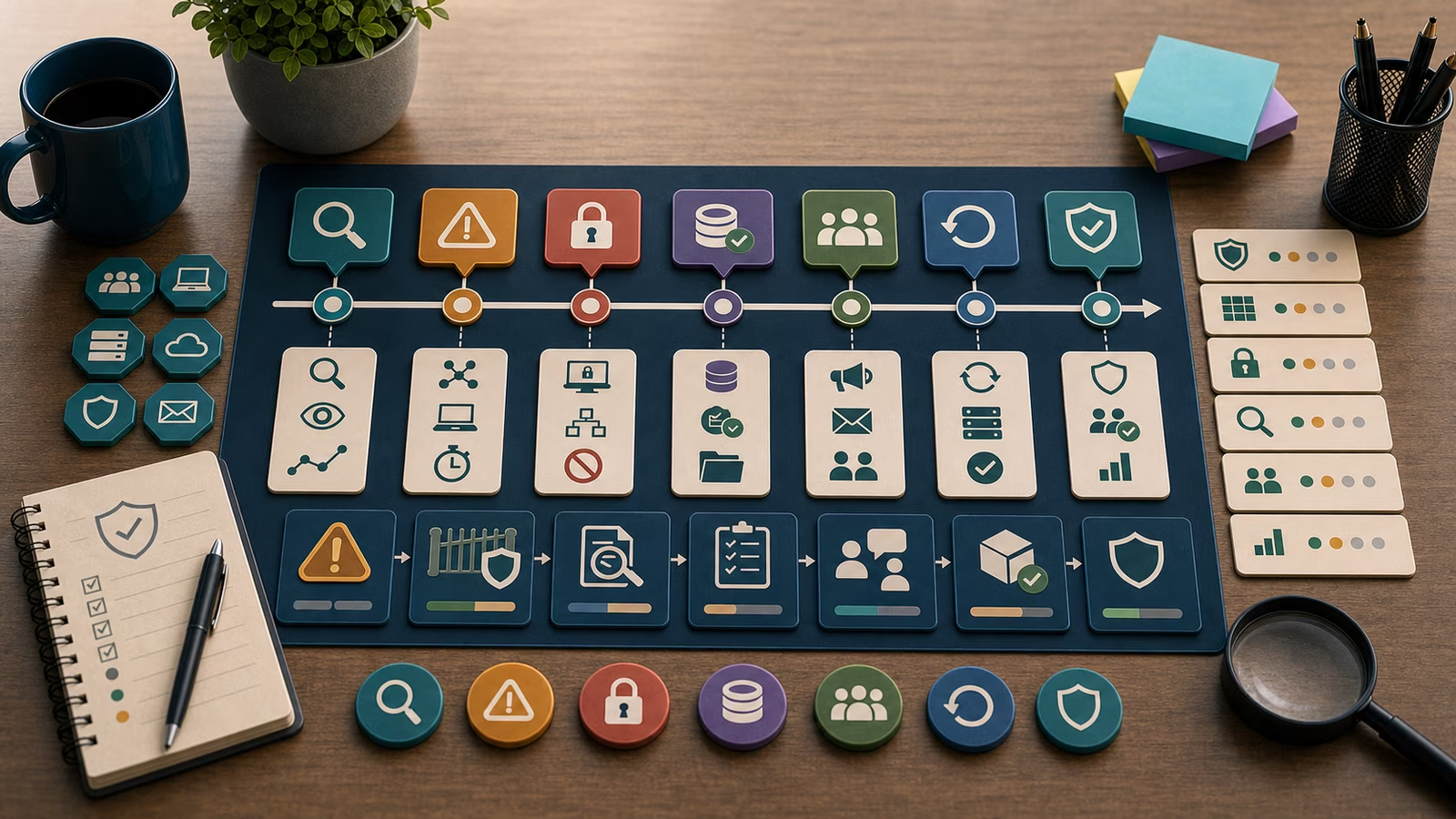
It helps to hold a rough sequence in mind. First comes initial access, often nothing more dramatic than a valid login from a stolen credential or a booby-trapped attachment that someone opened weeks ago. Then a dwell period, where the intruder is present but careful, learning the environment and looking for accounts with more reach. Somewhere in that window privileges tend to widen, movement spreads from one host to a file server or a backup console, and data may be copied out before anything is locked. Encryption is the finale, not the plot. Recovery is the epilogue the organization writes for itself.
Each of those phases leaves different traces, and none of them is a single alarm. The value of the timeline view is that it tells you a late clue and an early clue can describe the same intrusion. A defender who understands that a mass-encryption event was preceded by weeks of movement will look backward for the foothold rather than treating the encryption as the whole event. That backward look is what turns a cleanup into an actual investigation, and it is what keeps the same door from being used again a month later.
What evidence matters?
The evidence that matters shifts as the story moves, and knowing which phase you are looking at tells you which records to pull. Early on, authentication logs carry the most weight: a login for a sensitive account at an odd hour, from an unfamiliar location, or one that succeeds after a run of failures. These are not proof of anything by themselves, but they are the kind of fact you can timestamp and tie to a named account, which makes them reviewable rather than merely alarming. The related guide on Valid Accounts covers why legitimate credentials are the quietest way in and the hardest signal to read.
In the middle of the timeline, the evidence turns toward relationships between machines. A workstation that suddenly talks to a file server it has never contacted, an administrative tool running on a host that has no business running it, or a service account being used interactively are all worth writing down. Signals like these belong to the story told in Lateral Movement Signals . Near the end, the evidence becomes unmistakable but also the least useful for prevention: a burst of file rewrites, extensions changing across a share, and processes touching thousands of files in minutes. That mass-encryption pattern is the subject of File Entropy and Mass-Encryption Clues , and it is exactly the signal that arrives too late to stop the whole event but early enough to shrink it. Throughout, evidence is strongest when it is exported and preserved rather than screenshotted, because a responder reading it a day later needs the surrounding context, not just a single frame.
Toy example
Picture a fictional design studio called Marlowe & Vale, with a dozen laptops, a shared file store, a customer database, and a handful of SaaS tools. The first faint clue arrives on a Tuesday: an account belonging to a contractor named “r.okafor” signs in successfully at 3:10 a.m., which is unusual because that contractor works daytime hours in the same time zone. Nobody panics, and nobody dismisses it. Someone writes down the observable fact and asks the owner whether that login was expected.
Over the following days, if this were a real intrusion, the studio might notice that the same account now reaches the file server, that a laptop labeled “studio-07” begins connecting to hosts it never touched, and that a backup console shows a login from an account that has never administered backups. None of these needs to be treated as the ransom event. Each is a place where a defender still has leverage: a chance to confirm with the owner, preserve the relevant logs, and decide whether to isolate one machine. The lesson of the toy example is that the earliest clue and the eventual crisis are points on the same line, and the studio’s fate depends far more on the Tuesday login than on the moment files lock.
Where the leverage actually is
Defenders sometimes assume that stopping ransomware means catching the encryption in the act. In practice, the encryption is the phase where you have the least room to maneuver, because it is fast and largely automated once it starts. The real leverage sits earlier, in the quiet stretch when an intruder is moving carefully and generating small, boring anomalies. An organization that reads authentication and movement signals well can interrupt the sequence before the payload ever runs. This is why understanding Impact and Blast Radius matters: it tells you which early clue threatens the most and therefore deserves the fastest question.
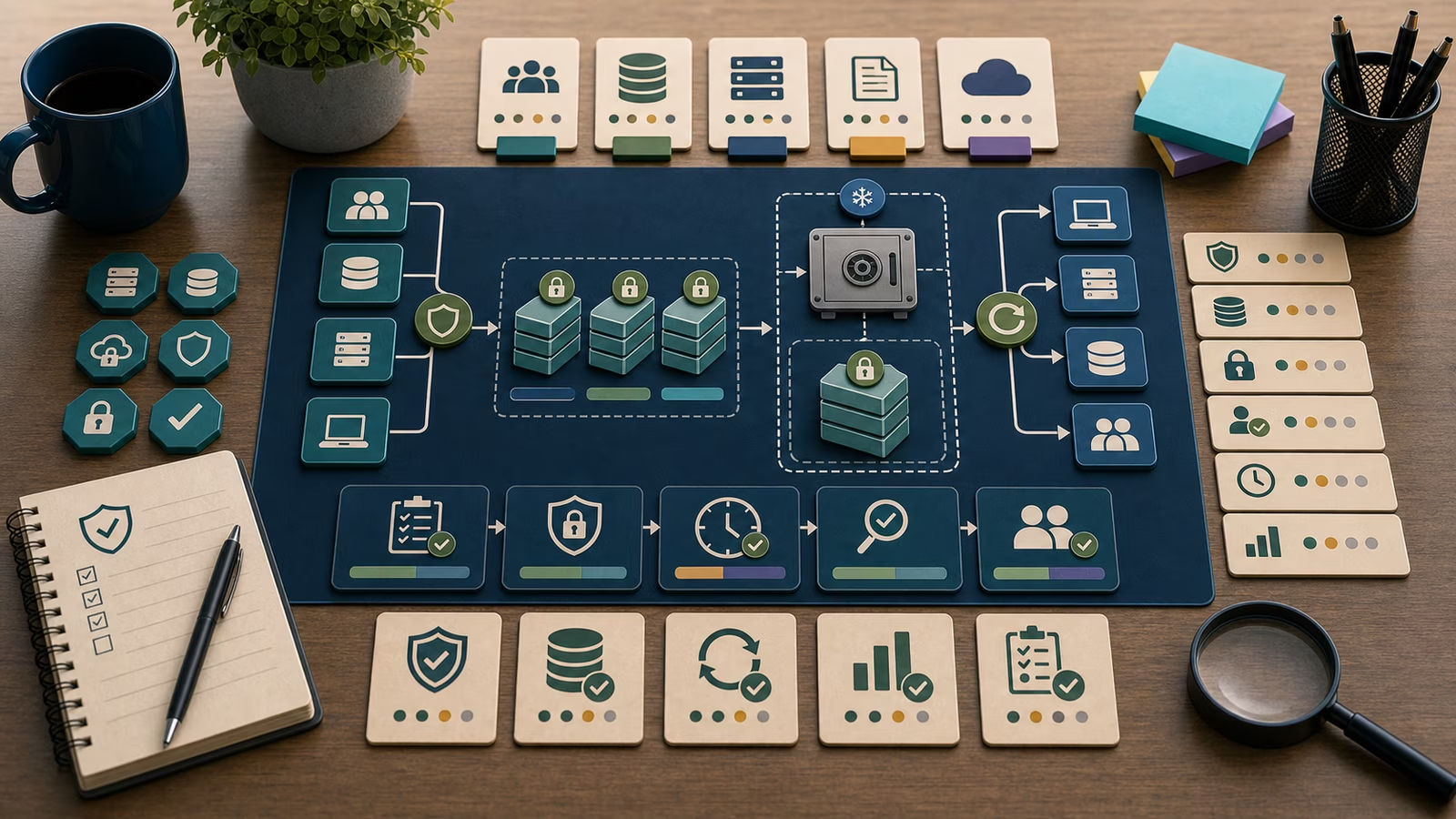
Leverage also comes from preparation that predates any incident. Backups that are held offline or made immutable turn the final phase from a catastrophe into an inconvenience, which is the argument developed in Backup Design for Recovery . And knowing in advance who can approve taking a machine offline, so that decision is not improvised at 3 a.m., is the difference between clean containment and a scramble. The timeline rewards teams who did their thinking before the clock started.
Common mistakes and false positives
The most common mistake is treating the ransom note as the beginning of the incident rather than its final act. Teams that do this clean the encrypted machines, restore from backup, and declare victory while the original foothold stays open, which is how a second event follows the first. A related error is assuming any burst of file activity is ransomware. Legitimate work produces bursts too: a bulk photo export at the design studio, a scheduled backup job rewriting archives, a migration tool copying a share. The odd 3 a.m. login can just as easily be a jet-lagged contractor or a misconfigured automation. Each of these deserves the same calm treatment, which is to write the observable fact, ask the owner, and check the baseline before naming it an attack.
False positives are not wasted effort. A late-night login that turns out to be legitimate still teaches you what normal looks like for that account, and a file burst that turns out to be a backup job still confirms that your monitoring can see mass file activity at all. The habit that protects a small team is separating what was seen from what it might mean, and refusing to write a verdict until the evidence supports one.
What to do next
If the evidence in front of you is an early clue, treat it as a question rather than a conclusion: confirm with the owner, preserve the relevant logs, and decide whether one machine should be isolated while you look. If it is a late clue, such as active encryption, shift into your incident-response plan, protect the backups, and involve qualified responders rather than experimenting. In both cases, resist the urge to wipe evidence in the name of speed, because the record of how the intrusion started is what prevents the next one.
For learning, keep your practice fictional and follow the arc deliberately. Take an invented scenario and write out where along the timeline you think you are, what you would observe next if you are right, and what the smallest safe action would be. Then read the neighboring guides for the phases that touch yours: Detecting Encryption Behavior for the loud end, Containment Decision Trees for the choices in the middle, and Exfiltration Paths for the data theft that often precedes the lock.
How this guide was made
This page is defensive education assembled from public frameworks and openly published incident-response guidance, illustrated with fictional organizations and invented account names. It describes the shape of a ransomware incident so defenders can reason about it, and it deliberately omits any operational offensive detail. It makes no claim to certification, legal advice, or incident-response authority; for real events, rely on your own plan and qualified professionals.
Official references
For orientation rather than certification, the CISA StopRansomware Guide lays out the phases and response checklist that this timeline reflects, NIST SP 800-61 Rev. 3: Incident Response Recommendations provides the incident-handling lifecycle that underlies the recovery arc, and the CIS Critical Security Controls v8 group the safeguards that give a small team leverage at each stage.
Related guidebooks
To go deeper on the phases named here, read Backup Design for Recovery and Detecting Encryption Behavior for the recovery and detection ends of the line, and Containment Decision Trees alongside Impact and Blast Radius for the judgment calls in between.