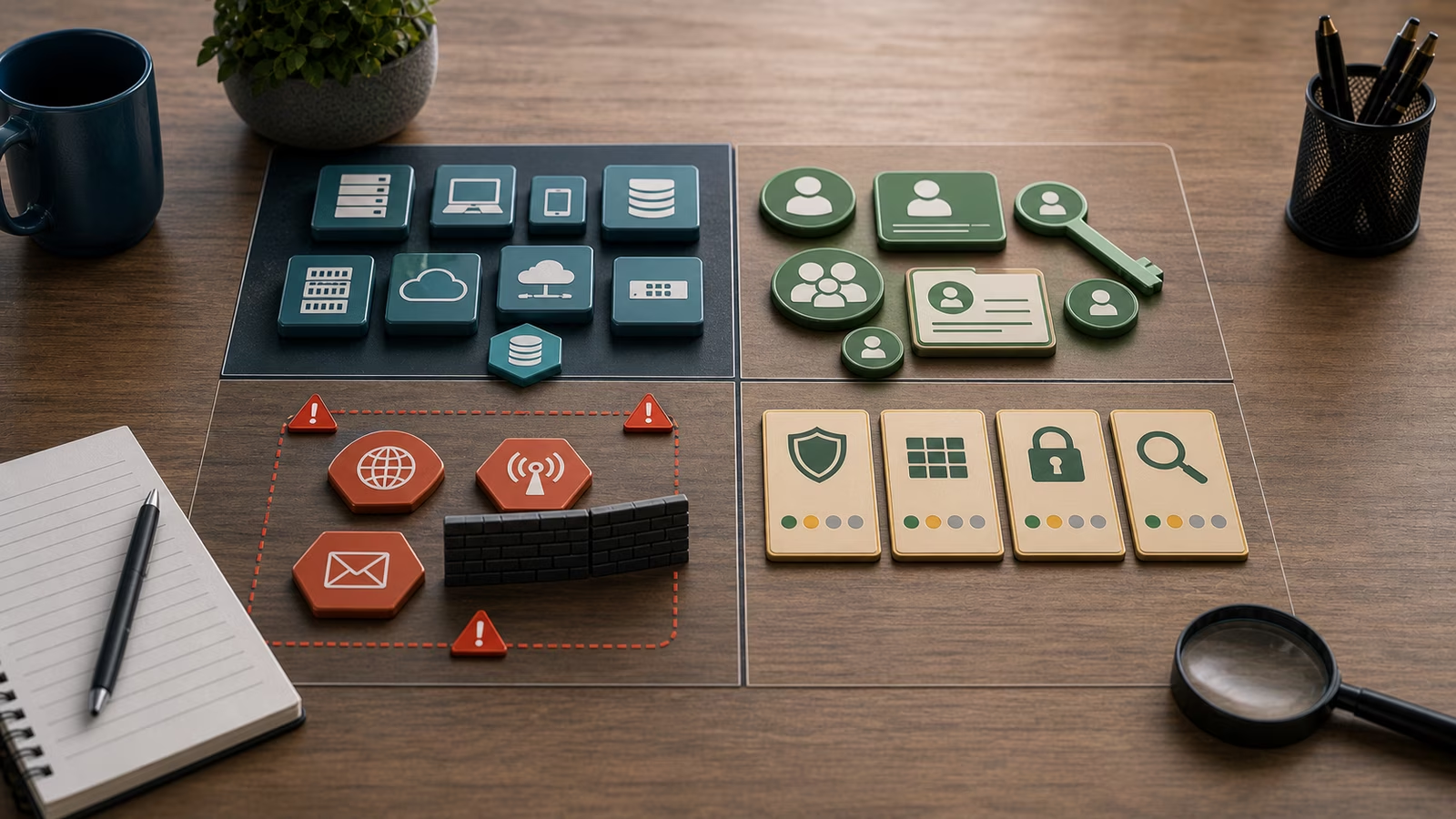

The difference between security education and a computer-crime charge is almost never the knowledge involved; it is authorization. Reading how an attack works, mapping how a defense responds, and practicing analysis on systems you own or are explicitly permitted to touch are ordinary learning. Running the same techniques against a system you do not own — a former employer, a website that annoyed you, a stranger’s server “just to see” — crosses a legal line that curiosity does not excuse. The boundary is not about how advanced the topic is. A beginner poking at someone else’s login page is over the line, while an expert dissecting malware in an isolated lab they built is not.
Holding that boundary clearly is what makes it possible to learn aggressively without becoming a hazard. Once you internalize that the question is always “do I have permission to do this, to this system,” you can study attacker technique in depth, read real incident write-ups, and build demanding practice environments — because the thing keeping it safe is the container you put the work in, not the timidity of the subject.
This guide is defensive education. It uses toy examples, observable evidence, and safe reasoning. It does not provide exploit instructions, malware code, credential theft steps, evasion playbooks, target scanning procedures, or operational offensive workflows. If you are handling an active incident, preserve evidence, follow your organization's incident-response plan, and involve qualified responders and legal counsel where appropriate.
Where the line actually is
Authorization is specific, not general. Permission to test one application does not extend to the server it runs on, the network around it, or the accounts of its users. “Scope” is the word for this in professional testing, and it exists precisely because good intentions are not a defense — acting outside the agreed target, even while trying to be helpful, is still unauthorized. For a learner with no client and no engagement, the safe scope is small and unambiguous: systems you personally own, accounts you personally control, and lab environments you built for the purpose. Anything shared, borrowed, or public belongs to someone else until they say otherwise in writing. When in doubt, the boundary sits on the side of not touching it.
Toy example
Imagine a student learning at the fictional Marigold Studio, where they have been given a sandboxed training account. They read an incident report about a consent-phishing attack and want to understand it properly. The safe version is entirely inside their own sandbox: they set up a throwaway app registration they own, walk through how an over-broad consent grant would appear in logs they already have access to, and practice writing the defensive note. What they do not do is send a lure to a real coworker “to test awareness,” register a look-alike app against the studio’s real tenant, or probe a login page they were never asked to assess. Every artifact is invented or self-owned, and the learning lives in modeling the attacker’s logic and the defender’s evidence rather than in acquiring a real victim. The reasoning drills that follow — turning an observation into a checkable claim — are the same ones in Evidence-First Triage .
What evidence matters?
Even in pure learning, the evidence discipline is the point, because it is the transferable skill. The four kinds that matter in real defense — the original signal, its context, the control state, and the decision record — are exactly what a good practice exercise rehearses. On a toy scenario you still write the smallest checkable claim, still separate what is observed from what is assumed, and still record confidence as a level rather than a certainty. Practicing on invented data has a hidden benefit: because you control the ground truth, you can check whether your reasoning actually reached the right conclusion, which is impossible when you are guessing about a real system you were never authorized to understand. Building this habit on safe material is why Processes, Parents, and Command Lines and Known-Good Baselines read the way they do.
Building a lab you own
A practice lab is the honest way to get realism without borrowing someone else’s systems. The essential property is ownership and isolation: virtual machines on hardware you control, on a network segment that cannot reach anyone else, with data you invented. Inside that container you can study demanding material — how encryption behavior looks in logs, how a suspicious process tree reads, how an attack path is reconstructed after the fact — because nothing you do can reach a system you lack permission to touch. Snapshots let you break things and reset; isolation keeps mistakes from escaping onto a real network. The discipline of keeping the lab sealed is itself a security lesson, and it lets you engage with genuinely offensive concepts from a defender’s chair without producing any real-world effect.
Studying attacker technique without becoming a hazard
Defenders have to understand offense; you cannot reliably detect what you refuse to comprehend. The safe way to study it is at the level of concept and detection rather than operational recipe — reading a public technique catalog to learn what a category of attack looks like in telemetry, tracing how a documented incident unfolded, and asking which control or signal would have caught it. That is a different activity from collecting working intrusion tooling or rehearsing a live attack against a system you do not own. Framing offensive knowledge as “what evidence would this leave behind, and what control would stop it” keeps the study defensive in both effect and intent, and it maps naturally onto the shared vocabulary that What an Attack Path Is uses to describe how intrusions chain together.
Common mistakes and false positives
The most common mistake is assuming good intentions convert unauthorized access into permitted access; they do not, and “I was only helping” is not consent. A second is scope creep — being allowed to look at one thing and drifting into the systems around it simply because they were reachable. A third is using real people, real accounts, or real company data in a “practice” exercise, which quietly turns a lesson into a live action with real consequences. A fourth is publishing or sharing something learned in a way that hands a working capability to someone who lacks the same boundaries.
The parallel to false positives is worth keeping. In learning, the equivalent of an overread is convincing yourself that a safe-looking exercise is fine when it actually touches something you do not own. When you catch that, the fix is the same as with any false positive: write down why it crossed the line, tighten the scope of the exercise, and keep the reasoning for next time. Recklessness and paralysis are the twin errors here; the middle path is a lab you own, data you invented, and a written reason for every step you take.
What to do next
Before any hands-on exercise, ask one question and answer it honestly: do I own, or have explicit written permission for, every system this will touch. If the answer is not a clear yes, redesign the exercise until it is — usually by moving it into a lab you built or a sandbox you were formally given. Keep names, hosts, and data fictional, rehearse the evidence-first note-taking that transfers directly to real defense, and treat the isolation of your practice environment as part of what you are learning.
If you ever move from study into a real environment, the rules change: you act only within an authorized scope, under your organization’s plan, and in an active incident you preserve evidence, follow that plan, and involve qualified responders and counsel rather than experimenting. When your practice is ready to move from “is this signal real” toward “how much does it matter,” Risk Scores, Severity, and Confidence is the natural next step.
How this guide was made
This page is defensive education built from public frameworks and widely published training guidance, illustrated with invented systems and toy data. It makes no claim to certification, legal advice, or incident-response authority, and it deliberately avoids exploit detail so it remains useful for safe learning. The official references below are orientation points, not a standard you are being measured against.
Official references
For a safe path into the field, the NIST Cybersecurity Framework 2.0 offers a structured map of defensive functions a new learner can follow, the CIS Critical Security Controls v8 lay out prioritized safeguards you can study and practice on systems you own, and the MITRE ATT&CK Enterprise Matrix lets you study attacker techniques through a defensive knowledge base rather than through live targets.
Related guidebooks
The safest place to begin is the Cyber Defense Quickstart: Think Like a Defender ; from there, What an Attack Path Is and Processes, Parents, and Command Lines give you demanding material you can study entirely on systems you own.