
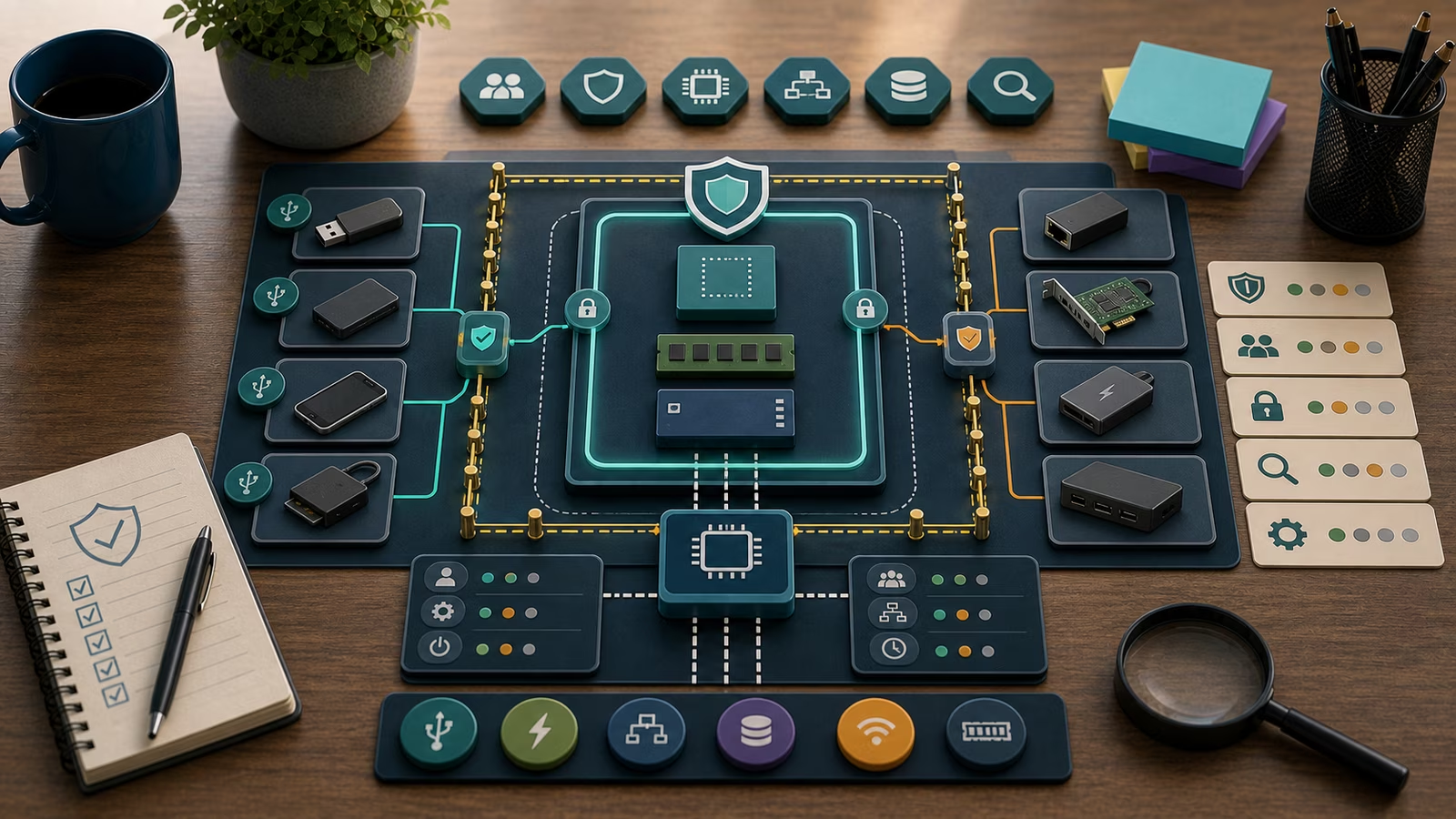
Peripherals are easy to overlook because they feel domestic. A memory stick, a dock, a webcam, a charging cable — these are the furniture of ordinary work, and most of the time they are exactly what they appear to be. Peripheral risk becomes a defensive topic once you notice that plugging something into a computer is, in effect, introducing a small device with its own identity and capabilities into a position of unusual trust. The interesting questions are not about paranoia toward every cable but about which ports and devices can reach further into a machine than others, and what a defender can observe and decide when something new appears.
Two distinctions do most of the work. The first is between devices that merely present data and devices that can act with more direct access to system memory. Ordinary storage on a common USB port is handled through layers that mediate what it can touch, whereas certain high-speed interfaces support direct memory access, or DMA, which lets a connected device read and write system memory more directly for performance reasons. That capability is a feature — it is how fast storage and displays work well — but it also means a DMA-capable port grants a peripheral a stronger position than a simple data port. The second distinction is whether the machine has protection mediating that access. An IOMMU, roughly an address-translation and permission layer for devices, can constrain what a DMA-capable peripheral is allowed to reach. Whether that protection is present and enabled is one of the more meaningful facts about a given host’s peripheral posture.
This guide is defensive education. It uses toy examples, observable evidence, and safe reasoning. It does not provide exploit instructions, malware code, credential theft steps, evasion playbooks, target scanning procedures, or operational offensive workflows. If you are handling an active incident, preserve evidence, follow your organization's incident-response plan, and involve qualified responders and legal counsel where appropriate.
Why the port matters as much as the device
A useful habit is to think about the port’s capability, not just the device’s label, because a peripheral inherits whatever position the port grants it. A device on a simple data port and the same-looking device on a DMA-capable high-speed port occupy different levels of trust, even if both are innocuous. This is why “a new USB device appeared” is an incomplete observation on its own; the more informative version names what kind of port it attached to and whether that port supports direct memory access. Two facts then shape the risk: the port’s capability and the machine’s protection posture, chiefly whether an IOMMU is present and enabled to mediate device access.
Another reason peripherals deserve attention is that a device can be more than it claims. The trust model of many interfaces is largely based on the device describing what it is, and a peripheral’s declared identity is a claim rather than a proof. A defender does not need to know how a device might misrepresent itself to take the sensible lesson: an unexpected peripheral’s self-description is not evidence of what it actually is, and a machine that automatically trusts whatever announces itself is extending trust on a claim. That is a policy and inventory question as much as a technical one, which is why peripheral risk sits close to asset tracking and least-privilege thinking, including the account-side reasoning in IAM Roles and Least Privilege .
Toy example
Imagine a fictional architecture practice, Northgate Studio, with a handful of laptops and no written rule about what may be plugged in. One morning a device-management console shows an unfamiliar peripheral attaching to a designer’s laptop, “studio-04,” through a high-speed port. The analyst on duty, Rosa, writes the informative version of the observation rather than the vague one: “An unrecognized peripheral attached to studio-04 at 09:14 through a DMA-capable port; the machine’s IOMMU status is not yet confirmed.” Naming the port capability and the protection posture, rather than just “a new USB thing,” is what turns the note into something reviewable.
Rosa’s questions are calm and ordinary. Who owns studio-04 and did they connect something, such as a new dock or fast drive? Is the port in question actually DMA-capable, or is it a simple data port that only looks alike? Is device-access protection enabled on this model, and is there any policy that should have governed the connection? She confirms with the designer that they attached a new display dock, checks that the laptop’s device-access protection is enabled, and records the peripheral in the studio’s informal inventory. The event resolves as benign, but it surfaces two lasting improvements: the studio now knows this laptop’s protection posture, and it has the beginnings of a peripheral policy where it previously had none. Had the owner not recognized the device, or had protection been disabled on a DMA-capable port, the same observation would have justified a more careful, preservation-minded response.
What evidence matters?
The evidence that matters here is more about configuration and provenance than about dramatic behavior. The most informative facts are the port’s capability, the machine’s protection posture — whether an IOMMU or equivalent device-access protection is enabled — the identity the device presents, whether an owner can account for the connection, and whether any policy governed it. A newly attached device is only mildly interesting; an unaccounted-for device on a DMA-capable port on a machine whose protection status is unknown is a coherent reason to slow down and confirm. Much of the useful evidence is knowable in advance, which is what makes this a posture topic: you can know a host’s protection state and its peripheral policy before any device is ever plugged in.
Evidence is strongest when it is tied to a specific host, timestamped, and connected to an owner’s confirmation or a policy record. Device-connection telemetry — the kind a kernel-level sensor of the sort described in eBPF for Defenders can help surface — is more useful when the host’s baseline configuration is already documented, so a new device can be compared against what is normal and approved. The honest limits are worth recording too: whether device telemetry was even being collected, and whether the protection posture was verified or merely assumed.
Worked defensive review
A good review of a peripheral event connects the device to the port, the port to the machine’s protection posture, and the whole thing to ownership and policy. Start with the narrow, informative fact: what attached, to what kind of port, on which host, when, and whether protection is enabled. State what the observation cannot yet establish — a device’s self-declared identity is a claim, and a new peripheral is not by itself evidence of harm. Then write what would raise concern, such as an unaccounted-for device on a DMA-capable port with protection disabled or unverified, and what would lower it, such as an owner who recognizes the device, a simple data port, and confirmed protection.
The reviewer then chooses the smallest proportionate step: confirm ownership, verify the protection posture, record the device in inventory, and, where a gap appears, propose a policy improvement rather than a one-off reaction. Because much of the risk is about posture, the most valuable outcomes are often preventive — knowing a fleet’s protection status and having a clear rule about what may be connected does more lasting good than adjudicating any single event. The confidence claim stays modest and specific: “confirmed a new device on a DMA-capable port with protection status unverified” is a fact worth acting on, while “this device was malicious” is a much larger claim that ordinary connection telemetry rarely supports on its own.
Practice lab
Spend twenty minutes on an invented scenario with fictional hosts and devices. Describe one peripheral event in the informative form — device, port capability, host, time, and protection posture — rather than the vague “a USB appeared.” List three observations, two unknowns (one of which should be a genuine gap, such as unverified IOMMU status or missing device telemetry), one control you could verify, and one proportionate next step. Deliberately choose a case that hinges on posture and ownership rather than on obvious malice, so the exercise trains the habit of asking about port capability and protection state.
Then reread and remove any sentence that treats the device’s self-description as fact or leaps from “new peripheral” to “attack.” Replace it with what is actually known — the port, the protection posture, the owner’s account — and what remains to be confirmed. The habit this builds is reading a peripheral event as a posture-and-provenance question, which is exactly what keeps this topic calm and preventable rather than alarming.
Common mistakes and false positives
The most common mistake is treating all ports and devices as equivalent, so that a benign flash drive on a simple data port and an unaccounted device on a DMA-capable port receive the same shrug or the same panic. The port’s capability and the machine’s protection posture are what distinguish them, and ignoring that distinction wastes attention in both directions. A second mistake is trusting a device’s declared identity as if it were verified, when what a peripheral announces about itself is a claim the host may be accepting on faith. A third is reacting to peripheral events without any policy or inventory to compare against, which turns every new dock or drive into an unanswerable question.
False positives are frequent and usually harmless: people connect legitimate docks, drives, headsets, and displays constantly, and most unfamiliar-device alerts resolve to an owner who simply bought new hardware. Each one worked cleanly should strengthen the studio’s or organization’s posture — a device added to inventory, a protection status confirmed, a small gap in policy closed. The goal is not to fear peripherals but to know each host’s protection posture and to have a clear, calm rule for what may be connected, so the rare genuinely concerning event stands out against a well-understood background.
What to do next
Let the open question point to the next guide. If a peripheral event coincides with unusual software behavior, the process reasoning in Processes, Parents, and Command Lines and Suspicious Process Indicators helps you weigh it, and if it coincides with unexpected network activity, Network Connections: Ports, Protocols, and Remote Hosts applies. For the telemetry that surfaces device and host events in the first place, eBPF for Defenders is the companion topic, and for the account-side discipline that limits what any single compromised machine can reach, IAM Roles and Least Privilege is the natural pairing.
For a real incident involving an untrusted peripheral, do not experiment: preserve the device event, note the host, port, and protection posture, communicate through approved channels, and involve qualified responders. For learning, keep every example fictional and keep returning to the posture questions that make this topic manageable: what attached, to what kind of port, on a machine with what protection, accounted for by whom, and governed by what policy.
How this guide was made
This page is defensive education assembled from public frameworks and device-security guidance, illustrated with fictional studios, hosts, and analysts. It focuses on peripheral posture, port capability, and policy rather than any technique for misusing a device, and it makes no claim to certification, legal advice, or incident-response authority. The examples stay invented so the guide remains a safe way to practice the reasoning.
Official references
The MITRE ATT&CK Enterprise Matrix catalogs hardware-addition and removable-media technique families that give context to why peripheral posture matters, while NIST SP 800-61 Rev. 3: Incident Response Recommendations frames how device-related indicators are handled during response. The CIS Critical Security Controls v8 place hardware inventory and device control among an organization’s foundational safeguards. Read them as orientation rather than certification.
Related guidebooks
Pair this with eBPF for Defenders for the telemetry that surfaces device and host events, and with IAM Roles and Least Privilege and Network Connections: Ports, Protocols, and Remote Hosts when a peripheral concern widens into questions of what a host can reach and where it connects.