Ring Sizing Guide: Get the Perfect Fit
An engagement ring might be the most symbolic piece of jewelry you ever wear, but it is also something profoundly physical—a circle of metal that must fit the unique geography of one particular finger on one particular hand. Get the size wrong, and that beautiful symbol becomes either a source of anxiety (will it slip off?) or discomfort (why does my finger look swollen?). Get it right, and you forget you’re wearing it at all, which is exactly how it should be.
The pursuit of perfect fit is both art and science. Your fingers are not static; they swell and shrink with temperature, time of day, activity level, and dozens of other factors. The ring you try on in a jewelry store at noon in July will feel different on a cold December morning. Understanding these dynamics transforms ring sizing from guesswork into informed decision-making.
The World of Ring Measurements
Before diving into methods, it helps to understand the landscape of sizing systems. The world has never agreed on a universal standard for ring sizes, which creates confusion for international shoppers but matters less if you’re buying locally.
The United States and Canada use numerical sizes that typically range from 3 to 13 for women and 7 to 15 for men, with half and quarter sizes available. The United Kingdom and Australia use an alphabetical system running from A to Z. European sizes measure the inner circumference in millimeters. Japanese sizes use a different numerical system entirely.
What unites all these systems is the underlying measurement: the inside diameter or circumference of the ring. A size 6 in the US corresponds to roughly 16.5 millimeters in diameter. Whether that translates to UK size L½ or European 51.5 matters only if you’re crossing systems.
The average engagement ring size in the United States hovers around 6 for women and 10 for men, but averages tell you nothing about your finger. Bodies come in magnificent variety, and ring sizes commonly range from 4 to 9 for women. The number on the ring matters far less than how it feels on your hand.
Methods for Finding Your Size
Several paths lead to the same destination. Each has its strengths and limitations, and the wisest approach often combines multiple methods to triangulate accuracy.
The Borrowed Ring Method
If you have access to a ring that already fits the intended finger well, you’ve discovered the gold standard of sizing methods. A ring that slides on smoothly, sits comfortably at the base of the finger, and comes off with just a bit of resistance provides a template for perfect fit.
Take that ring to any jeweler, who will measure its inside diameter with precision tools and convert it to a size. The process takes moments and costs nothing. If you cannot bring the ring itself, digital calipers—available for under fifteen dollars—allow you to measure the diameter yourself. Measure across the center of the ring, not at an angle, and take multiple measurements to ensure consistency.
The critical detail: the ring must fit the same finger where the engagement ring will live. Fingers vary in size even on the same hand, and a ring that fits perfectly on the middle finger tells you nothing reliable about the ring finger.
The String Method
When no suitable ring exists to measure, you can approximate size using simple materials. This method trades precision for accessibility—useful for getting in the ballpark, but not for final decisions.
Wrap a non-stretchy string, narrow strip of paper, or thin ribbon around the base of the finger where the ring will sit. The wrap should feel snug but not constricting—you want the fit of a comfortable ring, not a tourniquet. Mark where the material overlaps, then measure the length in millimeters. Divide by 3.14 to calculate diameter, then consult a sizing chart.
The method has inherent limitations. String can stretch. Paper can slip. The tension you apply affects the measurement. And fingers are not perfectly cylindrical—the knuckle may be significantly larger than the finger base, creating fitting challenges no simple measurement captures.
Professional Sizing
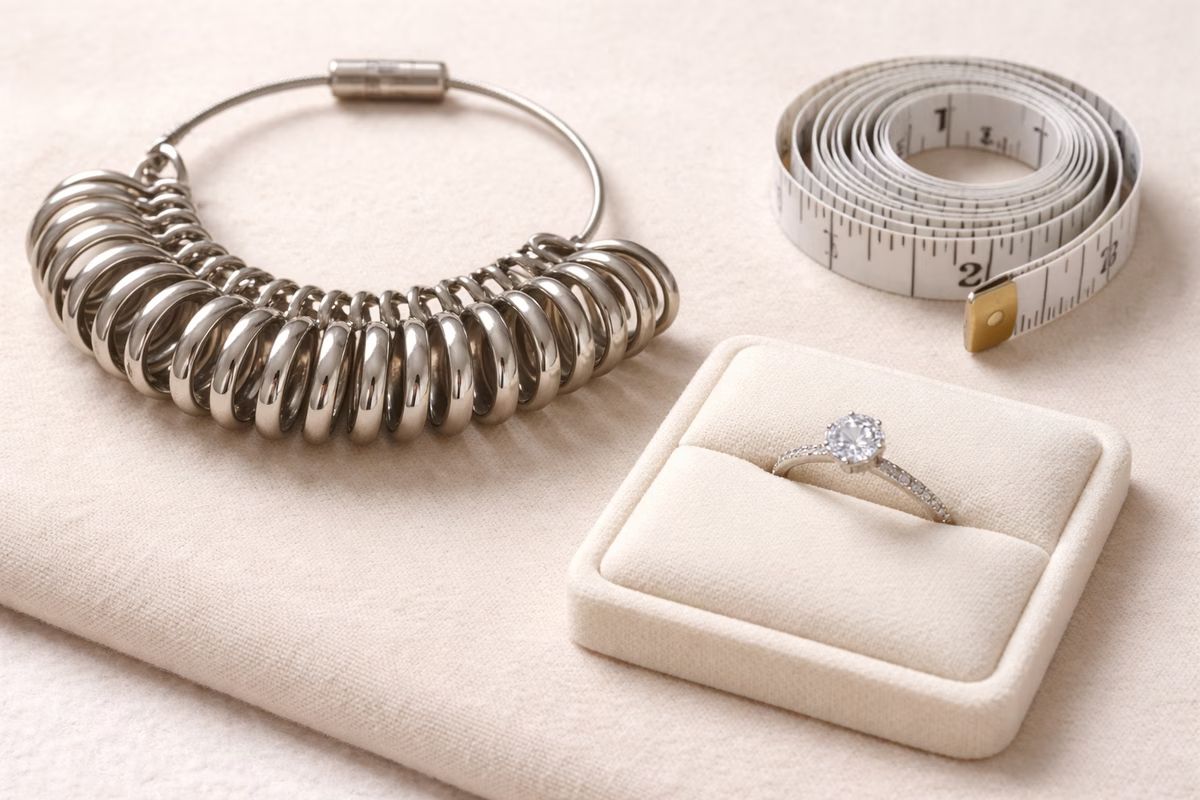
Nothing replaces the judgment of an experienced jeweler with proper tools. Professional sizing typically involves trying on calibrated sizing rings—sets of metal bands in incremental sizes that provide immediate feedback on fit.
A good jeweler does more than find a size that slides on. They assess how the ring feels at the base of your finger, whether there’s appropriate resistance when removing it, and how different widths affect the necessary size. They understand that a 6mm wide band feels tighter than a 2mm band at the same size, and they adjust recommendations accordingly.
Most jewelers offer sizing as a free service, even if you’re not buying from them immediately. Take advantage of this expertise by visiting two or three different shops. If they all agree on your size, you have confidence. If they differ, the variation itself is useful information about where your finger falls between sizes.
The Invisible Forces That Shape Your Fingers
Your ring size is not a fixed number. It fluctuates throughout the day, across seasons, and over years. Understanding these dynamics helps you choose a size that works well under varying conditions rather than just in the moment of measurement.
Time writes its variations subtly. Morning fingers tend toward their smallest, having been at rest all night at roughly horizontal orientation with the heart. As the day progresses and blood flows more actively to extremities, fingers expand. By evening, many people measure a quarter to half size larger than they did at dawn. The optimal time to size a ring is late afternoon or early evening, when your fingers have stabilized at a representative size.
Temperature exerts surprising influence. Cold weather constricts blood vessels and shrinks fingers, sometimes by as much as half a size. Warm weather causes expansion. If you’re sizing in the chill of January for a ring you’ll wear through summer heat, consider whether you might want a slightly snugger fit. Swimming in cold water causes particularly dramatic shrinkage—many rings have been lost to the ocean when they slipped from fingers suddenly far smaller than usual.
Diet and hydration leave their marks. Salty foods cause water retention and finger swelling. Dehydration shrinks fingers. Alcohol causes temporary swelling. These effects are transient but real, which is why you shouldn’t size a ring the morning after a salty dinner and several glasses of wine.
Physical activity creates temporary changes. Exercise increases blood flow and swelling—immediately after a workout, your fingers may measure a full size larger than normal. The effect fades within an hour or two, but it means you should avoid sizing directly after hitting the gym.
The body changes over years as well. Weight fluctuation affects finger size—roughly a quarter size for every ten to fifteen pounds gained or lost. Pregnancy causes significant swelling, often one to two full sizes. Arthritis and other conditions can enlarge knuckles. These longer-term changes may eventually require resizing, which is a normal part of a ring’s life with you.
The Anatomy of Proper Fit
A well-fitted ring should feel almost like an extension of your hand—present but not insistent. Understanding what “proper fit” actually means helps you evaluate sizing attempts.
When you slide a correctly sized ring onto your finger, it should pass over the knuckle with slight resistance. Not difficult, but not frictionless either. A ring that glides on without any drag will eventually glide off at an inopportune moment. Once past the knuckle, the ring should settle snugly at the base of the finger without pinching or leaving deep indentations in your skin.
Removal should require gentle effort—a slight twisting motion, perhaps a bit of pressure. If you can shake your hand vigorously with fingers pointing down and the ring stays securely in place, you’ve found a good fit. If you can pull the ring off with zero resistance, it’s too loose.
Some rotation is normal and acceptable. Rings spin on fingers; they’ve been doing so for millennia. Excessive spinning, where the ring constantly rotates and won’t stay oriented, suggests too loose a fit. But moderate movement—settling into position when you spread your fingers, occasional repositioning—is part of how rings live on hands.
After about fifteen minutes of wearing a properly sized ring, you should largely forget it’s there. If you remain conscious of pressure, tightness, or the weight of metal on skin, something isn’t right.
The Knuckle Conundrum
Nature did not design fingers with jewelers in mind. Many people discover that their knuckles are significantly larger than the base of their fingers—a sizing challenge as old as rings themselves.
If the difference is modest—perhaps a quarter to half size—the solution is usually to size for the knuckle. Yes, the ring will feel slightly loose at the base and may spin somewhat. But it can be removed comfortably, which matters more than perfect stability.
When the difference is more pronounced, several interventions exist. Sizing beads are small metal bumps added to the inside bottom of a ring band. They create friction that prevents spinning while still allowing the ring to clear a larger knuckle. The modification costs between fifty and one hundred fifty dollars and can be removed if circumstances change.
Speed bumps serve a similar purpose—small raised ridges on the inside of the band that grip the finger’s underside. A hinged shank is a more elaborate solution: the ring’s band contains a hidden hinge that opens to clear the knuckle, then closes to fit snugly at the base. This approach costs more and adds mechanical complexity but provides the most secure fit for challenging finger geometry.
For truly significant knuckle-to-base differences—one to two full sizes—a spring shank offers flexibility, literally. The band contains a mechanism that allows slight expansion over the knuckle, then contracts at the base. It’s an elegant solution that works well for moderate differences.
When the Size Isn’t Right
Even with careful measurement, sometimes a ring doesn’t fit as expected. Perhaps your finger was swollen the day you sized, or the ring you ordered differs slightly from the sizing band you tried. The question becomes: can this ring be resized, and what does that involve?
Most gold and platinum rings can be resized within reasonable limits—typically up to two sizes larger or one to two sizes smaller. The process involves adding or removing metal from the band, then refinishing to restore a seamless appearance. A straightforward solitaire in yellow gold represents the easiest case; more complex designs require more work and therefore more cost.
Sizing a ring larger requires adding metal. A skilled jeweler cuts the band, inserts matching metal, solders the joints, and polishes until the modification becomes invisible. Sizing smaller means removing a section of the band and rejoining the ends. Either direction typically costs between forty and three hundred dollars, depending on complexity, and takes one to two weeks.
Some designs resist resizing. Eternity bands with stones encircling the entire band cannot easily accommodate metal addition or removal without disturbing the stone pattern. Tension settings depend on precise calibration that resizing would disrupt. Channel settings with continuous stone rows present similar challenges. Heavily engraved or carved bands may lose design continuity if resized significantly.
Alternative metals—tungsten, titanium, stainless steel, ceramic—cannot be resized at all. Their hardness makes them impervious to the cutting and soldering that traditional resizing requires. If you choose these materials, your size needs to be correct from the start.
The Surprise Proposal: Sizing Without Spoiling
Perhaps the most challenging sizing scenario is shopping for an engagement ring in secret. You can’t exactly ask your partner for their ring size without raising suspicions. Several strategies help navigate this dilemma.
The borrowed ring approach works beautifully if you can pull it off. Wait until she’s showering or sleeping, borrow a ring she wears on her left ring finger, take it to a jeweler for measurement, and return it before she notices. The window needs to be tight—don’t leave a gap in her jewelry collection overnight.
Enlisting a trusted friend or family member provides another path. Her sister, mother, or best friend may already know her size from past jewelry conversations. They can also ask casually, framing it as hypothetical interest or gift-giving research, without arousing specific suspicion.
If you can’t measure and can’t ask, you can guess—carefully. For an average-build woman, size 6 to 7 represents the statistical center. Petite builds tend toward 5 to 6, larger builds toward 7 to 8. These are crude guidelines, but they get you in the neighborhood.
The universal wisdom for surprise proposals: when in doubt, go slightly larger rather than smaller. A too-large ring can be worn immediately, then resized down. A too-small ring can’t go on the finger at all, which rather dampens the magical moment. And sizing down is generally easier and cheaper than sizing up. Most jewelers understand this scenario and offer expedited resizing for newly engaged couples.
Width and Its Effects
Band width significantly affects how a ring fits, a detail that surprises many first-time buyers. A wider band feels tighter than a narrow band at the same size because more of the finger’s surface makes contact with metal.
A delicate 2 to 3mm band can be sized true to your measured size. A medium-width 4 to 5mm band often feels better with a quarter-size increase. Wide bands of 6 to 7mm may need half a size larger than your narrow-band size, and very wide bands of 8mm or more sometimes require three-quarters of a size additional.
This relationship matters when you’re trying on sizing rings that don’t match the width of your eventual purchase. If you’ve sized yourself using a narrow sizing band but plan to purchase a wide wedding band, account for the difference. Ask your jeweler to demonstrate how width affects feel—most will have multiple widths in the same size to illustrate the point.
Living With Your Ring Over Time
Sizing isn’t a one-time event. Bodies change, and a ring that fit perfectly at purchase may eventually need adjustment. Building in periodic size checks preserves both comfort and security.
Annual assessments should become habit, perhaps timed with other ring maintenance like cleaning and prong inspection. If a ring that once fit comfortably now feels loose or tight, that’s useful information to act on before problems develop. Loose rings get lost; tight rings can become stuck emergencies.
Significant life changes warrant immediate attention. If you lose or gain substantial weight, check your ring fit. Pregnancy changes finger size dramatically—many women move their rings to a necklace during the later months. Post-pregnancy, wait several weeks for your body to stabilize before assessing whether resizing is necessary.
Some conditions can cause permanent changes in finger size or shape. Arthritis often enlarges knuckles while sometimes thinning the finger base—a particularly challenging combination. Hormonal changes across life stages affect water retention patterns. These are not problems to solve so much as realities to accommodate, and a good jeweler can help navigate options.
Temporary Fixes for Temporary Problems
Before committing to permanent resizing, consider whether a temporary solution might suffice.
If a ring has become slightly loose—perhaps you’ve lost some weight or the weather has turned cold—ring size adjusters offer non-permanent help. These coil or sleeve devices wrap around the inner band, effectively reducing its diameter. They’re invisible when worn and easily removed if circumstances change.
If a ring has become slightly tight due to temporary swelling, the solution isn’t adjustment but patience. Elevate your hand, apply cold water, reduce salt intake, and give your body time to resolve the swelling. For occasional tight days, a bit of Windex or hand soap can help the ring slide off when needed. The dental floss method—wrapping floss tightly above the ring to compress the finger, then unwinding from below while pushing the ring up—handles more stubborn cases.
True fit problems require true solutions. But many sizing concerns resolve themselves with time, weather changes, or lifestyle adjustments. A ring that feels perfect in summer and snug in winter isn’t necessarily mis-sized; it’s accurately sized for your average, with variation in both directions.
The Essential Wisdom
Finding the perfect ring size is less about achieving a single correct number and more about understanding the range in which your finger operates. Your size at 3 PM on a warm day differs from your size at 8 AM on a cold morning. The goal is comfort across that range, security that prevents loss, and a fit that lets you forget about the mechanics and simply enjoy the meaning of what circles your finger.
When you’re uncertain, seek professional guidance. Jewelers have seen thousands of fingers and understand the subtleties that trip up first-time buyers. Their expertise is usually free, and their interest aligns with yours—a well-fitted ring makes a happy customer.
Ultimately, the ring you wear should feel like it belongs to your hand—present enough that you know it’s there when you think about it, unobtrusive enough that you stop thinking about it most of the time. That’s the mark of a perfect fit: not a number on a chart, but a sensation of rightness that accompanies you through every day you wear it.