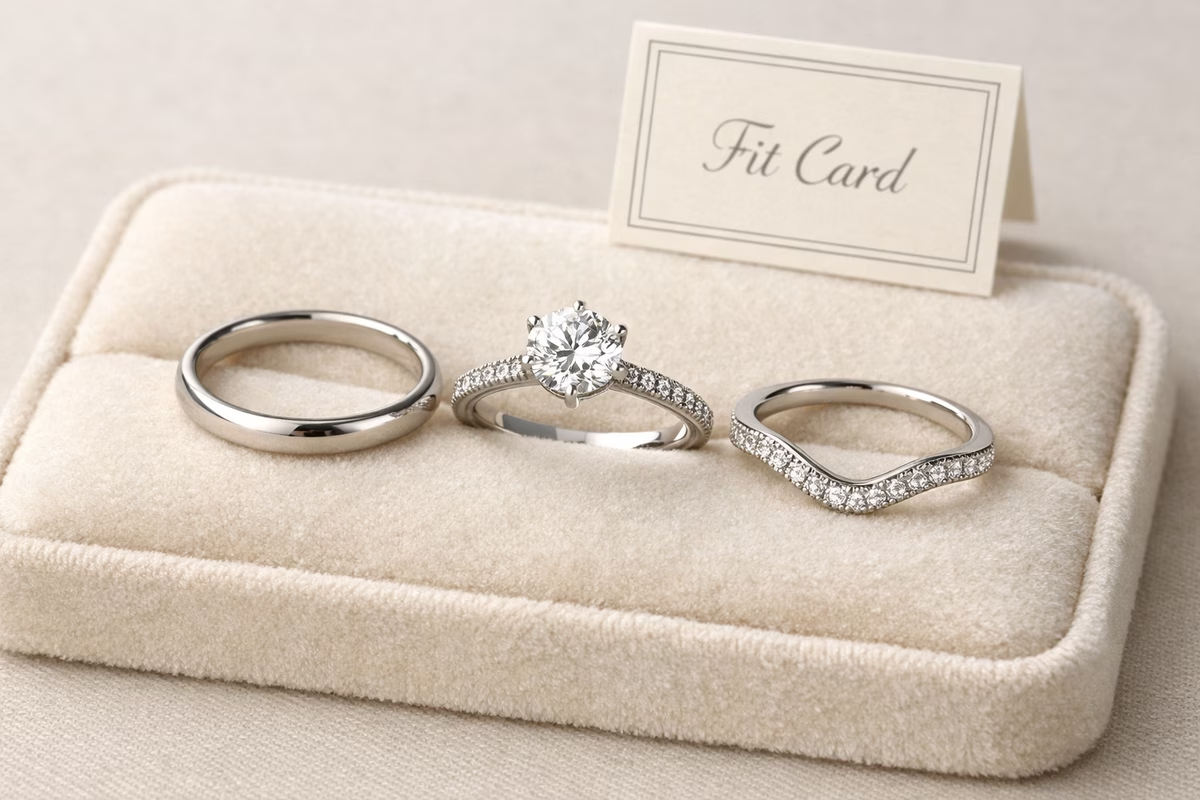
Wedding Band Pairing with an Engagement Ring: Fit, Gaps, and Practical Matching
Choosing an engagement ring feels like the main event. Choosing the wedding band can feel like an afterthought—until you try stacking bands and realize you’ve opened a whole new set of questions:
Why is there a gap between the rings? Will the rings scratch each other? Should the band match the engagement ring metal exactly? Should the band be plain, pavé, curved, or custom? What happens if fingers swell or the ring spins?
The goal is simple: a set that looks intentional and feels comfortable every day.
This guide is about making that happen without guesswork.
The quick answer (what most people actually want)
Most couples are happiest when the band sits comfortably (no pinching or pressure points), looks balanced next to the engagement ring (not too thin, not too heavy), doesn’t create constant maintenance issues (stones loosening, metal wearing down), and keeps future resizing and repairs realistic.
If that sounds obvious, great. The details below are the parts that trip people up.
Step 1: Understand the “gap” problem
Many engagement rings aren’t designed to sit flush with a straight band.
Common causes are a low-set center stone that blocks the band, a cathedral setting or decorative shoulders, a hidden halo or under-gallery that protrudes, or simply a wider engagement ring shank.
A gap is not automatically bad. Some people like the airiness.
But you should decide intentionally because gaps can affect:
how the set looks from the top, whether food and lotion collect between rings, and how much the rings move and rub against each other.
Three ways to handle a gap
Option A: Accept the gap
This is the simplest.
It keeps your options open: no special band required, and resizing and service are usually simpler. The trade-off is mostly aesthetic and practical: some people dislike the look, and the space can trap grime and encourage more ring-on-ring rubbing.
Option B: Choose a contoured band
Contoured (curved) bands are shaped to nest against the engagement ring.
The appeal is the “made for each other” look and, often, better comfort in a stack. The downside is flexibility: if you upgrade or change the engagement ring later, the contour may no longer make sense, and resizing can be more complex depending on the design.
Option C: Custom-fit a band
A jeweler can make a band that fits your engagement ring precisely.
This gives the best fit and the cleanest look, but it usually costs more and it’s often “married” to that specific engagement ring design.
Step 2: Decide the vibe: support or spotlight
Your band can either:
support the engagement ring (quiet, minimal) or add sparkle and presence (true stack energy).
Support styles (timeless)
Support styles include a plain metal band, very subtle pavé, or a gently shaped band like a knife-edge.
Spotlight styles (stack energy)
Spotlight styles include half- or full-eternity designs, alternating stone shapes, and textured bands (engraved, hammered).
If your engagement ring is already detailed, a simple band often looks more expensive because it gives the center ring room to breathe.
Step 3: Match metal intentionally (not dogmatically)
Many people assume metals must match exactly.
In practice, you have options.
Option A: Exact metal match
An exact match means the same metal type (platinum vs. gold), the same karat (14K vs. 18K), and the same color tone (yellow/white/rose).
This is the most cohesive look.
Option B: Mixed metals (intentional contrast)
Mixed metals can look modern and personal.
For example, a yellow gold band next to a white-metal engagement ring can make the stone pop, and a rose gold band next to a yellow gold engagement ring can create a warm, romantic stack.
If you mix metals, make it look deliberate:
repeat the mixed metal somewhere (bezel, prongs, accent) and keep finishes aligned (both polished or both matte).
Wear and scratching considerations
Different metals can wear at different rates.
If two rings rub constantly, they can show wear. This is less about “never do it” and more about choosing designs that reduce friction.
Step 4: Choose width and thickness (comfort + balance)
Band width changes everything.
A practical width approach
- If the engagement ring band is thin, a super thin wedding band can look fragile.
- If the engagement ring is substantial, a too-thin band can look like an afterthought.
A good starting point is to choose a band width that is:
- Similar to the engagement ring shank, or
- Slightly thinner if you want the engagement ring to stay dominant
Thickness (durability)
Very thin bands can bend over time.
If you’re active with hands, a slightly thicker band often ages better.
Step 5: Decide on stones: plain, pavé, or eternity
Plain band
Pros:
- Most durable
- Easiest to resize
- Lowest maintenance
Cons:
- Less sparkle if that’s what you want
Pavé band (small diamonds along the top)
Pros:
- Adds sparkle without overwhelming
Cons:
- Requires periodic checks (stones can loosen)
- Can feel rough if poorly set
Eternity band (stones all the way around)
Pros:
- Maximum sparkle
Cons:
- Resizing is difficult or impossible
- Stones can rub adjacent fingers
- More maintenance and cost
For most people, a half-eternity or partial pavé is the sweet spot: sparkle where you see it, practicality where you need it.
Step 6: Shape compatibility (profiles and edges)
Comfort in a stack is mostly about the ring profile.
High, sharp-edge bands can irritate adjacent fingers, while a comfort-fit interior (rounded inside) can feel dramatically better—especially if you’re stacking more than two rings.
If you’re stacking multiple rings, consider smoother profiles.
Step 7: Preventing ring-on-ring damage
Rings can scratch each other, especially if one has diamonds along the side.
You reduce damage by choosing designs that minimize friction: avoid side stones that face the neighboring ring, choose a band with a smooth side profile, and make sure the engagement ring has enough clearance so the band isn’t grinding against prongs.
Some people use a very thin spacer band between rings. That can work, but it adds complexity and changes the look.
Step 8: The “try it on” process (how to actually shop)
If you want the best result, do this in order.
1) Try bands with your exact engagement ring
Even small differences in setting height change fit.
2) Evaluate from the top and from the side
Top view: proportions.
Side view: whether the rings clash or create an awkward step.
3) Move your hand like real life
Make a fist, grip a bag handle, and touch your palm.
If it pinches, it will annoy you later.
4) Pay attention to spin
If the engagement ring spins a lot, stacking can either stabilize it or make it worse.
Sometimes a slightly wider band helps stabilize.
Step 9: Plan for the long term (resizing, pregnancy, lifestyle)
Fingers change.
Temperature, exercise, pregnancy, and time all shift size and comfort.
A practical approach is to pick designs that can be resized if needed.
If you want an eternity band, consider whether you’re okay with limited resizing options.
Step 10: Common pairing scenarios (and what works)
Solitaire engagement ring
Almost everything pairs well.
- Plain band for timeless
- Pavé band for sparkle
Halo ring
Halo rings are already sparkly.
- Plain band often looks most elegant
- If adding pavé, keep it subtle
Low-set center stone
Expect a gap.
- Consider contoured band
- Or accept the gap intentionally
Three-stone ring
Three-stone rings have presence.
- Slightly thicker plain band can look balanced
- Avoid overly busy bands that compete
Vintage/engraved ring
Match the vibe.
- Engraved band
- Milgrain details
- Or choose a clean modern band for contrast (intentional)
What to ask a jeweler
A few questions save headaches:
Can this band be resized later? Will these rings sit flush or will there be a gap? Will the band rub the setting or prongs? What maintenance should I expect (stone checks, replating)?
The takeaway
A great engagement ring + wedding band set is not just pretty—it’s livable.
If you remember five things, make them these: decide whether you want a gap, choose band width intentionally, don’t overcomplicate sparkle unless you love maintenance, make mixed metals look deliberate, and try on the set while moving your hand like real life. Do that and you’ll end up with a set that looks like it was meant to be together—because it was.