Verification Notes: Keep Evidence Without Making a Mess
How to record dates, contacts, messages, payment details, and account changes so recovery and reporting are easier.
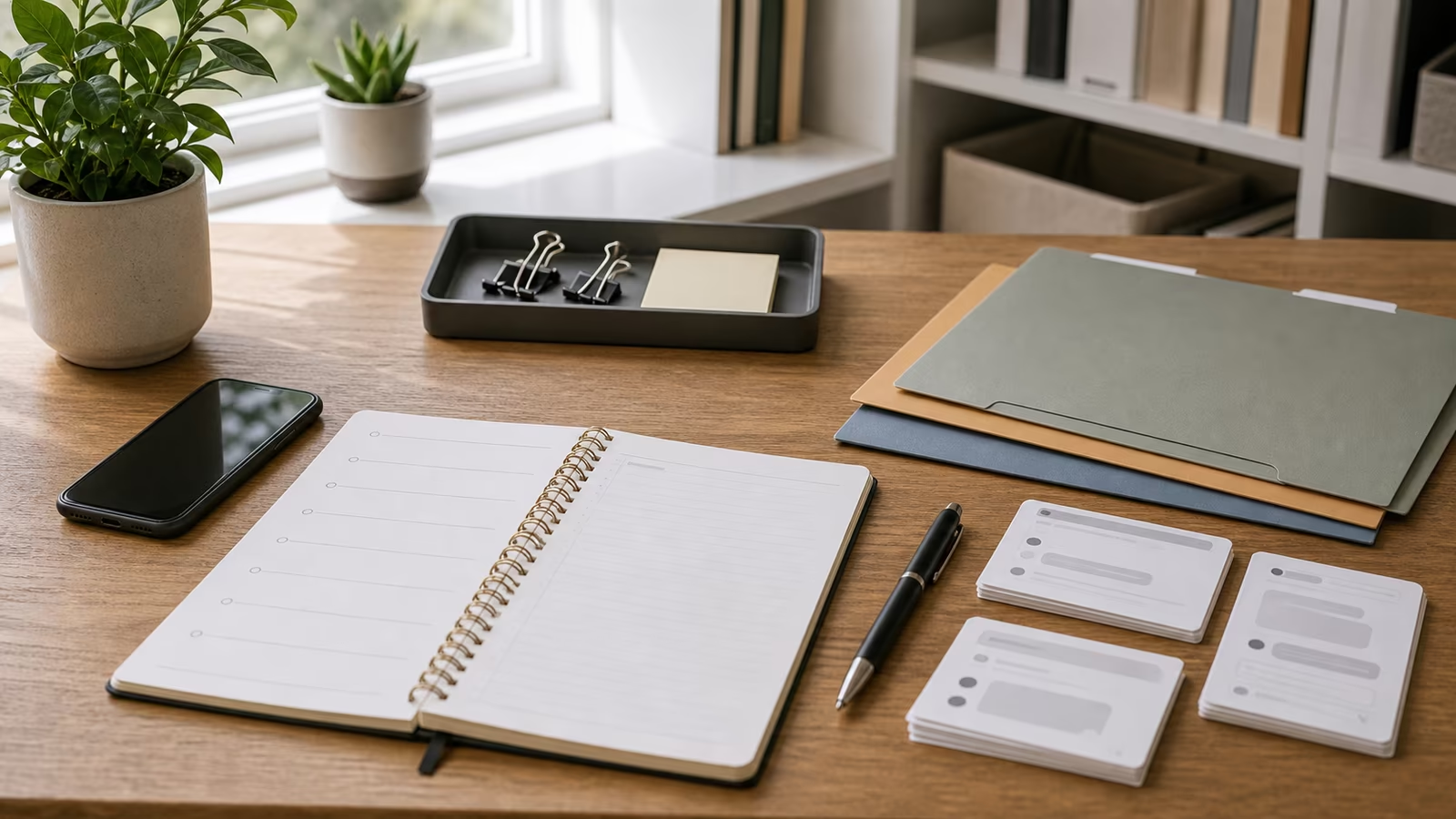
A suspicious message, payment request, or account change can be hard to reconstruct later. A short private note and a few relevant records can help you explain what happened to a bank, platform, or trusted helper. Start with what you know; you do not need to prove the whole story before asking for help.
Heads up
Reality Check Desk boundary
Reality Check Desk is practical education. It does not investigate crimes, recover stolen money, or replace legal, financial, medical, or safety advice. Use official support and professional help when the stakes call for it.
The human pattern underneath
When a request arrives with urgency or embarrassment, it is easy to focus on the most dramatic message and lose track of the payment, account change, or independent check that followed. Evidence notes are for clarity, not obsession. A small, ordered record is easier to use than a folder of repeated screenshots and speculation.
You do not have to decide whether a stranger is a scammer to record what happened. Separate what you saw or did from what the other person claimed and what you have not yet verified.
Quick facts
| Question | Practical answer |
|---|---|
| Level | Beginner |
| Time | About 8 minutes for a first note; a complex incident may take longer. |
| First move | Pause the request and save what you safely can. Do not delay urgent recovery or safety help to make a complete file. |
| Useful record | Preserve relevant originals where possible, a dated timeline, and transaction or report references. |
| Share carefully | Keep originals private and share only what an independently verified recipient needs. |
Plain definitions
| Term | Plain meaning |
|---|---|
| Evidence note | A private account of what happened, when, where, and through which channel. |
| Original record | The message, email, receipt, or file as received or saved before you edit it. A screenshot is a useful capture, but may not preserve the full context or underlying data. |
| Timeline | A sequence of contacts, actions, checks, and reports, with dates and times where known. |
The practical workflow
| Step | What to do |
|---|---|
| Preserve safely | Keep relevant messages, chat history, receipts, account notices, and listing details before blocking or deleting when practical. Save a screenshot showing the sender, date, and surrounding context where visible. If a message may disappear, note what you can safely see; do not delay blocking or getting help. Do not open suspicious links or attachments to collect evidence. |
| Record the path | Note the platform, handle or displayed number, and relevant URL as text if safely available. A displayed name or number is a clue, not proof of who contacted you. Do not revisit a suspicious link just to copy it. |
| Record actions | Add the date and time of each event, including the time zone if useful, what was requested, and what you did. If you write the note later, distinguish the event time from when you recorded it. For a payment, note the provider, date, amount and currency, recipient details, and transaction reference from your own account. Record claimed details as claims, and note where each detail came from. |
| Check and follow up | Note the independent contact route, the person or department reached, what they confirmed or could not confirm, and any case number or next step. Use a known-channel callback to check the request. |
| Keep originals and share copies | Store records in a private, access-controlled place. Make a separate copy for redaction or annotation; do not overwrite the original. Ask the verified recipient what they need and how to send it securely. |
For email, retain the message in its original form if your email service allows it; full headers may be useful to a reporting agency. A screenshot or printed message may omit details. The FBI IC3 FAQ lists records such as receipts, electronic emails, web pages, and chat transcripts to retain securely.
For an IC3 complaint in the U.S., the form does not accept attachments; keep originals in case an investigating agency requests them. Save or print the completed complaint before leaving the confirmation page: IC3 says that is the only opportunity to retain a copy. If you learn more later, its FAQ says to file a new complaint stating that it adds information to the previous one.
A note you can copy
Use one entry per event. Leave unknown details blank or mark them as approximate rather than guessing.
Date and time (time zone if relevant):
Date note written, if different:
Channel and displayed sender or handle:
What was claimed or requested:
What I did, and when:
Payment or account change, if any (provider, amount, recipient, reference):
Independent check (route, person or department, result):
Report or support contact (date, case number, next step):
Records saved and where:
Unknown or unverified details:
For example: “May 20, 2026, about 7:40 p.m. local time: marketplace chat from seller handle [handle]. Seller asked for a deposit by payment app and declined platform checkout. I did not pay. Saved the listing URL and chat screenshots. The seller’s identity and item availability are unverified.” If a payment was made, add its actual details from the payment provider. Record a later callback or report as a new entry: “May 21, 2026, 9:15 a.m.: contacted marketplace support through the app. Support confirmed the listing had been removed; they did not confirm the seller’s identity.” This is an illustrative example, not a finding about a real listing.
If a detail changes, add a dated update rather than silently replacing the earlier note. For example, distinguish a recipient name supplied in a chat from the name shown on your payment receipt. A case number records a contact; it does not by itself confirm the claim or guarantee a recovery.
Protect sensitive records
Keep the unedited record separate from a copy you prepare for sharing. Remove unnecessary personal details from the copy, but preserve enough context for the recipient to understand it. Use a redaction method that removes the underlying information, rather than merely covering it with a shape; check every page or image and the exported copy before sending. For a document, try selecting or searching for the removed text in the exported copy. A crop can hide information without removing it from the original file. If a bank or investigator needs an unredacted record, confirm its identity through an established channel and ask for its secure submission method. Never put passwords, one-time codes, or recovery codes in the note. Keep full account numbers and identity documents out of ordinary notes unless a verified recipient specifically needs them through a secure process. If you suspect someone has access to your device or account, use a trusted device and account to seek help and store your notes.
Do not post screenshots with private details or publicly accuse someone on incomplete evidence. For intimate material or a child involved, do not forward or download images to build a file. Record non-image details such as the platform, account, URL, and time when safe, and seek appropriate local support. NCMEC’s Take It Down specifically says not to send, share, or download an image to submit it to that service.
If money or access has already moved
Do not wait until the timeline is complete. Contact your bank, card issuer, payment app, or transfer provider immediately through a known channel and ask whether the transaction can be stopped or reversed. Recovery is not guaranteed. Keep the receipt and support case number, then add details as you find them. See what to do after sending money .
If you shared a password or login code, use the provider’s official recovery process and review account access; the account access guide covers next steps. For immediate physical danger, contact local emergency services.
Common mistakes
- Deleting messages or receipts before saving relevant information, when it is safe and practical to keep them.
- Saving only the dramatic message and overlooking the transaction, account notice, or outcome of an independent check.
- Cropping or annotating the only copy so that context disappears.
- Treating a sender’s claim or displayed identity as a confirmed fact.
- Sending a complete folder of sensitive records to someone whose identity or need has not been checked.
Try this next
- Use the reporting map to find a route for the type of incident and your location.
- Use screenshot verification when a captured image is being offered as proof.
- Review phishing links without panic before handling a suspicious message.
- Keep the Reality Check Desk guidebook shelf handy for a more specific check.
Official references
- FBI IC3: Frequently asked questions — complaint details, original records, and evidence retention; the IC3 is a U.S. reporting channel.
- FTC: What to do if you were scammed — payment and account recovery steps and U.S. reporting options.
- NCMEC: Take It Down — help with explicit images taken when a person was under 18, including guidance against downloading or sharing images for submission.