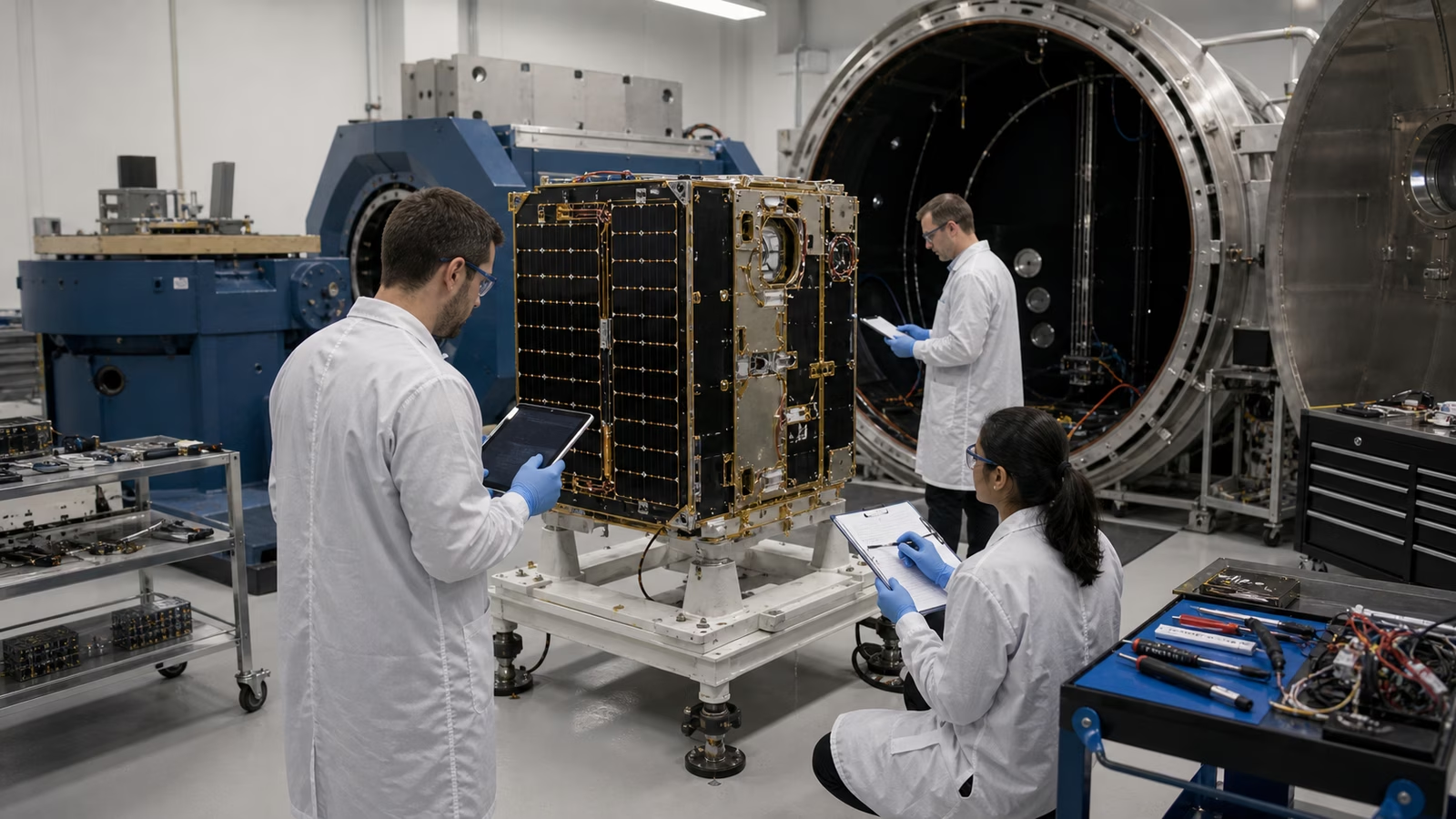
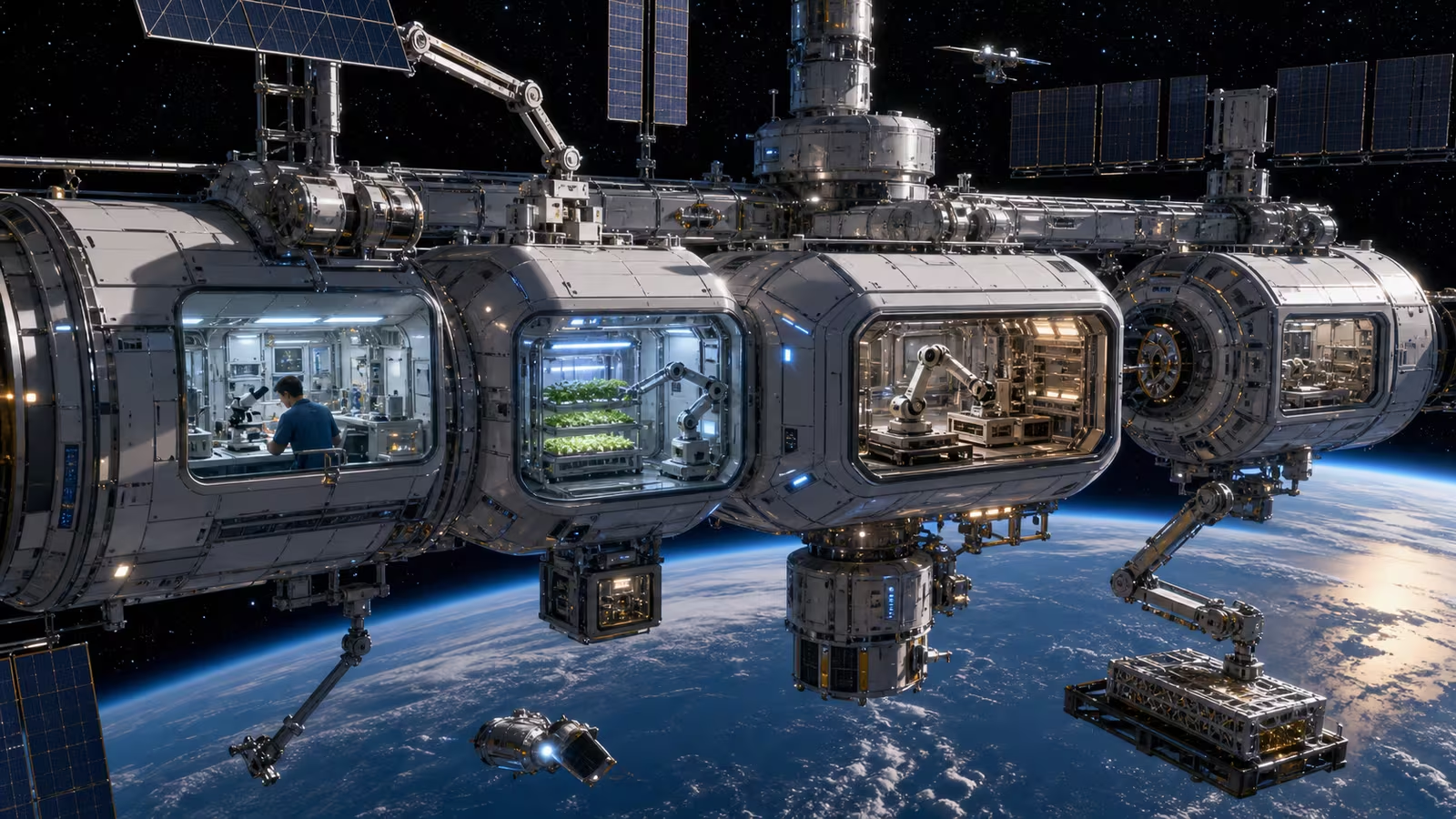
Space stations are easy to picture as heroic outposts, but the future version may be closer to a business park, laboratory, and service garage in orbit. A station provides volume, power, cooling, communications, docking ports, life support if crewed, robotics, and a stable environment where people or machines can work for longer than a short spacecraft visit. That makes it one of the basic pieces of a space economy.
The International Space Station proved that people can live and work in low Earth orbit for long periods. The next question is whether commercial stations can turn that capability into repeatable services: research, manufacturing, astronaut training, tourism, media, national space programs, technology testing, satellite servicing, and maybe production of materials that are easier to make in microgravity.
Microgravity is the special ingredient
The most unusual thing a station offers is microgravity. Objects are still under Earth’s gravity, but they are falling around Earth, creating a condition where things appear weightless. Fluids behave differently. Crystals can grow differently. Flames, cells, metals, foams, powders, and biological systems can act in ways that are hard to reproduce on the ground.
That does not mean every product becomes better in space. Microgravity is not magic. It is a special environment, like a very clean room, a deep ocean lab, or an extreme cold chamber. It is valuable only when the environment changes the result enough to justify the cost of getting there, operating there, and bringing something back if needed.
The strongest early uses may be research and high-value manufacturing rather than bulk products. If a material is worth millions per kilogram or teaches something valuable about medicine, electronics, or physics, space production may make sense. If the product is cheap and heavy, Earth will usually win.
Stations need customers
A commercial station is not useful because it looks futuristic. It needs customers who pay for access. Those customers may include national space agencies, private astronauts, pharmaceutical researchers, materials companies, semiconductor researchers, universities, defense agencies, media projects, or satellite operators. The station must package orbit into a service that customers can actually use.
This is harder than selling a normal laboratory. Customers need experiment design, launch integration, crew time or automation, data return, sample return, safety review, and schedules. A company that wants to grow protein crystals or test a fiber may not want to become a space operator. The station business must make the process manageable.
Think of a commercial station as a hotel plus lab plus port. A hotel needs rooms, utilities, safety, cleaning, bookings, and staff. A lab needs equipment, procedures, and quality control. A port needs docking, cargo handling, and schedules. Orbit makes all three harder.
Manufacturing in orbit
Orbital manufacturing is exciting because some materials may form better without gravity-driven settling, convection, or contamination. Examples often discussed include special optical fibers, biological tissues, crystals, advanced alloys, pharmaceuticals, and semiconductor-related materials. The promise is that microgravity can produce structures that are difficult or impossible on Earth.
The challenge is closing the business case. The process must work reliably. The product must be valuable. Launch and return must be affordable. Quality control must be strong. Customers must trust the supply. If the material only works once in a demonstration, it is not an industry. It becomes an industry when the station can make it repeatedly, safely, and at a price someone will pay.
Automation may matter more than astronauts for many manufacturing uses. Robots do not need life support, food, exercise, or return seats. Crewed stations are useful for maintenance and flexible problem-solving, but uncrewed platforms may handle routine production if the process can be automated.
Servicing and assembly
Stations can also act as places to assemble, test, refuel, repair, or stage spacecraft. In-space servicing is attractive because satellites are expensive and sometimes fail because of one component or lack of fuel. If robots can inspect, refuel, repair, or upgrade spacecraft, the economics of satellites may change.
Large structures may also be easier to assemble in orbit than launch fully folded inside a rocket fairing. Telescopes, power systems, antennas, and habitats could grow beyond launch-vehicle limits if assembly becomes routine. This is still hard, but reusable rockets and robotics make it more plausible.
Safety and life support
Crewed stations require serious safety systems. Fire, pressure leaks, toxic materials, radiation, micrometeorites, docking accidents, medical issues, and evacuation plans all matter. A commercial station must prove not only that it can host customers, but that it can protect them. Tourism may attract headlines, but safety culture decides whether people keep trusting the destination.
Uncrewed stations avoid some human risks but still need reliability. If a manufacturing platform loses power or attitude control, the product and vehicle may be lost. Space is unforgiving whether people are onboard or not.
Why this matters
Space stations and orbital manufacturing matter because they ask whether orbit can be a workplace, not only a destination. If stations can support useful research, manufacturing, servicing, and assembly, the space economy gains a middle layer between launch and distant exploration.
For a normal reader, the best question is “What job does the station do?” Is it a lab, factory, hotel, training site, servicing port, or national platform? Who pays? What can be done there that cannot be done better on Earth? What goes up, what comes down, and what stays in orbit? A station becomes important when the answers are practical enough that orbit feels less like a stunt and more like a place where work happens.