If you find it hard to begin tasks, lose track of time, forget the middle steps of things you know how to do, dread switching from one activity to another, or feel helplessly pulled toward your phone, it is natural to wonder whether there is a name for it. ADHD is the name most people reach for, partly because it is discussed everywhere right now. But struggling with these things does not, on its own, mean you have ADHD, and it certainly does not mean you are lazy or lacking character. Executive-function difficulty is a common human experience with a long list of possible contributors, and the honest first step is to resist collapsing that whole list into a single label learned from a short video.
The trouble with the question “does this mean I have ADHD?” is that it is really two different questions wearing the same coat. One is a clinical question that only a qualified professional, working with your actual history, can properly answer. The other is a practical question about your daily life that you can start working on today: what specifically is getting harder, for how long, in which situations, and what actually helps. This page is here for the second question, and to help you gather the kind of information that would make the first question easier for a professional to answer well.
Why the same struggle has many possible causes
The reason a symptom list cannot settle anything is that the visible difficulty and the underlying cause are only loosely connected. Trouble concentrating and starting tasks can grow out of poor or interrupted sleep, sustained stress, anxiety that makes the mind race, low mood that drains motivation, a specific learning difference, a workload that would overwhelm anyone, grief, a physical health condition, an environment full of interruptions, instructions that were never clear in the first place, ADHD, or several of these tangled together. Two people with the identical complaint of “I can’t get started” may have entirely different reasons behind it, which is exactly why a real evaluation looks at the whole person rather than checking boxes.
This is not a reason to dismiss your experience. It is a reason to be curious about it rather than to rush to a verdict. Noticing that your difficulties began after months of broken sleep, or that they only appear in one specific setting, or that they have been present in every environment since childhood, are all genuinely useful observations, and each points in a different direction. A professional can work with those distinctions. A one-line label cannot.
The observations worth collecting
Instead of asking which diagnosis fits, spend a week or two collecting the kind of concrete detail a clinician or school team can actually use. Pay attention to the pattern of the difficulty: is it occasional or constant, recent or lifelong, tied to one setting or spread across many areas of your life? Long-standing and cross-situational looks different from recent and specific, and that difference is diagnostically meaningful.
Pay attention, too, to impact, because impact is what turns a quirk into something worth evaluating. Look honestly at how the difficulty touches school or work, the running of your home, your finances, your relationships, your sleep, your safety, and your emotional strain. A tendency that is mildly annoying is a different matter from one that is costing you jobs, grades, or your sense of well-being.
And record the context around it: how you have been sleeping, what stresses are loading on you, your workload, your mood, your physical health, your environment, and any recent changes in your life. These are not distractions from the “real” question; they are often the answer, and even when they are not, they help a professional rule things in and out. The goal of all this noticing is not to build your own case for a label. It is to arrive at a conversation with organized, specific notes rather than a vague sense that something is wrong.
Trying supports without deciding the cause
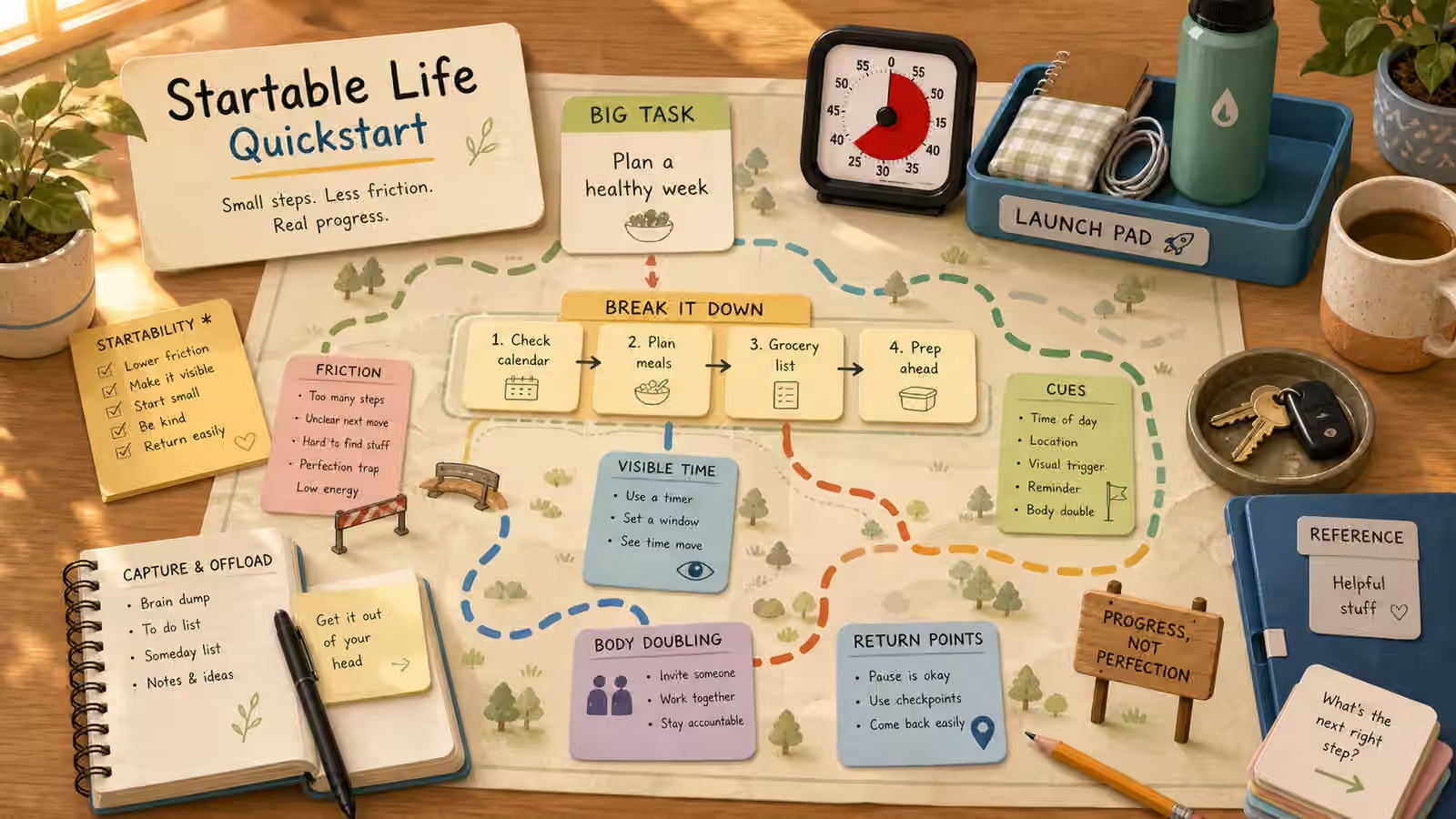
While you gather observations, you can also try practical supports from this lab, and it is worth being clear about what a support does and does not tell you. A visible timer, a smaller first step, an external memory system, or a body double may make a task noticeably easier to begin. That is genuinely good news for your daily life. But whether a support helps does not diagnose anything. Plenty of strategies that ease ADHD-related friction also ease friction that comes from stress, poor sleep, or a badly designed environment. So try a support for a week and record whether it changed the task, not whether it proved a theory about your brain. Keeping those two things separate protects you from the trap of reading every good or bad day as evidence in a case you are not qualified to try.
When and how to seek support
The clearest signal to seek professional support is impact over time: when attention, focus, mood, anxiety, sleep, learning, or everyday functioning are seriously and persistently affecting your life, that is reason enough to talk to someone qualified, regardless of what the eventual explanation turns out to be. You do not need to be certain it is ADHD, and you do not need every day to be dramatic. Difficulty that is quietly and consistently costing you counts.
When you go, bring the notes. A description like “across two semesters I have missed deadlines even when I understood the material, and visible timers help but not enough” gives a professional far more to work with than “I think I might have ADHD.” For a child, the same principle applies, and the school team belongs in the conversation early: a note that a student can explain the homework perfectly well but falls apart at the moment of starting tells a teacher something concrete and actionable. Keep questions about diagnosis, medication, and treatment where they belong, with the qualified people trained to answer them, and let this lab stay in its lane as a source of practical, everyday support.
A careful next step
Treat this page as a way to sort your thinking, not as a test with a score at the bottom. Collect a few real examples, note their duration and impact, try one low-risk support, and if the difficulties are serious or lasting, book a conversation with a qualified professional. For a minor, involve caregivers and the appropriate school or medical supports rather than deciding anything alone. For related reading, see Reality Check Desk for weighing online health and productivity claims, and Sleep Setup Lab for the sleep and environment factors that so often shape attention.