
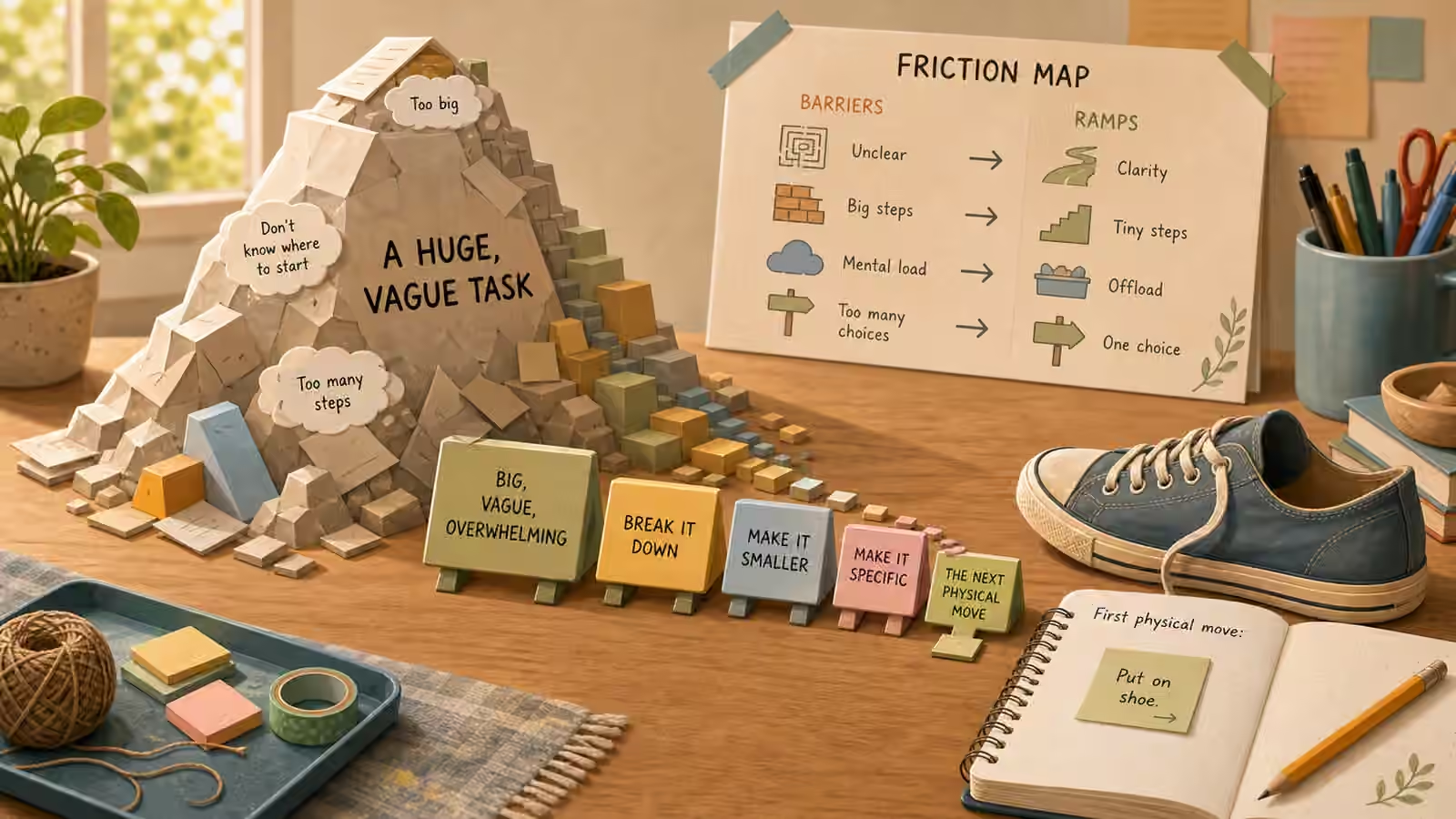
“Just start” is the kind of advice that sounds wise and helps no one, because it quietly skips the exact part that is hard. It assumes the only thing standing between you and the task is a decision to begin, when in reality the begin itself is the obstacle. If starting were a single clean action, you would already be doing it. The reason you are not is that most stuck tasks are not one action at all. They are dense bundles of hidden decisions wearing the costume of a single word, and “just start” tells you to lift the whole bundle without ever unpacking it.
Task initiation gets easier the moment the first action stops being abstract. The aim here is not to bully yourself across some motivational threshold or to manufacture a burst of discipline you do not feel. It is to remove enough ambiguity that your body finally has something small and real to do. Motivation is not the missing ingredient; a clear physical instruction is. Give your hands a specific move and they will often make it before the dread has time to organize itself.
The hidden decisions inside a stuck task
Consider what “write the report” actually contains before you can begin it. You have to decide where you will work, what program or document to open, what the first section should be, what counts as good enough for a first pass, which distractions to ignore, roughly how long the whole thing will take, and what you will do if you get interrupted halfway through. That is at least seven decisions, most of them unmade, all of them demanding attention at the very moment you have the least. “Just start” pretends none of these exist. It looks at a task made of seven quiet negotiations and calls it one simple move, then acts puzzled when you stall.
This is why the advice fails so reliably and why the failure feels so personal. You are not refusing an easy thing; you are stalling in front of a stack of unresolved choices with no obvious entry point. The fix is not more resolve. It is to drag those hidden decisions into the light, make a few of them in advance, and shrink what remains down to a single move your body can perform without further debate. A task begins the instant it stops being a moral command and becomes a physical instruction.
Four moves from fog to first contact
Start by naming the fog. Write the task exactly as it shows up in your head, in its natural vagueness, because the vague version is the one you have been avoiding. Stuck tasks tend to sound like “catch up,” “organize,” “apply,” or “study,” words that describe a destination without a single step toward it. Getting the fog onto paper is itself progress, because you cannot dismantle what you refuse to look at.
Next, find the hidden decisions. Read that vague phrase and ask what you still have to choose before you could move: the tool, the location, the file, the order, the stopping point. Each unmade decision is a small doorway you have been standing in front of. Then choose the first contact, an action that literally touches the task’s materials, open, place, plug in, label, collect, move. First contact matters because it is physical and unmistakable; there is no ambiguity about whether you opened the folder. Finally, lower the commitment until the first action stays useful even if you stop after sixty seconds. If quitting after one minute still leaves you better off than before, the action is small enough to actually begin.
Try it on one real task
Take a single stuck task and run it through. Write it at the top of a blank page, then circle every word in it that is not physical, every “handle,” “sort out,” “get to,” “deal with.” Those circled words are where the task hides from you. Now replace just one of them with a visible action, something a stranger could watch you do. Do only that action, and give yourself explicit permission to stop on purpose if momentum does not arrive; the stopping is allowed, and knowing that in advance is often what makes starting possible. When you do stop, leave the materials in a slightly cleaner or more open state than you found them, so the next attempt begins a step ahead.
The point of running it this way is that you learn where your own resistance actually lives. For most people it is concentrated almost entirely in the transition from untouched to touched. Cross that line once, deliberately and with low stakes, and the task loses much of its power to intimidate. You are not proving you can grind through the whole thing. You are proving the first move is available, and the first move is what “just start” could never give you.
What startable language sounds like
The gap between advice and action is usually visible right in the wording. “Apply for internships” is a project with no handle; “open the resume file and save a copy called internship draft” is a move you could make in the next thirty seconds. “Deal with email” is an anxiety; “open the inbox and flag the three messages that need a reply” is a bounded, finishable round. “Get fit” is a whole life reorganization; “put the walking shoes by the door and fill the water bottle” is two physical acts that set up the real thing without demanding it yet. In each pair the second version wins not because it is more ambitious but because it is unmistakably doable. It names what starts, what counts as enough for this round, and where the task will wait if you walk away, and that plain language works just as well for an adult facing paperwork as for a student facing homework, because it trades blame for an observable next move.
Traps that keep you stuck
A handful of mistakes tend to reintroduce the fog you just cleared. The most common is mistaking motivation for instructions, waiting to feel ready instead of writing down the move you would make if you did. Another is making the first step too heroic, choosing an opening move so ambitious it carries all the weight of the whole task and none of the ease of a real start. A third is reaching for a digital first step when a physical one would be simpler, opening an app when placing an object on the desk would have been easier and harder to escape. And the oldest trap is deciding the entire project before you allow yourself any start line at all, letting planning swell until it becomes one more thing to avoid. Each of these quietly rebuilds the pile of hidden decisions the method was meant to clear.
When it is more than friction
It is worth saying plainly that difficulty starting can come from many directions at once, stress, poor sleep, anxiety, a heavy learning load, low mood, unclear instructions, a chaotic environment, or plain overload, and sometimes several of these at the same time. A guidebook cannot sort out which of those is at work for you, and it certainly cannot assess anything medical; that is genuinely the domain of a qualified professional, and asking for that help is a reasonable, capable thing to do when the difficulty is affecting the things that matter. What this guide can do is make ordinary starts less abstract. So for everyday practice, keep the loop small: pick one task, make only its next start line visible, take that one move, then stop and notice what changed and leave a return point behind you. From here, The Start Line goes deeper on turning a vague task into a first physical move, the Digital Distraction Map helps with tasks that keep vanishing inside tabs and notifications, and the Reality Check Desk is a good stop when you want to weigh a productivity claim without shame or hype.