Understanding Tiny Home Legality
Tiny homes aren’t “illegal” so much as they’re easy to mis-file in a system designed around a few traditional buckets: single-family houses, accessory units, manufactured homes, and recreational vehicles. The challenge is that tiny homes can look like one thing (a small cottage), move like another (a trailer), and be marketed as a third (a lifestyle product) — while the law cares about how a unit is built, installed, occupied, and connected to utilities.
The fastest way to get clarity is to treat legality as three separate questions:
- What is it, legally? (classification and construction standard)
- Where will it live? (zoning and land-use rules)
- How will it be approved? (permits, inspections, and certificates)
When those three line up, you usually get a clean path. When they don’t, you’ll encounter the familiar pain points: minimum size rules, limits on living in RVs, ADU eligibility constraints, utility hookup requirements, and local policies that lag behind the market.
The Legal Classifications
How Tiny Homes Are Classified
Classification is not just paperwork — it determines which code book applies, what inspections you can expect, how you can finance and insure the home, and (most importantly) where it can be placed.
Below are the most common buckets you’ll encounter. Different jurisdictions use slightly different names, but the practical differences tend to rhyme.
1) Recreational Vehicle (RV) / Tiny House on Wheels (THOW)
An RV-style tiny house is built on a permanent chassis and treated as a vehicle-like unit, even if you use it as a home in practice. Many jurisdictions restrict RVs to RV parks or to short-term occupancy on private land.
What usually matters:
- Built on a trailer/chassis and intended to be moved
- Built to an RV standard (often NFPA 1192 or ANSI A119.5) and typically RVIA-inspected/certified when you want the broadest acceptance
- Occupancy framed as “temporary” in many zoning codes
2) Accessory Dwelling Unit (ADU)
An ADU is a second dwelling on a lot with a primary residence. ADU policy is one of the most important levers for legal tiny living because it’s designed for small, independent units. If you can qualify as an ADU, you may avoid minimum size rules that apply to primary homes.
Typical traits:
- Permanent installation (often foundation) and residential code compliance
- Allowed only in certain zones and usually only on a lot with an existing primary home
- Subject to setbacks, utility requirements, and owner-occupancy rules depending on the city/county
3) Park Model RV
Park models occupy the middle ground: technically in the RV family, but sized and configured for longer stays. Many are designed for seasonal use in parks.
Common traits:
- Often capped around 400 sq ft
- Built to ANSI A119.5
- Transportable, but not designed for frequent moves
4) Manufactured/Mobile Home
Manufactured homes are factory-built to a federal HUD code rather than the International Residential Code (IRC). That’s neither good nor bad — it’s simply a different framework that many zoning codes explicitly recognize.
What to watch:
- Zoning may require placement in manufactured-home districts/parks
- Foundations, tie-downs, and installation standards are often regulated separately
5) Site-Built Tiny House (Permanent Foundation)
This is often the most straightforward legal route: a small house treated like a house. It’s typically reviewed under the IRC (with any local amendments) and can be sited wherever a single-family dwelling is allowed — assuming you satisfy minimum size, setbacks, and utility rules.
If you want the cleanest permitting path, a permanent foundation plus IRC compliance is usually the safest bet.
Building Codes
International Residential Code (IRC)
If your tiny home is intended to be a dwelling (not an RV), you’ll almost always run into the International Residential Code (IRC) or a close cousin. Cities and counties adopt a version of the IRC (often with local amendments), and the building department uses it to review plans and perform inspections.
2018 IRC Appendix Q: Tiny Houses
Appendix Q is a milestone because it acknowledges the reality of tiny-house layouts: lofts, compact stairs, ladders, and reduced clearances — while still preserving life-safety expectations like emergency egress.
Appendix Q commonly addresses:
- Loft access options such as ladders, alternating tread devices, or ship’s ladders
- Emergency egress for sleeping lofts and sleeping rooms
- Reduced minimum dimensions for certain spaces compared to typical dwellings
- Ceiling height allowances in compact areas
The catch is adoption: Appendix Q becomes relevant only when your jurisdiction has adopted it (or adopted a similar local standard). Many places are “tiny friendly” in practice even without Appendix Q; others will require a code-compliant stair/egress solution under older rules.
Appendix Q adoption varies widely — sometimes even between neighboring towns — so treat state-level guidance as a starting point, not an answer.
RVIA Certification (Tiny House on Wheels)
If your tiny home is on wheels and you want broader acceptance in RV parks — and in some cases for insurance and financing — RVIA certification (through an RVIA-inspected builder) is often a practical route.
RVIA certification generally signals that the unit was built and inspected to a recognized RV construction standard (commonly NFPA 1192 or ANSI A119.5), with attention to life-safety systems such as ventilation, egress, electrical protection, and (if used) LP gas installation.
In practical terms, certification can help with:
- Park access: some parks require documentation that a unit is an RV built to RV standards
- Insurance/financing: some providers are more comfortable when the unit fits an established category
- Resale: buyers may value a clearer paper trail
For DIY builds, the issue is less “is it safe?” and more “can someone verify it?” Certification programs are structured around ongoing inspections in a certified facility. If you’re building yourself, you may still be able to pursue inspections through local authorities, but the path can be narrower and more dependent on the jurisdiction.
Zoning Regulations
Understanding Zoning
Building codes answer “how it must be built.” Zoning answers “where it is allowed to exist.” A tiny home can be beautifully code-compliant and still be prohibited on a parcel because the land-use rules don’t allow a second dwelling, don’t allow an RV to be used as housing, or require a minimum home size.
Zoning is typically organized by district (for example: single-family residential, multi-family residential, agricultural, manufactured housing). Each district defines allowed uses, setbacks, height limits, lot coverage, parking requirements, and sometimes minimum dwelling size.
You’ll often see shorthand categories like:
- R-1 / single-family residential: commonly the most restrictive for tiny homes as primary dwellings
- R-2 / R-3 / multi-family: sometimes more flexible, but can introduce additional site requirements
- MH / manufactured housing: rules specific to manufactured-home placement
- RV: rules focused on vehicle-style units and RV parks
- Agricultural / rural: often the most flexible, but not always (some rural counties regulate dwellings tightly to protect groundwater, fire safety, or road access)
Where Can You Put a Tiny Home?
Tiny homes usually land in one of four siting strategies. The “right” strategy depends less on aesthetics and more on what category your tiny home falls into and what the parcel’s zoning allows.
Option 1: Your own land (primary dwelling or ADU)
If you own the parcel, you have the most control — but you still have to satisfy the district’s rules. The most common forks in the road are: whether the tiny home will be the primary dwelling or an ADU, whether it will be on a permanent foundation, and how utilities will be handled.
In many places, the hardest version is “tiny home as the only dwelling in an R-1 district.” That’s where minimum size rules and political resistance show up. The easiest version is often “code-compliant ADU behind an existing home,” because the zoning code already expects a small, secondary unit.
Option 2: Someone else’s land (backyard rental or private lease)
Placing a tiny home in someone’s backyard can be viable when the lot is eligible for an ADU and the owner is willing to pursue permits. The legal risk increases when the arrangement is informal — for example, “park an RV-like tiny home and live in it full time” in a district that bans residential RV occupancy.
If you’re considering a private land lease, treat the legal and practical constraints as part of your lease negotiation: utility access, driveway/fire access, waste/water approvals, and who carries liability.
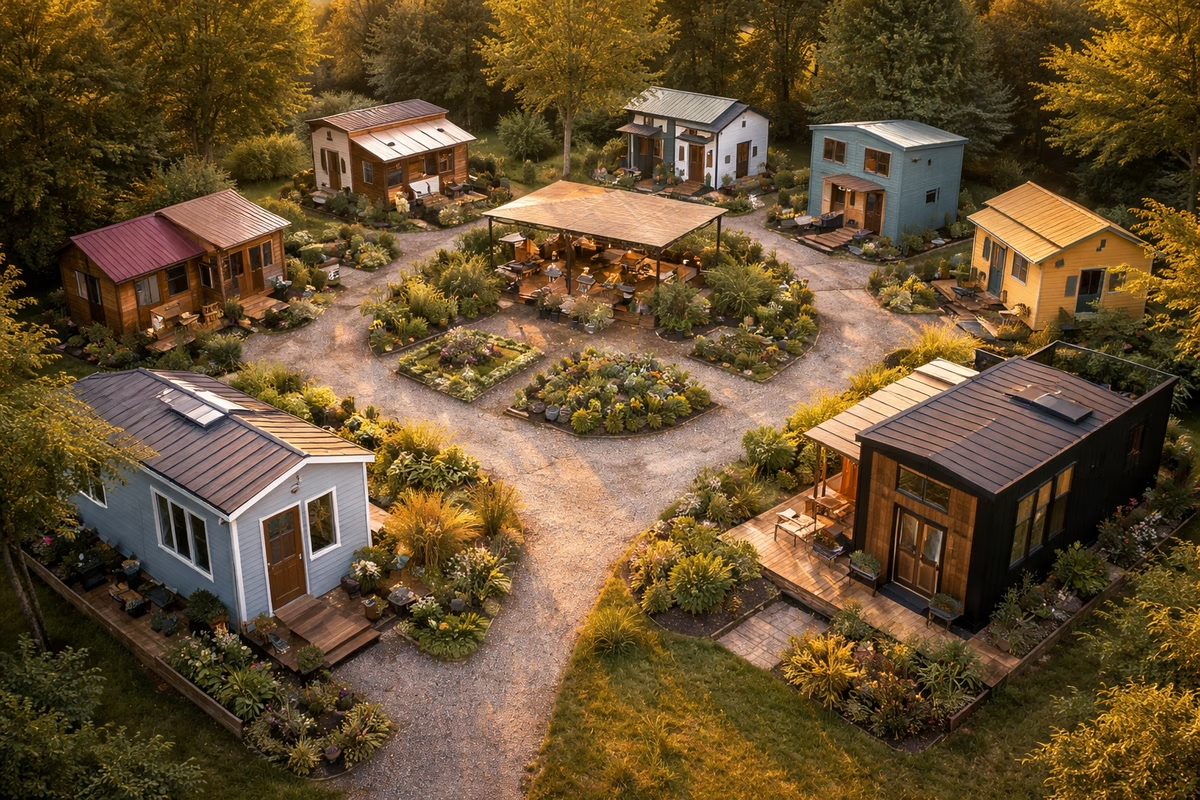
Option 3: Dedicated tiny home communities
Communities can be legally clean because they’re designed around a recognized model: an RV park, a manufactured-home park, or a subdivided small-lot neighborhood with approved dwellings. The tradeoff is governance (HOAs, community rules) and ongoing fees — but many people find the certainty worth it.
Option 4: RV parks
If your tiny home is RV-classified (especially RVIA-documented), RV parks can be the simplest siting option. The limitation is that many jurisdictions and parks treat RV occupancy as short-term or seasonal. Even when long-term stays are allowed, it’s worth confirming mail, school enrollment expectations, and the park’s rules before committing.
Permits and Approvals
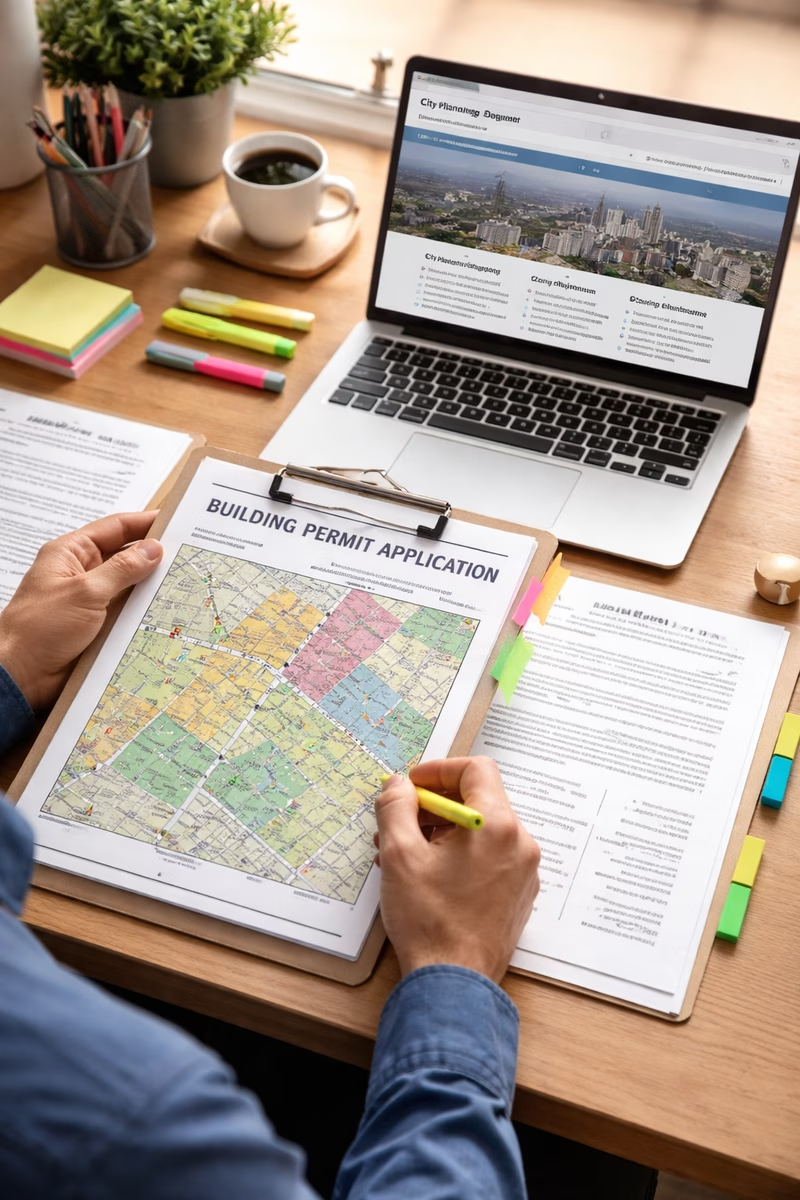
Permitting is where tiny homes go from “possible” to “approved.” Even in tiny-friendly jurisdictions, departments typically need to see plans that demonstrate compliance with adopted codes and local amendments.
In broad strokes, permits are commonly required for:
- New dwellings on permanent foundations
- Electrical and plumbing work
- Utility connections (water/sewer/septic)
- Structural work (framing, foundations)
Permits may be treated differently (or routed through different agencies) for vehicle-classified units. For example, a tiny home that is legally an RV might not be “permitted as a dwelling” in the same way — but you still may face rules about where it can be parked and whether it can be used as a residence.
A Typical Permit Path
Most building departments follow a predictable rhythm:
Pre-application clarity. Ask what the unit would be classified as in their eyes, which code they enforce for that classification, and what documents they want (plans, engineering, energy compliance, septic approval, etc.).
Plan submittal. Submit drawings and forms for review. Plans are checked against structural requirements, egress/egress windows, smoke/CO alarms, stair/loft access, energy and ventilation expectations, and local amendments.
Corrections cycle. It’s normal to receive corrections. The winning move is responding cleanly: revised sheets, clear notes, and a short narrative explaining what changed.
Permit issuance. Once plans are approved and fees are paid, the permit is issued.
Inspections. For site-built work, inspections typically track the build sequence. Common checkpoints include foundation, framing/structural, rough electrical, rough plumbing, insulation/energy (where applicable), and final.
Final approval / certificate. Many jurisdictions issue a final sign-off and, for dwellings, a Certificate of Occupancy (CO) or equivalent.
When Zoning Doesn’t Fit: Variances and Conditional Use
If the zoning code blocks your plan, you’ll often hear about two tools:
Variance
A variance is an exception from a specific zoning rule (for example: setbacks, lot coverage, or sometimes minimum size). Variances often require a public process and are not guaranteed. Treat it as an uphill option that can work when you have a strong hardship argument and a low-impact proposal.
Conditional Use Permit (CUP)
A CUP allows a use that isn’t normally permitted in the zone, often with conditions attached (for example: time limits, screening requirements, parking conditions, or owner-occupancy rules). CUPs can be powerful, but they also add time, cost, and uncertainty.
ADU Permits
ADU processes vary, but many jurisdictions have made them more streamlined. Even so, ADUs often come with rules about parking, owner occupancy, size relative to the primary home, and utility connections. If your tiny home plan can fit the ADU pathway, it’s often the least adversarial route to legality.
State-by-State Overview
State-level signals can help you pick a direction, but tiny-home legality is overwhelmingly local. What the state controls (building code adoption, ADU enabling laws, statewide preemption rules) sets the stage; what the city/county controls (zoning, enforcement, local amendments) determines your day-to-day reality.
Instead of chasing a “best state” list, use state context to identify where the odds are better — then do locality-level research before you buy land or sign a lease.
Generally Friendlier Signals
These states are often cited as friendlier, primarily because of combinations of ADU policy, Appendix Q adoption, and a track record of communities or local approvals. Still, you must verify the specific county/city.
California
California’s statewide ADU reforms have pushed many cities to create clearer pathways for small secondary dwellings. In practice, the cleanest path is often a permitted ADU on a qualifying lot — not an RV-style unit treated as a permanent residence.
Oregon
Oregon is frequently mentioned because of adoption patterns and the prevalence of ADU-friendly cities. Portland and other metro areas have developed relatively mature permit ecosystems, though you still need to match the unit type to the pathway.
Texas
Texas has wide variation. Some cities have explicit tiny-home programs or small-house allowances; many rural counties can be flexible, but may still require septic approvals, driveway/fire access, and compliance with adopted codes.
Florida
Florida’s year-round climate makes RV-style living more common, and some jurisdictions have communities and parks that make long stays practical. That said, “can park” and “can legally occupy as a home” are different questions.
Colorado
Colorado has seen a range of local programs and increasing acceptance. Mountain and wildfire considerations can add additional constraints (defensible space, access, and materials).
North Carolina
North Carolina includes pockets of stronger acceptance (including some tiny home communities) alongside more traditional jurisdictions. Expect variance at the county/city level.
Moderately Friendly States
Arizona, Maine, Massachusetts, New Mexico, Tennessee, Vermont, and Washington often have tiny-friendly local pockets — alongside areas with stricter interpretations. Consider these “good candidates for local research,” not guarantees.
Challenging States
States often described as more restrictive include New York, New Jersey, Connecticut, and Illinois (especially in and around major metros). Even here, there are exceptions — but the burden is on careful locality-by-locality validation.
Common Legal Challenges
Minimum Square Footage
Why it happens: A surprising number of zoning codes were written with the assumption that a “house” must be a certain size — often 600–1,000 sq ft or more. The intent is usually to preserve neighborhood character or property values, but the practical impact is that a fully safe, code-compliant small dwelling can be blocked by a rule that has nothing to do with safety.
How people navigate it: The most reliable workaround is choosing a pathway where minimum size rules are different or absent.
For example:
- ADU pathways often allow smaller units because the primary dwelling carries the “main house” expectations.
- Jurisdiction selection can be the simplest solution: some counties/cities simply do not impose a minimum size, or have updated the rule.
- Variances can work, but treat them as a higher-friction option: you’re asking for an exception, and you may need to justify hardship and demonstrate minimal neighborhood impact.
Primary Dwelling Requirement
Why it happens: ADUs are designed as “secondary” by definition, so many jurisdictions require a primary residence on the parcel before an ADU is permitted. That can frustrate people who want a tiny home to be the only dwelling on an empty lot.
How people navigate it:
- Start with a lot that already has a primary home.
- Partner with a homeowner (backyard ADU) where the lot is eligible.
- In some cases, build a compliant small primary home first, then add an ADU.
If you’re evaluating empty land, this rule is one of the first things to confirm — because it can be a deal-breaker even in places that publicly “support tiny homes.”
Hookup Requirements
Why it happens: Utility rules are often driven by public health: wastewater disposal, potable water standards, electrical safety, and fire response. Even rural jurisdictions may be strict about septic approvals, greywater rules, and road access for emergency services.
How people navigate it:
- Treat utilities as a first-class design constraint early (not an afterthought).
- Ask specifically about septic permitting, well approvals, and whether composting toilets or alternative systems are allowed and under what conditions.
- If you want off-grid systems, ask what evidence the department needs (engineered plans, manufacturer specs, inspections).
The key is framing: many departments are open to alternatives when they can validate performance and maintenance — but they’re wary when systems feel improvised.
Parking Restrictions
Why it happens: Many zoning codes treat RV occupancy as short-term by default. A tiny home on wheels can look like a home, but if the code categorizes it as a vehicle, it may be prohibited from serving as a residence in a residential district.
How people navigate it:
- If you want long-term, residential legality, consider a permanent foundation and the residential code path.
- If you want mobility, focus on legal places to stay (RV parks, approved communities) and verify stay limits.
- In some areas, a CUP or similar approval can create a lawful carve-out, but it adds time and uncertainty.
Also watch for enforcement triggers: complaints, visible hookups, exterior modifications, or anything that signals “permanent occupancy.” Staying compliant is usually easier than staying unnoticed.
Insurance and Financing
Insurance
Insurance tends to follow classification. Insurers want to know: what standards were used, where the home will be located, and what risks apply (transport, wildfire exposure, flood zones, etc.).
Tiny home on wheels: Some owners pursue RV-style coverage (often easier with documentation that the build followed RV standards and inspections). Others use specialty tiny-home insurers. If the home moves, you may need coverage for transit.
Tiny home on a foundation: This can be closer to standard homeowners coverage, especially if the unit is permitted and treated as a dwelling. Some carriers still consider it “non-standard,” but the conversation is usually simpler when the unit is recognized as a code-compliant structure.
Regardless of type, make sure you understand what’s covered:
- Liability (on-site injuries)
- Structure (replacement value vs actual cash value)
- Contents
- Transport (for mobile units)
Financing
Financing is often less about “tiny” and more about “non-traditional collateral.” Lenders are comfortable when they can classify the asset, secure it, appraise it, and predict resale. When the unit is one-of-one and the siting is uncertain, lending becomes harder.
Common pathways include personal loans, RV loans (when the unit fits an RV category), construction loans for permitted foundation builds, and borrowing against equity in another property. The best fit depends on how your home is classified and whether it will be treated as real property (foundation) or personal property (wheels/chattel).
Whatever path you pursue, expect to be asked for documentation: plans/specs, proof of inspections or certifications, and details on where the home will be located.
Legal Action Plan
Step-by-Step
Treat your legal path like a project plan. The more you decide early (classification, siting strategy, and permitting pathway), the less money you burn on designs that can’t be approved.
1) Define the unit you’re actually building (Week 1)
Be brutally specific: wheels vs foundation, primary dwelling vs ADU, utility approach (grid-tied vs alternative systems), and whether you need mobility or permanence.
2) Validate the pathway with the authority that matters (Weeks 2–3)
Before you buy land or start construction, talk to the local building department and planning/zoning office. Ask:
- How would you classify this unit?
- Which code book applies?
- Is Appendix Q adopted or accepted?
- What are the minimum size and setback rules?
- If ADU: what are the eligibility requirements and limits?
Document what you’re told. Even an email summary back to the department can reduce “telephone game” confusion later.
3) Evaluate land with zoning in hand (Weeks 4–6)
If you’re buying land, never assume. Pull the zoning designation, read the allowed uses, and confirm utility feasibility (septic/well approvals can dominate timelines).
4) Pick the least-friction strategy (Week 7)
If the locality has a clean ADU pathway, use it. If it doesn’t, consider whether a foundation build or a tiny-home community creates a more predictable route than trying to push an RV unit into a residential zone.
5) Submit plans and respond like a pro (Weeks 8–12)
Plans review is rarely “one and done.” Treat corrections as normal. Clear revisions and complete answers build trust and speed up approval.
6) Build with inspections in mind (Months 4–12)
Schedule inspections early, keep records, and avoid improvising changes that invalidate approved plans. The final sign-off is the finish line that makes everything else easier (utilities, insurance, resale, long-term stability).
Resources
The best resources are the ones that translate your idea into the language of the jurisdiction.
Start with:
- Your city/county planning and building department websites (handbooks, checklists, fee schedules)
- Online code libraries (for many jurisdictions) via Municode or similar services
- County GIS/zoning maps for quickly confirming districts and overlays
If you need help, choose specialists who work in your locality:
- A zoning/land-use attorney for variances, CUPs, and tricky interpretations
- A real estate attorney when land terms and easements matter
- Builders and designers who have successfully permitted similar projects in the same jurisdiction
Next Steps
- Read Building Guide to understand construction requirements
- Explore Sustainable Systems for off-grid options
- Check out Tiny Home Communities Database for legal options
The legal path can feel intimidating because you’re crossing three systems at once — classification, zoning, and permitting. The good news is that tiny-home success is rarely about luck; it’s about choosing a pathway that the local rules already know how to approve. Do the locality-level research early, design to the chosen pathway, and you’ll trade uncertainty for a plan you can execute.