Introduction
In the world of watchmaking, a “complication” is any function beyond simply telling the time. That might sound like an odd word for a feature, but it perfectly captures what’s going on inside the case—every additional function complicates the movement, adding dozens or even hundreds of tiny parts that must work together in perfect harmony. Complications are where watchmaking becomes truly artful. They demonstrate extraordinary mechanical skill, add genuine utility to your wrist, and they can significantly increase a watch’s value, both monetary and emotional.
Whether you’re drawn to the satisfying click of a chronograph pusher or the quiet poetry of a moonphase disc, understanding complications will change the way you look at watches. This guide covers everything from the humble date window to million-dollar grand complications, so let’s dive in.
Simple Complications
Date Display
The date display is the most common complication you’ll encounter, and there’s a good chance the watch on your wrist right now has one. It does exactly what you’d expect: it shows the current date, cycling through numbers 1 through 31. Inside the case, a date wheel with 31 positions advances once every 24 hours, usually clicking over right around midnight. The catch? Since not every month has 31 days, you’ll need to manually correct the date five times a year at the end of shorter months.
There are a few different ways manufacturers display the date. A pointer date uses a small hand that sweeps around the dial’s periphery to indicate the number. A window date—by far the most common approach—shows the date through a small aperture cut into the dial. Then there’s the big date, an oversized date display pioneered by A. Lange & Söhne that uses two separate discs to create a dramatically larger, more legible readout.
Most modern watches offer a quick-set feature that lets you rapidly adjust the date by pulling the crown to a specific position and turning. One important word of caution here: never adjust the date between roughly 8 PM and 4 AM. During those hours the date-change mechanism is actively engaged, and forcing it can strip or damage the delicate gears inside.
In terms of value, a date complication adds very little premium since it’s become an industry-standard feature. You’ll find iconic examples in the Rolex Datejust, which essentially defined the date-window watch, and the Omega Seamaster with its cleanly placed date aperture at 6 o’clock.
Day-Date
Take the date display and add the day of the week, and you’ve got the day-date complication. An additional wheel inside the movement tracks seven days, and both the day and date indicators advance together at midnight. Different brands offer the day display in various languages, which is a nice touch if you’re a polyglot or just appreciate international flair.
The most famous day-date watch is, of course, the Rolex Day-Date—affectionately known as “the President”—which has graced the wrists of world leaders and captains of industry since 1956. As a complication, the day-date typically commands only a small premium over a date-only model, but it adds a satisfying completeness to the dial.
Power Reserve Indicator
If you’ve ever wondered how much life is left in your mechanical watch before it winds down and stops, the power reserve indicator has your answer. This complication connects a gauge to the mainspring barrel and displays the remaining energy, typically showing a range from 0 to around 40 or more hours.
For hand-wound watches, a power reserve indicator is genuinely practical—it tells you when it’s time to give the crown a few turns. For automatic watches it’s somewhat less essential since wearing the watch keeps it wound, but it still makes for a visually interesting and mechanically clever addition to the dial. The complication adds moderate value and complexity to a movement. Notable examples include the Panerai Luminor Power Reserve, the IWC Portugieser Automatic with its elegant arc-shaped display, and the more accessible Seiko Presage Power Reserve.
Intermediate Complications
Chronograph
The chronograph is arguably the most popular and beloved complication in all of watchmaking. At its heart, it’s a stopwatch built into your wristwatch, letting you time events with the press of a button.
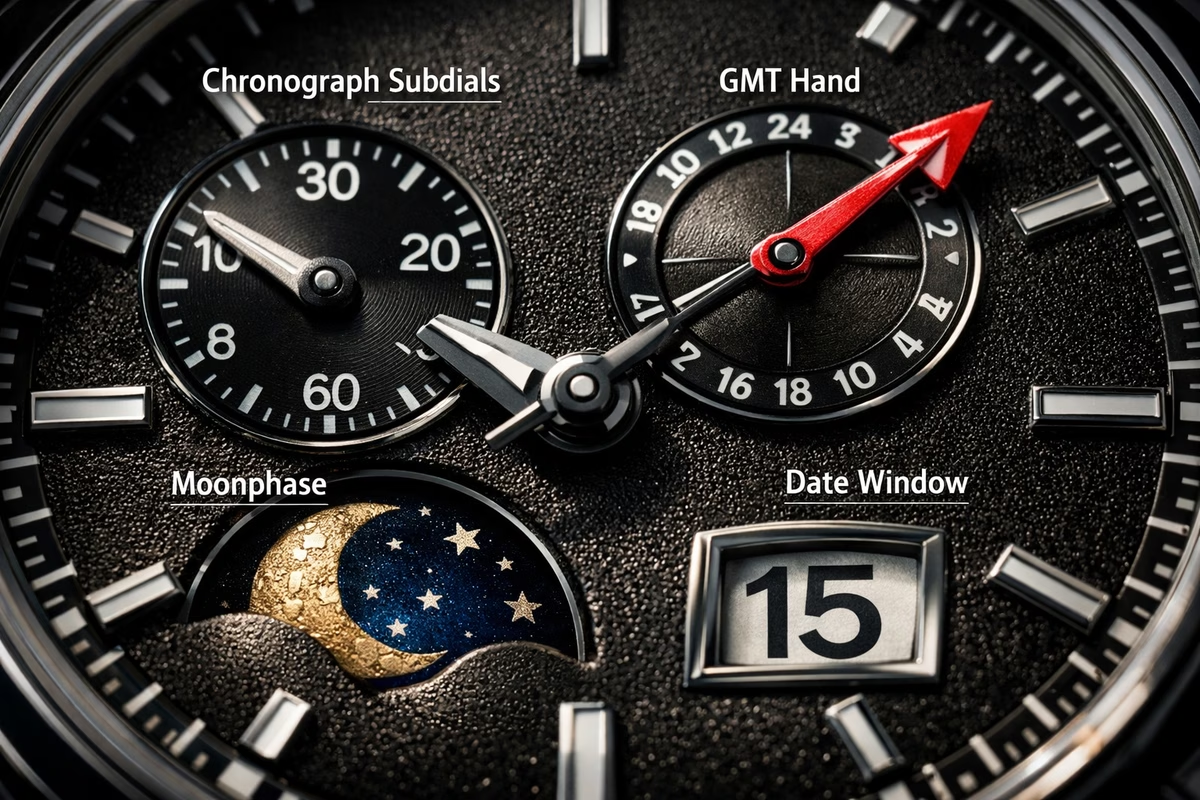
A typical chronograph layout includes a center-mounted chronograph seconds hand, along with sub-dials that track elapsed 30-minute and 12-hour totals. A separate running seconds sub-dial keeps continuous time so you can confirm the watch is ticking even when the chronograph isn’t engaged. Two pushers on the side of the case control the action: the top pusher starts and stops the timer, while the bottom one resets everything back to zero.
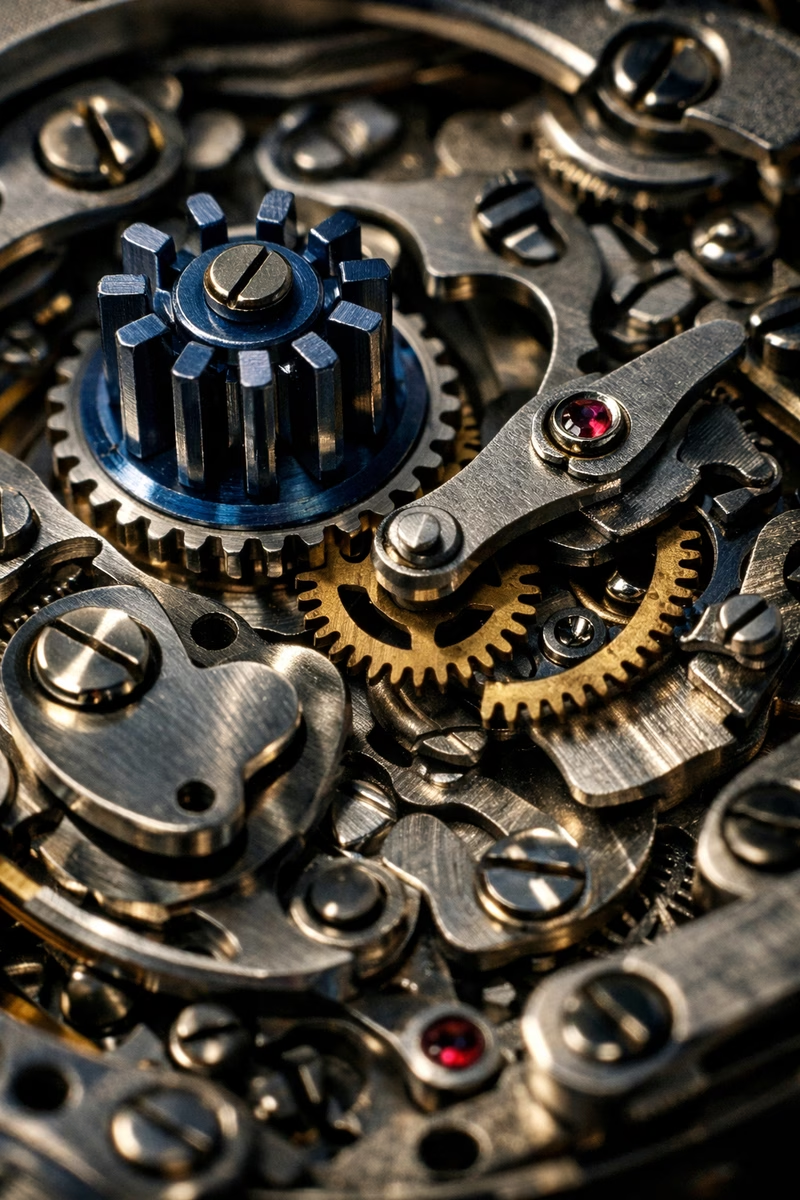
Under the hood, a chronograph adds between 200 and 300 extra parts to the base movement. When you hit that start pusher, a clutch engages the chronograph wheel, setting the chronograph seconds hand sweeping around the dial. The sub-dial counters track accumulated minutes and hours, and when you press reset, a series of heart-shaped cams snap all the hands back to their zero positions in a deeply satisfying instant.
Chronographs come in two main flavors when it comes to winding. A manual-wind chronograph, like the legendary Omega Speedmaster Professional, tends to be thinner since there’s no automatic rotor taking up space—it’s the traditional, purist’s choice. An automatic chronograph, like the Rolex Daytona, adds the convenience of self-winding but usually results in a thicker case.
Diving deeper into the mechanics, there’s a meaningful distinction between column-wheel and cam-actuated chronographs. A column-wheel mechanism is the traditional approach, offering a smoother, more refined feel when you press the pushers—it’s more expensive to produce and is considered the mark of a higher-end movement. A cam-actuated chronograph is a more modern, cost-effective design that’s slightly less refined in feel but perfectly functional.
Two advanced chronograph variants deserve special mention. The flyback chronograph lets you reset and instantly restart the timer with a single push, which is incredibly useful when you need to time successive events—originally developed for pilots timing navigation legs. Then there’s the rattrapante, or split-seconds chronograph, which uses two superimposed chronograph hands that can be independently stopped, allowing you to time two events that start together but end at different times. The A. Lange & Söhne Double Split is a stunning example of this extremely complex and expensive complication.
Chronographs command a significant price premium, typically 30 to 50 percent above the equivalent non-chronograph model. You can find budget quartz chronographs from Seiko or Citizen for around $200, solid mid-range mechanical options from Hamilton and Tudor in the $2,000 to $5,000 range, luxury pieces like the Omega Speedmaster at $6,800 and the Rolex Daytona at $14,800, and haute horlogerie chronographs from Patek Philippe and A. Lange & Söhne starting north of $30,000.
GMT / Dual Time
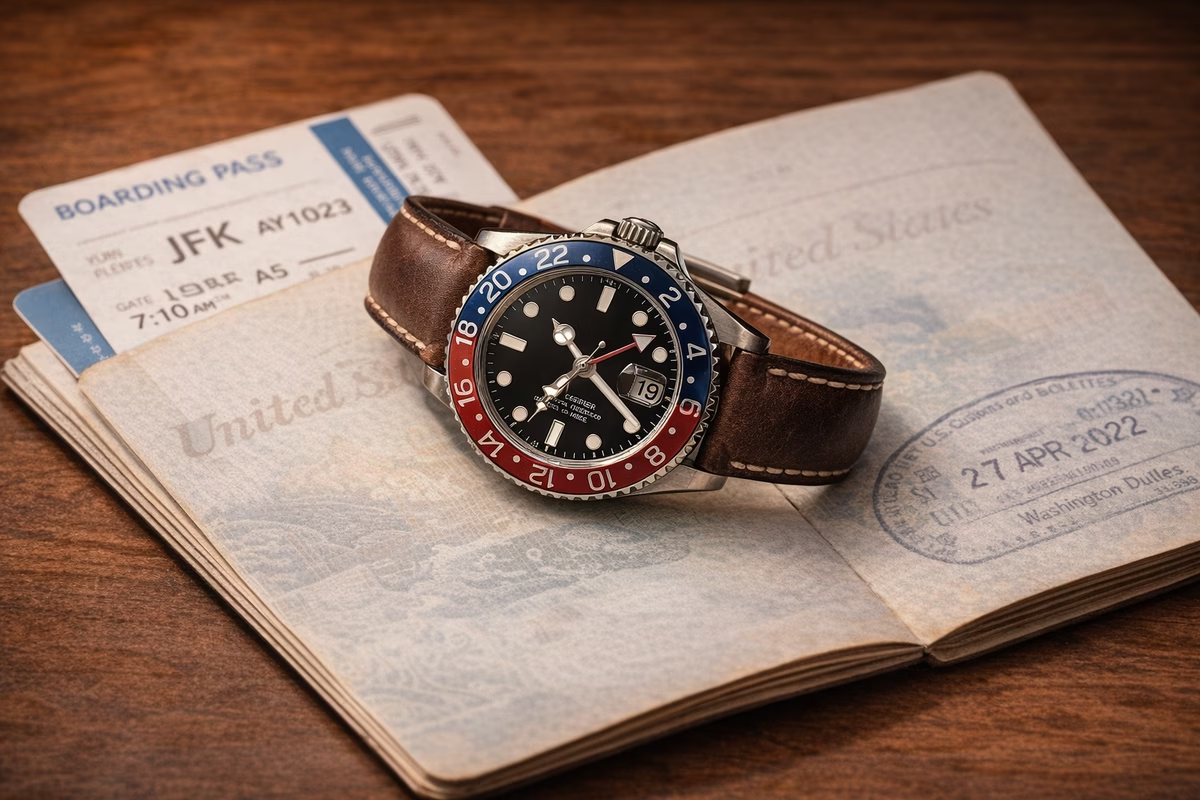
If you’ve ever needed to keep track of time back home while traveling abroad, the GMT complication is your best friend. It adds a fourth hand to the dial—the GMT hand—which completes one full rotation every 24 hours instead of the usual 12. Combined with a 24-hour scale on the bezel or dial, this extra hand lets you read a second time zone at a glance.
Using a GMT watch is straightforward. You set the GMT hand to your home time zone, and when you travel, you adjust the regular hour hand independently to match local time. Just like that, you’re tracking two time zones simultaneously. If you want a third, simply rotate the 24-hour bezel to offset it from the GMT hand.
There’s an important distinction between what collectors call a “True GMT” and a “Caller GMT.” In a True GMT, the regular hour hand can be adjusted independently in one-hour jumps, making it ideal for the person who actually travels—you land in a new city and quickly hop your local hour hand forward or back. In a Caller GMT, it’s the GMT hand that’s independently adjustable, which is better suited for someone who stays put but wants to track a colleague or loved one in a different time zone.
The value impact of a GMT complication ranges from moderate to significant. Iconic examples include the Rolex GMT-Master II at $10,800, the Tudor Black Bay GMT at a more accessible $4,100, the Grand Seiko SBGE201 at $6,800, and the Omega Seamaster Aqua Terra GMT at around $7,000.
World Time
If tracking two time zones isn’t enough, the world time complication takes things to the extreme by displaying all 24 time zones simultaneously. The dial features a rotating 24-hour ring paired with a city disc showing 24 representative cities from around the globe. You set your reference city using the crown, and from there you can instantly read the current time in any time zone on Earth just by glancing at the corresponding city name.
Mechanically, a world timer is considerably more complex than a simple GMT since it has to coordinate all those zones at once rather than just two. The complication carries a significant value premium to match. Patek Philippe’s World Time models start north of $40,000, Vacheron Constantin’s Overseas World Time comes in around $33,000, and for a more accessible entry point, the Frederique Constant Worldtimer ranges from about $3,000 to $7,000.
Moon Phase
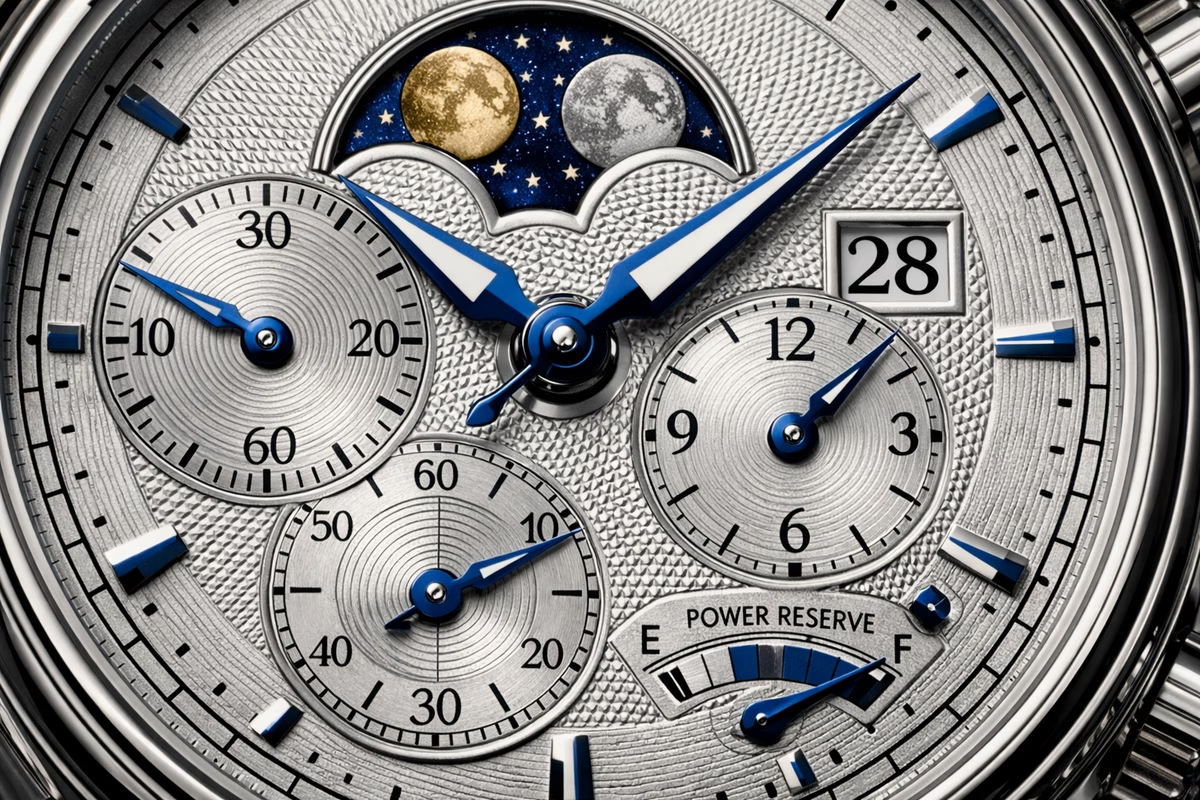
There’s something undeniably romantic about the moon phase complication. A small aperture in the dial reveals a rotating disc decorated with two moons (usually against a starry blue sky), showing you the current phase of the lunar cycle as it progresses from new moon through full moon and back again over the course of 29.5 days.
The mechanism is elegantly simple compared to many other complications: a 59-tooth wheel advances one notch per day, cycling the moon disc through its complete rotation. Since the actual lunar month is 29.53 days—not a perfect 29.5—most moon phase displays drift slightly and need correction roughly every two to three years.
Is it useful? Let’s be honest: unless you’re a sailor timing the tides, a farmer planting by the moon, or perhaps a werewolf planning your calendar, the practical utility is essentially zero. But that’s not the point. The moon phase is a purely aesthetic and romantic complication, and it adds a mesmerizing bit of celestial poetry to the dial. It carries a moderate value premium and can be found in watches like the Omega Speedmaster Moonphase at $10,000, the Jaeger-LeCoultre Master Ultra Thin Moon at $11,000, Patek Philippe’s Annual Calendar Moon Phase at $40,000 and up, and the much more accessible Oris Artelier Moonphase at around $2,000.
Advanced Complications
Annual Calendar
The annual calendar is a clever step up from a simple date display. Instead of requiring manual correction five times a year, it mechanically “knows” which months have 30 days and which have 31, automatically making the adjustment at the end of each month. The only time you’ll need to intervene is at the end of February, since the mechanism can’t distinguish between 28 and 29 days—making it a once-a-year correction instead of five.
Compared to a full perpetual calendar (which we’ll get to next), the annual calendar is simpler and therefore less expensive, but it’s still a genuinely complex mechanism that commands significant respect from collectors. Prices typically fall in the $10,000 to $50,000 range. Standout examples include the Patek Philippe Annual Calendar starting above $40,000, the Frederique Constant Annual Calendar between $6,000 and $10,000, and the Montblanc Heritage Annual Calendar at around $7,500.
Perpetual Calendar
If the annual calendar is clever, the perpetual calendar is nothing short of a mechanical genius. This complication automatically accounts for 30-day months, 31-day months, the variable length of February, and even leap years—all without any electronic assistance whatsoever. A tiny mechanical “brain” inside the movement tracks the day, date, month, and an entire four-year leap year cycle using a specially shaped cam. Once set correctly, a perpetual calendar theoretically needs no manual adjustment until the year 2100, which won’t be a leap year under the Gregorian calendar’s rules despite being divisible by four.
The typical perpetual calendar dial displays the day, date, and month, and very often includes a moon phase indicator and sometimes a leap year display as well. Achieving all of this requires hundreds of additional parts—typically between 300 and 600—making it essentially a miniature mechanical computer strapped to your wrist. It’s one of the most complex and prestigious complications in all of watchmaking.
First created as a wristwatch by Patek Philippe in 1925, the perpetual calendar carries an extreme value premium. Prices range from around $35,000 for an entry-level IWC Portugieser Perpetual Calendar to $60,000–$100,000 for Vacheron Constantin models, $80,000 and well beyond for Patek Philippe and Audemars Piguet Royal Oak Perpetual Calendar editions.
Tourbillon
Few complications capture the imagination quite like the tourbillon. Invented by the legendary Abraham-Louis Breguet in 1795, it was originally designed to improve the accuracy of pocket watches, which spent most of their time in a single vertical position inside a waistcoat pocket. The idea is brilliantly simple in concept: mount the entire escapement and balance wheel inside a rotating cage that completes one full revolution per minute, thereby averaging out the gravitational errors that would otherwise accumulate in a fixed position.
Does it actually improve accuracy in a modern wristwatch? That’s a matter of lively debate. Since wristwatches are constantly moving on your arm throughout the day, they naturally experience a variety of positions, which already averages out positional errors to a large degree. Modern testing has shown minimal accuracy improvement from a tourbillon in a wristwatch. But here’s the thing—accuracy was never really the point for wristwatch tourbillons. They’ve become the ultimate showcase of watchmaking virtuosity and a powerful luxury status symbol. Watching a tourbillon spin through a dial aperture or exhibition caseback is genuinely mesmerizing.
The complication comes in several varieties. A standard tourbillon features a single cage, while some ambitious manufacturers have created double and even triple tourbillon designs with multiple cages. A flying tourbillon eliminates the upper bridge, creating the illusion that the cage is floating in mid-air. And then there’s the gyro tourbillon, pioneered by Jaeger-LeCoultre’s Gyrotourbillon, which rotates on multiple axes for an even more spectacular visual effect. A. Lange & Söhne is particularly renowned for their double tourbillon creations.
Tourbillons carry an extreme value premium, with prices typically ranging from $50,000 to well over $500,000. Breguet tourbillons—fittingly, given the inventor’s legacy—start above $100,000. Audemars Piguet’s Royal Oak Tourbillon exceeds $150,000, and A. Lange & Söhne models command $200,000 and up. For a more accessible entry into the tourbillon world, the Tag Heuer Carrera Tourbillon Heuer 02T comes in at around $20,000.
Minute Repeater
The minute repeater is, for many collectors and watchmakers alike, the pinnacle of mechanical watchmaking. This complication chimes the time audibly on demand using tiny hammers that strike finely tuned gongs inside the case—a feat of engineering that predates electric lighting, when knowing the time in a dark room meant listening rather than looking.
Here’s how it works: you activate a slide or pusher on the case, and the watch begins its performance. First, it sounds the hours with a series of low-pitched bongs. Then it chimes the quarter-hours using a distinctive two-tone “ding-dong” pattern. Finally, it ticks off the remaining minutes past the last quarter with high-pitched single dings. So if the time is 3:47, you’d hear three low bongs for the hours, three ding-dongs for three quarter-hours (representing 45 minutes), and then two high dings for the two minutes past 3:45. It’s like a tiny concert on your wrist.
The minute repeater is one of the most difficult complications to execute well, requiring hundreds of precision parts and exacting tolerances. But what truly separates a great minute repeater from a mediocre one is the sound quality. Top manufacturers spend thousands of hours perfecting the tone, volume, and clarity of their repeaters—the difference between an entry-level repeater and a top-tier Patek Philippe or Audemars Piguet is comparable to the difference between a cheap bluetooth speaker and a concert hall.
The rarity matches the difficulty: only a few hundred minute repeaters are produced across the entire watch industry each year. Prices reflect that exclusivity, ranging from $200,000 to well over $2,000,000. Patek Philippe minute repeaters typically fall between $400,000 and $1,000,000 or more, Audemars Piguet Royal Oak versions exceed $500,000, and Vacheron Constantin examples start around $300,000.
Grand Complications
When a single watch combines three or more major complications—or multiple very complex ones—it earns the prestigious designation of “grand complication.” These are the summit of mechanical watchmaking, representing years of development and hundreds upon hundreds of hours of hand assembly and finishing.
Typical grand complication combinations include a perpetual calendar paired with a chronograph and moon phase, or the ultimate trinity: a perpetual calendar combined with a chronograph and a minute repeater. Other configurations might feature a tourbillon alongside a perpetual calendar and an equation of time display. Prices for grand complications start around $200,000, regularly exceed $2,000,000, and can climb past $10 million for unique or one-of-a-kind pieces.
A few legendary examples deserve special attention. The Patek Philippe Grandmaster Chime Ref. 6300 packs an astonishing 20 complications into a single wristwatch—making it the world’s most complicated wristwatch. It includes a minute repeater, perpetual calendar, rattrapante chronograph, four-digit year display, second time zone, and moon phases, among others. The retail price hovers around $2.5 to $3 million, though one unique example sold at auction for a staggering $31 million, making it the most expensive watch ever sold.
Then there’s the Vacheron Constantin 57260, a pocket watch boasting an almost incomprehensible 57 complications. It took eight years to create and was a one-of-a-kind commission—a true testament to what human ingenuity and patience can achieve in the mechanical arts.
The Patek Philippe Sky Moon Tourbillon Ref. 6002 is a double-faced masterpiece featuring a perpetual calendar, minute repeater, tourbillon, moon phase, and a celestial sky chart on its reverse dial, with prices in the $1.5 to $2 million range. And the Jaeger-LeCoultre Master Grande Tradition Grande Complication combines a minute repeater, flying tourbillon, and zodiac calendar for over $500,000.
Specialty Complications
Equation of Time
The equation of time complication displays the difference between “solar time”—based on the actual position of the sun—and “mean time,” which is the standardized 24-hour day we all live by. Because the Earth’s orbit is elliptical and its axis is tilted, the length of a true solar day varies throughout the year, and this difference can be as much as 16 minutes in either direction.
Is it useful in modern life? Not in the slightest. This is a pure horological flex—a complication that exists because it can, and because it connects the wearer to centuries of astronomical timekeeping tradition. It’s extremely rare and found only in the highest echelons of haute horlogerie.
Foudroyante (Lightning Seconds)
The foudroyante, also known as “lightning seconds,” is one of the most visually dramatic complications you’ll ever see. Instead of a normal seconds hand completing one revolution per minute, the foudroyante features a fractional seconds hand that whips around its sub-dial once every single second. Depending on the movement’s beat rate, it might tick at one-quarter, one-fifth, or one-eighth of a second intervals, creating a rapid, almost frantic motion that’s absolutely mesmerizing to watch.
Beyond the visual spectacle, the foudroyante allows for more precise timing measurements than a standard seconds hand. Notable examples include the Breguet Classique Chronométrie 7727 and the F.P. Journe Chronographe Rattrapante.
Jump Hour
The jump hour complication takes a completely different approach to displaying the time. Instead of a gradually sweeping hour hand, the hour is shown as a digit in a small window on the dial, and it jumps instantly from one hour to the next rather than making a smooth transition. This “instant jump” is more technically challenging than it might sound, because the mechanism needs to store up energy and release it all at once to snap the disc to the next position.
The result is a unique, almost digital-looking display powered entirely by mechanical means. The A. Lange & Söhne Zeitwerk is perhaps the most famous modern example, featuring a full digital-style mechanical display that’s a tour de force of engineering. On the vintage side, the Rolex Prince from the 1930s offered an early take on this distinctive complication.
Helium Escape Valve
The helium escape valve is a highly specialized complication designed for professional saturation divers. During deep-sea saturation diving in pressurized chambers, tiny helium molecules can penetrate the watch case. When the diver decompresses, that trapped helium needs to escape or it could pop the crystal right off the case. The helium escape valve is a one-way valve that allows the gas to vent safely during decompression.
Do you need one? Unless you’re among the roughly 0.001% of the population who are professional saturation divers, absolutely not. But it’s still a cool bit of engineering that speaks to the extreme conditions these tool watches were designed to endure. You’ll find helium escape valves on the Rolex Sea-Dweller, the Omega Planet Ocean Deep Black, and the Rolex Deepsea.
Complication Tiers by Price
Understanding how complications map to price tiers can help you set realistic expectations as you explore the market. At the entry level, between roughly $500 and $2,000, you’ll find the everyday essentials: date displays, day-date combinations, simple quartz or budget mechanical chronographs, and power reserve indicators. These are the complications that add practical value without breaking the bank.
Moving into the mid-tier range of $2,000 to $10,000, things get more interesting. This is where you’ll find quality mechanical chronographs, GMT watches, moon phase displays, and appealing combination pieces that pair a chronograph with a date and moon phase on the same dial.
The premium tier, spanning $10,000 to $50,000, opens the door to serious horological craftsmanship. Column-wheel chronographs, annual calendars, entry-level perpetual calendars, world time complications, and even some entry-level tourbillons from brands like Tag Heuer fall into this range.
At the haute horlogerie level, from $50,000 to $500,000, you’re looking at perpetual calendars and tourbillons from the top Swiss houses, minute repeaters, and elaborate combinations of multiple complications. And above $500,000, you’ve entered the rarefied world of grand complications—watches with multiple major complications, minute repeater and perpetual calendar and chronograph combinations, and unique one-off creations that push the absolute boundaries of what’s mechanically possible.
Do You Need Complications?
Let’s talk practicality for a moment. Some complications genuinely earn their keep on your wrist. A date display is useful every single day. A GMT complication is a genuine asset if you travel frequently or work across time zones. A chronograph comes in handy more often than you’d expect—timing a parking meter, a cooking recipe, or a morning run—and it’s undeniably fun to use. A power reserve indicator is a thoughtful addition if you own a hand-wound watch, taking the guesswork out of winding.
Other complications lean more toward the romantic and aesthetic side of the equation. A moon phase is breathtakingly beautiful but essentially useless in daily life. A tourbillon is mesmerizing to watch spinning away but provides minimal functional benefit in a wristwatch. The equation of time is a pure flex with zero practical application. And a minute repeater, while steeped in historical romance and engineering brilliance, won’t help you catch your flight on time.
If you’re looking for the most practical complications, date and GMT top the list. For sheer fun and enjoyment, chronographs and moon phases are hard to beat. And if you want to own something that makes other watch enthusiasts gasp, a perpetual calendar, minute repeater, or tourbillon will do the trick every time.
Complications & Value Retention
Not all complications are created equal when it comes to holding their value over time. If investment potential matters to you, certain combinations of brand prestige, in-house movements, and classic complications tend to perform best on the secondary market.
On the strong side, the Rolex Daytona chronograph has a well-documented history of actually appreciating in value. Patek Philippe perpetual calendars are legendary for holding their worth, and Audemars Piguet Royal Oak complications enjoy a robust and active secondary market. The general rule of thumb is straightforward: an in-house movement from a prestigious brand, combined with a classic complication, equals the best possible value retention.
On the flip side, budget complications from lesser-known brands tend to depreciate the fastest. Generic-movement chronographs and ETA-based complications—while perfectly good watches—don’t hold their value as well simply because those movements are widely available and not exclusive to any particular brand.
Learning More
- Play Complications Quiz
- Read Watch Movements for movement basics
- Study Luxury Brands to see who makes what complications