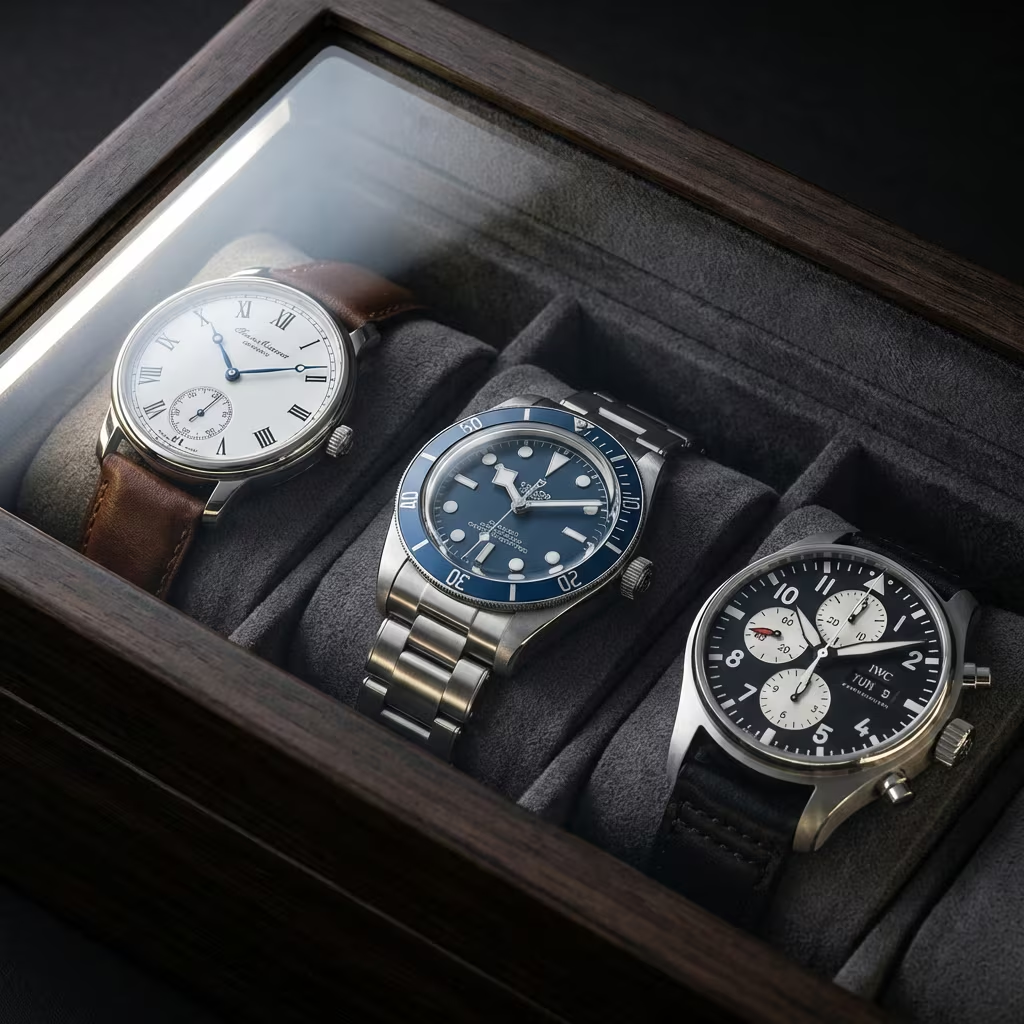
Watch Collecting: 30-Minute Quickstart
New to watches and feeling overwhelmed by the terminology, price ranges, and passionate opinions? This quickstart gives you the foundations to make smart choices quickly—without turning your first watch into a research project.
The point of collecting isn’t to win arguments online. It’s to understand what you like, buy thoughtfully, and wear your watches often enough that they become part of your life.
Minute 1–5: The basics that unlock everything else
What makes a watch “collectible”?
A watch becomes worth collecting when it offers more than timekeeping:
- Craft: the movement, finishing, construction, materials.
- Design: proportions, legibility, restraint (or intentional loudness).
- Heritage: the story of a model line, a brand’s identity, a tool watch’s original job.
- Fit: comfort and proportion on your wrist.
Even if you don’t care about heritage yet, you’ll care about fit immediately.
Reading a dial in 10 seconds
Every dial usually tells you:
- Brand (who made it)
- Model line (the “family” the watch belongs to)
- Complications (date, chronograph, GMT, etc.)
- Movement type (mechanical/automatic/quartz)
- Water resistance (what it can realistically handle)
Two advanced-but-beginner-friendly additions:
- Lume (glow in the dark) tells you if the watch is oriented toward tool use.
- Hands and indices tell you about legibility: thin dress hands feel elegant but aren’t as readable as chunky tool hands.
A quick truth about case size
Case diameter gets all the attention, but it’s not the whole story. Lug-to-lug length and case thickness often matter more for comfort.
As a rule of thumb, if the lugs overhang your wrist, the watch will feel awkward no matter how good it looks in photos.
Minute 6–10: Movement types (and what you’re actually choosing)
Movement choice is a lifestyle decision. None is morally superior.
Mechanical (hand-wound)
You wind the crown to store energy in a mainspring.
- Why people love it: thin cases, traditional feel, a daily ritual.
- Trade-offs: you must wind it; accuracy is “good enough,” not atomic.
Automatic (self-winding mechanical)
An automatic is a mechanical watch with a rotor that winds from wrist movement.
- Why people love it: classic watch feel without daily winding.
- Trade-offs: usually thicker; if you don’t wear it often, it will stop.
Quartz
Quartz uses a battery and a vibrating quartz crystal for timekeeping.
- Why people love it: accuracy, convenience, generally lower maintenance.
- Trade-offs: fewer “mechanical romance” points; battery changes.
The healthy mindset
Mechanical isn’t “better.” It’s different.
If you want a watch you can grab in the dark, not think about, and trust, quartz is excellent. If you want craft, ritual, and tiny engineered parts moving together, mechanical/automatic can be deeply satisfying.
Minute 11–15: Watch styles (so you can name what you’re drawn to)
Most watches you’ll see fall into a few families. You don’t need to memorize them—you need to recognize your own preferences.
Dress watches
Designed to disappear under a cuff and look refined.
- Slim cases and clean dials
- Often leather straps
- Usually simple time-only or date
Dive watches
Originally designed for timing underwater. Now they’re just great casual everyday watches.
- Rotating bezel (often unidirectional)
- High legibility
- Strong water resistance
Field watches
Simple, legible, durable. The “t-shirt” of watches.
- Easy to read
- Versatile and usually affordable
- Great first mechanical watch category
Pilot watches
Legibility and instrument inspiration.
- Bold numerals, high contrast
- Often larger cases
Chronographs
Stopwatch complication with pushers.
- Sporty, technical, historically significant
- More parts, more service complexity
Minute 16–20: Shopping like a sane person
The three risks beginners underestimate
- Fit: buying a watch that looks great online but feels wrong on wrist.
- Service: ignoring maintenance costs until you’re already attached.
- Impulse: buying “a great deal” that doesn’t match your taste.
How to set a budget that won’t make you regretful
Set two numbers:
- Watch budget: what you’ll pay for the piece.
- Ownership budget: what you can tolerate in service/straps over time.
Mechanical watches often need servicing every 5–7 years. It’s not an emergency schedule, but it’s real. Factor it into your “ownership budget” and your choices get clearer.
New vs used (both are valid)
- New tends to mean warranty, known history, and easy returns.
- Used can mean better value, broader selection, and the ability to try a model without paying full retail.
If you buy used, buy the seller, not just the watch: look for clear photos, transparent condition notes, and a return policy if possible.
Water resistance: how to think about it
Water resistance ratings are useful, but they’re not a magical promise. Gaskets age and crowns can be left open.
Practical guidance:
- Everyday splashes: most watches can handle, but don’t tempt fate.
- Swimming: choose a watch designed for it and ensure gaskets are healthy.
- Hot showers/saunas: avoid. Heat and steam are hard on seals.
Minute 21–25: Building a collection (without chasing “the perfect set”)
The best collections feel personal. They aren’t a checklist.
A simple way to think about “coverage”
Instead of hunting for categories, choose roles:
- Everyday: the watch you reach for without thinking.
- Occasion: something slimmer or more expressive.
- Rough-and-ready: travel, outdoor, errands, anything you don’t want to baby.
That can be one watch, two watches, or five. The point is that each watch earns its place.
Straps and bracelets: the cheapest way to change a watch
Straps aren’t just accessories—they’re how a watch feels day-to-day.
- Bracelets tend to be durable and “all-season,” but sizing and comfort vary.
- Leather can make a watch feel dressier and lighter, but it doesn’t love water.
- Rubber is practical for heat, sweat, and travel.
- NATO-style straps are affordable and can make a watch feel more casual.
If you’re unsure about a watch, try it on different straps in your head. Sometimes you don’t dislike the watch—you dislike the strap context.
Service reality (so you don’t get surprised later)
Mechanical servicing is normal ownership, not a defect. The cost depends on brand, complication, and whether parts are needed.
If you’re budgeting tightly, a simple, widely serviced movement is a good first step. As you gain experience, you can decide whether high-end servicing costs feel worth it for you.
Your first watch: a reliable way to pick
Ask three questions:
- Where will you wear it most: office, outdoors, mixed?
- Do you want to feel the mechanism (mechanical) or forget it exists (quartz)?
- Do you love bracelets, straps, or both?
Then try on a few sizes and let comfort decide. If it feels “invisible” on wrist, that’s usually the right direction.
Minute 26–30: A practical action plan
Step 1: Measure your wrist and learn your fit range
Measure wrist circumference with string/tape. Then focus on lug-to-lug as well as diameter.
Step 2: Try on watches in person
Try on 3–5 different styles. Take photos in the mirror (camera close-ups distort proportions).
Step 3: Learn one brand deeply
Pick one brand or one model line and learn what changes across generations: size, bracelets, movement upgrades, dial variations. This is how you build taste quickly.
Step 4: Buy the watch you’ll wear
Your first watch should teach you what you like. It doesn’t need to be “the forever watch.”
Common beginner questions (answered without drama)
“Do I need an expensive watch to enjoy this?”
No. Affordable watches can teach you as much as luxury ones. The early win is clarity about your preferences.
“Is quartz ‘cheating’?”
No. Quartz is simply a different technology optimized for accuracy and convenience.
“Do I need a watch winder?”
Usually no. If you’re wearing an automatic regularly, it will stay wound. If it stops, you can wind and set it in a minute.
“Should I chase hype?”
Hype can be fun to watch, but it’s a noisy teacher. If you love a watch, buy it because you’ll wear it, not because it’s trending.
“How do I avoid fakes?”
The safest path is buying from reputable sellers with clear photos, documentation, and a return policy. If a deal feels too good, assume there’s a reason.
If you’re new, it’s okay to pay a bit more for peace of mind.
Confidence Builders
You Already Know Enough to: ✅ Understand the difference between mechanical, automatic, and quartz ✅ Identify major watch categories and their purposes ✅ Set a realistic budget for your first quality watch ✅ Know what size watch suits your wrist ✅ Avoid common beginner pitfalls and bad value watches
You Don’t Need to: ❌ Memorize every watch complication ❌ Buy a Rolex to be a “real” collector ❌ Spend thousands on your first watch ❌ Understand the entire history of horology ❌ Service your own watches (leave it to pros!)
Trust Your Wrist: If you love wearing it, it’s the right watch. Don’t let anyone shame your taste!
Quick Reference Card (Screenshot This!)
Movement Quick Guide
Want tradition and craftsmanship? → Mechanical/Automatic (Seiko, Rolex, Omega)
Want accuracy and low maintenance? → Quartz (Grand Seiko 9F, Citizen Eco-Drive)
Want the best of both worlds? → Spring Drive (Grand Seiko SBGA/SBGE models)
Size Guide by Wrist
- Small wrist (<16cm): 36-40mm, <48mm lug-to-lug
- Medium wrist (16-18cm): 38-42mm, 48-52mm lug-to-lug
- Large wrist (>18cm): 40-44mm+, 50mm+ lug-to-lug
Budget Sweet Spots
- Entry ($100-500): Learn without risk
- Enthusiast ($500-2,000): Swiss/Japanese quality
- Luxury ($2,000-10,000): Investment-grade pieces
- High Horology ($10,000+): Patek, AP, Lange
You’re Ready to Explore!
You now know: ✅ The three main movement types ✅ How to choose the right watch size ✅ Where to find great value in every budget ✅ How to build a versatile collection ✅ What to do next
Go forth and discover! Watches are meant to be worn, enjoyed, and appreciated. There are no wrong choices—only your preferences waiting to be discovered.
Questions? Dive deeper:
Remember: The best watch is the one YOU love to wear. Never let anyone tell you your taste is “wrong.” Explore, experiment, and most importantly—enjoy the journey! ⌚